
-
 Argentina
-
 Australia
-
 Austria
-
 Belgium
-
 Brazil
-
 Canada
-
 China
China
-
 Czech Republic
-
 Denmark
-
 Finland
-
 France
-
 Germany
-
 Greece
-
 Hong Kong
-
 Hungary
-
 Iceland
-
 India
India
-
 Ireland
-
 Israel
-
 Italy
Italy
-
 Japan
Japan
-
 Korea
Korea
-
 Luxembourg
-
 Malaysia
-
 Netherlands
-
 New Zealand
-
 Norway
-
 Poland
-
 Portugal
-
 Qatar
Qatar
-
 Romania
-
 Saudi Arabia
-
 Singapore
-
 Spain
Spain
-
 Sweden
-
 Switzerland
-
 Taiwan
-
 Turkey
-
 United Kingdom
-
 United States
research use only
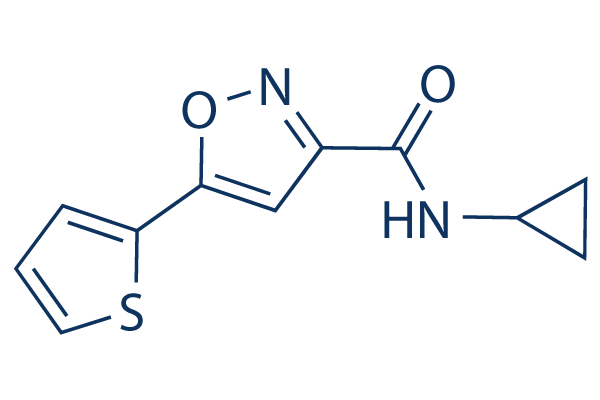
ISX-9 (Isoxazole 9) Neural Stem Cell Differentiation Inducer
Cat.No.S7914
Quality Control
| Related Targets | JAK TGF-beta/Smad Wnt/beta-catenin ERK GSK-3 ROCK Hedgehog/Smoothened PKA Secretase STAT |
|---|---|
| Other Inhibitors | YAP-TEAD Inhibitor 1 (Peptide 17) L-Buthionine-(S,R)-sulfoximine (L-BSO) PF-3644022 WAY-641966 WAY-320461 |
Cell Culture, Treatment & Working Concentration
| Cell Lines | Assay Type | Concentration | Incubation Time | Formulation | Activity Description | PMID |
|---|---|---|---|---|---|---|
| HCN | Function assay | Induction of NMDA receptor-mediated Ca2+ influx in rat HCN cells in presence of NMDA receptor antagonist MK801 | 18552832 | |||
| HCN | Function assay | 5 uM | Induction of L-type calcium channel/NMDA receptor-mediated Ca2+ influx in rat HCN cells at 5 uM by Fura-2 imaging analysis in presence of multiple of inhibitors | 18552832 | ||
| HCN | Function assay | 50 uM | 3 hrs | Induction of NMDA receptor-mediated neuroD gene expression in rat HCN cells at 50 uM after 3 hrs by RT-PCR analysis in presence of NMDA receptor antagonist MK801 | 18552832 | |
| HCN | Function assay | 25 uM | 4 days | Inhibition of gliogenesis differentiation in rat HCN cells at 25 uM after 4 days | 18552832 | |
| HCN | Function assay | 5 uM | Induction of L-type calcium channel/NMDA receptor-mediated Ca2+ influx in rat HCN cells at 5 uM by Fura-2 imaging analysis | 18552832 | ||
| HCN | Function assay | 5 uM | Induction of NMDA receptor-mediated Ca2+ influx in rat HCN cells at 5 uM by Fura-2 imaging analysis in presence of NMDA receptor antagonist MK801 | 18552832 | ||
| HCN | Function assay | 50 uM | 3 hrs | Induction of L-type calcium channel/NMDA receptor-mediated neuroD gene expression in rat HCN cells at 50 uM after 3 hrs by RT-PCR analysis in presence of multiple inhibitors | 18552832 | |
| HCN | Function assay | Induction of L-type calcium channel/NMDA receptor-mediated Ca2+ influx in rat HCN cells | 18552832 | |||
| HCN | Function assay | Induction of L-type calcium channel/NMDA receptor-mediated Ca2+ influx in rat HCN cells in presence multiple inhibitors | 18552832 | |||
| HCN | Function assay | 50 uM | 24 hrs | Induction of NMDA receptor-mediated neuroD gene expression in rat HCN cells at 50 uM after 24 hrs by RT-PCR analysis in presence of NMDA receptor antagonist MK801 | 18552832 | |
| HCN | Function assay | 50 uM | 24 hrs | Induction of NMDA receptor-mediated neuroD gene expression in rat HCN cells at 50 uM after 24 hrs by RT-PCR analysis in presence of NMDA receptor antagonist nifedipine | 18552832 | |
| HCN | Function assay | 50 uM | 24 hrs | Induction of L-type calcium channel/NMDA receptor-mediated neuroD gene expression in rat HCN cells at 50 uM after 24 hrs by RT-PCR analysis in presence of multiple inhibitors | 18552832 | |
| HCN | Function assay | 8 to 64 uM | 9 hrs | Induction of neurogenesis in undifferentiated rat HCN cells assessed as MAP2AB protein level at 8 to 64 uM after 9 hrs by protein blotting analysis | 18552832 | |
| HCN | Function assay | Induction of HDAC5 translocation in cytoplasm of rat HCN cells assessed as phosphorylated HDAC5 accumulation | 18552832 | |||
| HCN | Function assay | Induction of CAMK-mediated MREx3 activity in rat HCN cells by luciferase reporter gene assay in presence of 2.5 uM potassium channel inhibitor KN92 | 18552832 | |||
| HCN | Function assay | 8 to 64 uM | 9 hrs | Induction of neurogenesis in undifferentiated rat HCN cells assessed as GlR2/3 protein level at 8 to 64 uM after 9 hrs by protein blotting analysis | 18552832 | |
| HCN | Function assay | 6 hrs | Induction of HDAC5 phosphorylation in rat HCN cells after 6 hrs | 18552832 | ||
| HCN | Function assay | 24 hrs | Induction of HDAC5 phosphorylation in rat HCN cells after 24 hrs | 18552832 | ||
| HCN | Function assay | Induction of HDAC5 translocation in nucleus of rat HCN cells assessed as phosphorylated HDAC5 accumulation | 18552832 | |||
| HCN | Function assay | 5 uM | Induction of HDAC5 translocation in nucleus of rat HCN cells assessed as GFP-HDAC5 S258A S498A mutant fusion protein accumulation at 5 uM by fluorescence assay | 18552832 | ||
| HCN | Function assay | 50 uM | 3 hrs | Induction of NMDA receptor-mediated neuroD gene expression in rat HCN cells at 50 uM after 3 hrs by RT-PCR analysis in presence of NMDA receptor antagonist nifedipine | 18552832 | |
| HCN | Function assay | 20 uM | Induction of HDAC5 translocation in nucleus of rat HCN cells assessed as GFP-HDAC5 fusion protein accumulation at 20 uM by fluorescence assay | 18552832 | ||
| HCN | Function assay | Induction of CAMK-mediated MREx3 activity in rat HCN cells by luciferase reporter gene assay in presence of 200 nM PKC inhibitor Go6976 | 18552832 | |||
| HCN | Function assay | 24 hrs | Induction of L-type calcium channel-mediated neuroD gene expression in rat HCN cells after 24 hrs by luciferase reporter gene assay in presence of multiple inhibitors | 18552832 | ||
| HCN | Function assay | 24 hrs | Induction of L-type calcium channel-mediated neuroD gene expression in rat HCN cells after 24 hrs by luciferase reporter gene assay in presence of NMDA receptor antagonist MK801 | 18552832 | ||
| HCN | Function assay | 24 hrs | Induction of L-type calcium channel-mediated neuroD gene expression in rat HCN cells after 24 hrs by luciferase reporter gene assay in presence of NMDA receptor antagonist nifedipine | 18552832 | ||
| Click to View More Cell Line Experimental Data | ||||||
Solubility
|
In vitro |
DMSO
: 47 mg/mL
(200.62 mM)
Ethanol : 12 mg/mL Water : Insoluble |
Molarity Calculator
|
In vivo |
|||||
In vivo Formulation Calculator (Clear solution)
Step 1: Enter information below (Recommended: An additional animal making an allowance for loss during the experiment)
Step 2: Enter the in vivo formulation (This is only the calculator, not formulation. Please contact us first if there is no in vivo formulation at the solubility Section.)
Calculation results:
Working concentration: mg/ml;
Method for preparing DMSO master liquid: mg drug pre-dissolved in μL DMSO ( Master liquid concentration mg/mL, Please contact us first if the concentration exceeds the DMSO solubility of the batch of drug. )
Method for preparing in vivo formulation: Take μL DMSO master liquid, next addμL PEG300, mix and clarify, next addμL Tween 80, mix and clarify, next add μL ddH2O, mix and clarify.
Method for preparing in vivo formulation: Take μL DMSO master liquid, next add μL Corn oil, mix and clarify.
Note: 1. Please make sure the liquid is clear before adding the next solvent.
2. Be sure to add the solvent(s) in order. You must ensure that the solution obtained, in the previous addition, is a clear solution before proceeding to add the next solvent. Physical methods such
as vortex, ultrasound or hot water bath can be used to aid dissolving.
Chemical Information, Storage & Stability
| Molecular Weight | 234.27 | Formula | C11H10N2O2S |
Storage (From the date of receipt) | |
|---|---|---|---|---|---|
| CAS No. | 832115-62-5 | Download SDF | Storage of Stock Solutions |
|
|
| Synonyms | N/A | SMILES | C1CC1NC(=O)C2=NOC(=C2)C3=CC=CS3 | ||
Read more about storage stability stock solution CAS number SMILES
Mechanism of Action
| In vitro |
Isoxazole 9 (ISX-9) increases cell number and promotes cell differentiation in NSPCs, whereas it induces cell damage in OPCs. In outgrowth EPCs, this compound decreases tube formation without effect on early EPCs.
|
|---|---|
| In vivo |
In mice, isoxazole 9 (ISX-9) (20 mg/kg, i.p.) crosses the BBB and increases proliferation of neuroblasts and neurogenesis via Mef2-specific mechanisms in the hippocampal SGZ. This compound also increases differentiation and dendritic complexity of immature neurons and improves memory. In MWM, it improves spatial memory.
|
References |
|
Tech Support
Tel: +1-832-582-8158 Ext:3
If you have any other enquiries, please leave a message.

Products are for research use only. Not for human use. We do not sell to patients.
©Copyright 2013 Selleck Chemicals. All Rights Reserved.