
-
 Argentina
-
 Australia
-
 Austria
-
 Belgium
-
 Brazil
-
 Canada
-
 China
China
-
 Czech Republic
-
 Denmark
-
 Finland
-
 France
-
 Germany
-
 Greece
-
 Hong Kong
-
 Hungary
-
 Iceland
-
 India
India
-
 Ireland
-
 Israel
-
 Italy
Italy
-
 Japan
Japan
-
 Korea
Korea
-
 Luxembourg
-
 Malaysia
-
 Netherlands
-
 New Zealand
-
 Norway
-
 Poland
-
 Portugal
-
 Qatar
Qatar
-
 Romania
-
 Saudi Arabia
-
 Singapore
-
 Spain
Spain
-
 Sweden
-
 Switzerland
-
 Taiwan
-
 Turkey
-
 United Kingdom
-
 United States
research use only
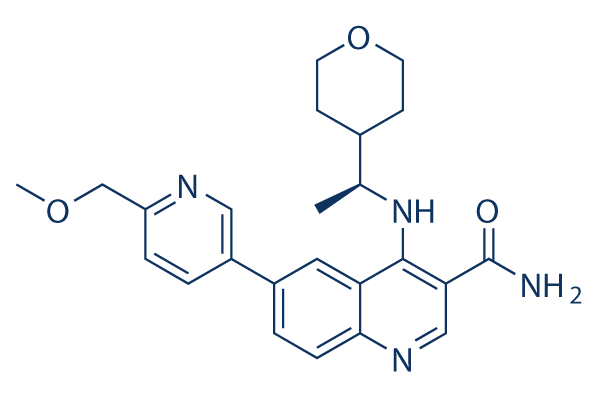
AZ31 ATM/ATR inhibitor
Cat.No.S8556
Quality Control
| Related Targets | HDAC PARP DNA-PK WRN DNA/RNA Synthesis Topoisomerase PPAR Sirtuin Casein Kinase eIF |
|---|---|
| Other ATM/ATR Inhibitors | Ceralasertib (AZD6738) AZD1390 Berzosertib (VE-822) Lartesertib (M4076) Camonsertib (RP-3500) KU-60019 KU-55933 VE-821 AZ20 AZD0156 |
Solubility
|
In vitro |
|
Molarity Calculator
|
In vivo |
|||||
In vivo Formulation Calculator (Clear solution)
Step 1: Enter information below (Recommended: An additional animal making an allowance for loss during the experiment)
Step 2: Enter the in vivo formulation (This is only the calculator, not formulation. Please contact us first if there is no in vivo formulation at the solubility Section.)
Calculation results:
Working concentration: mg/ml;
Method for preparing DMSO master liquid: mg drug pre-dissolved in μL DMSO ( Master liquid concentration mg/mL, Please contact us first if the concentration exceeds the DMSO solubility of the batch of drug. )
Method for preparing in vivo formulation: Take μL DMSO master liquid, next addμL PEG300, mix and clarify, next addμL Tween 80, mix and clarify, next add μL ddH2O, mix and clarify.
Method for preparing in vivo formulation: Take μL DMSO master liquid, next add μL Corn oil, mix and clarify.
Note: 1. Please make sure the liquid is clear before adding the next solvent.
2. Be sure to add the solvent(s) in order. You must ensure that the solution obtained, in the previous addition, is a clear solution before proceeding to add the next solvent. Physical methods such
as vortex, ultrasound or hot water bath can be used to aid dissolving.
Chemical Information, Storage & Stability
| Molecular Weight | 420.50 | Formula | C24H28N4O3 |
Storage (From the date of receipt) | 3 years -20°C powder |
|---|---|---|---|---|---|
| CAS No. | 2088113-98-6 | -- | Storage of Stock Solutions |
|
|
| Synonyms | N/A | SMILES | CC(C1CCOCC1)NC2=C3C=C(C=CC3=NC=C2C(=O)N)C4=CN=C(C=C4)COC | ||
Read more about storage stability stock solution CAS number SMILES
Mechanism of Action
| Targets/IC50/Ki |
ATM
|
|---|---|
| In vitro |
Antitumor effects of AZ31 + SN38 are cytostatic rather than cytotoxic. |
| Kinase Assay |
ATM enzyme assay
|
|
Compounds in 100% DMSO were added to assay plates by acoustic dispensing. ATM enzyme was added in a Hepes buffer (50 mM HEPES pH 7.4, 150 mM NaCl, 10 mM, MnCl2 1 mM, DTT, 5% v/v Glycerol, 0.05% v/v Tween 20) and allowed to preincubate with compound for 30 minutes prior to addition of substrate solution containing p53 and ATP. The enzyme reaction was stopped after 2 hours by the addition of detection reagent (33 mM HEPES pH 7.4, 20 mM EDTA, 0.1 M KF, 0.1 mg/mL BSA, 13 nM D2 Anti-GST antibody (Cisbio) and 0.5 nM Eu3+ Anti-p53phosphoS15 antibody) and incubated overnight before reading on a Pherastar Instrument with a standard HTRF filter block method. The final concentrations of DMSO, ATP and p53 in the assay were 1%, 5 µM, and 50 nM respectively. IC50 values (concentrations of test compound that inhibited 50% of enzyme activity) were determined using a four parameter fit method (smart fitting model) in the data analysis software.
|
|
| In vivo |
Pharmacokinetic investigation of AZ31 as a single agent and in combination with irinotecan revealed that plasma concentrations of this compound were highest 1-hour after administration followed by a stepwise decrease at 3, 6 and 16 hour in the combination sensitive CRC098. |
References |
|
Tech Support
Tel: +1-832-582-8158 Ext:3
If you have any other enquiries, please leave a message.
Signaling Pathway Map

Products are for research use only. Not for human use. We do not sell to patients.
©Copyright 2013 Selleck Chemicals. All Rights Reserved.