
-
 Argentina
-
 Australia
-
 Austria
-
 Belgium
-
 Brazil
-
 Canada
-
 China
China
-
 Czech Republic
-
 Denmark
-
 Finland
-
 France
-
 Germany
-
 Greece
-
 Hong Kong
-
 Hungary
-
 Iceland
-
 India
India
-
 Ireland
-
 Israel
-
 Italy
Italy
-
 Japan
Japan
-
 Korea
Korea
-
 Luxembourg
-
 Malaysia
-
 Netherlands
-
 New Zealand
-
 Norway
-
 Poland
-
 Portugal
-
 Qatar
Qatar
-
 Romania
-
 Saudi Arabia
-
 Singapore
-
 Spain
Spain
-
 Sweden
-
 Switzerland
-
 Taiwan
-
 Turkey
-
 United Kingdom
-
 United States
research use only
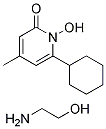
Ciclopirox ethanolamine ATPase inhibitor
Cat.No.S3019
Quality Control
| Related Targets | CFTR CRM1 CD markers AChR Calcium Channel Sodium Channel Potassium Channel GABA Receptor TRP Channel GluR |
|---|---|
| Other ATPase Inhibitors | (-)-Blebbistatin Thapsigargin Brefeldin A (BFA chemical) CB-5083 Golgicide A Sodium orthovanadate Bufalin CDN1163 Ginsenoside Rb1 Oligomycin |
Solubility
|
In vitro |
DMSO
: 40 mg/mL
(149.05 mM)
Ethanol : 30 mg/mL Water : Insoluble |
Molarity Calculator
|
In vivo |
|||||
In vivo Formulation Calculator (Clear solution)
Step 1: Enter information below (Recommended: An additional animal making an allowance for loss during the experiment)
Step 2: Enter the in vivo formulation (This is only the calculator, not formulation. Please contact us first if there is no in vivo formulation at the solubility Section.)
Calculation results:
Working concentration: mg/ml;
Method for preparing DMSO master liquid: mg drug pre-dissolved in μL DMSO ( Master liquid concentration mg/mL, Please contact us first if the concentration exceeds the DMSO solubility of the batch of drug. )
Method for preparing in vivo formulation: Take μL DMSO master liquid, next addμL PEG300, mix and clarify, next addμL Tween 80, mix and clarify, next add μL ddH2O, mix and clarify.
Method for preparing in vivo formulation: Take μL DMSO master liquid, next add μL Corn oil, mix and clarify.
Note: 1. Please make sure the liquid is clear before adding the next solvent.
2. Be sure to add the solvent(s) in order. You must ensure that the solution obtained, in the previous addition, is a clear solution before proceeding to add the next solvent. Physical methods such
as vortex, ultrasound or hot water bath can be used to aid dissolving.
Chemical Information, Storage & Stability
| Molecular Weight | 268.35 | Formula | C12H17NO2.C2H7NO |
Storage (From the date of receipt) | |
|---|---|---|---|---|---|
| CAS No. | 41621-49-2 | Download SDF | Storage of Stock Solutions |
|
|
| Synonyms | Ciclopirox olamine, HOE 296,Ciclopiroxolamine | SMILES | CC1=CC(=O)N(C(=C1)C2CCCCC2)O.C(CO)N | ||
Read more about storage stability stock solution CAS number SMILES
Mechanism of Action
| Features |
Exhibits antifungal activity via a specific iron limiation mechanism, with no single case of fungal resistance reported.
|
|---|---|
| Targets/IC50/Ki |
ATPase
|
| In vitro |
Ciclopirox significantly inhibits the growth of C. albicans strain SC5314 cells, with MIC80s of 1.0-2.0 μg/mL, growth decreased dramatically at the concentrations of >0.6 μg/mL, and almost complete growth inhibition at concentration of 0.7 μg/mL, unlike fluconazole which shows a much wider range of concentrations with intermediate inhibition. Like iron chelator bipyridine, Ciclopirox reduces cell growth by binding to iron ions, which can be reversed by addition of FeCl3. Moreover, Ciclopirox treatment at subinhibitory concentration (0.6 μg/mL) only moderately reduces the virulence genes such as genes encoding secreted proteinases or lipases, but leads to a distinct up- or down-regulation of genes encoding iron permeases or transporters (FTR1, FTR2, and FTH1), a copper permease (CCC2), an iron reductase (CFL1), and a siderophore transporter (SIT1). Although the Candida drug resistance genes CDR1 and CDR2 are up-regulated after Ciclopirox treatment, no change in resistance or increased tolerance could be observed even after an incubation period of 6 months, in contrast to fluconazole in which the MICs for cells noticeably increase after 2 months. Ciclopirox inhibits the growth of Aspergillus fumigatus strain B5233 with IC50 of 4.22 μM, more potently compared with deferiprone with IC50 of 1.29 mM. |
References |
|
Clinical Trial Information
(data from https://clinicaltrials.gov, updated on 2024-05-22)
| NCT Number | Recruitment | Conditions | Sponsor/Collaborators | Start Date | Phases |
|---|---|---|---|---|---|
| NCT00990587 | Completed | Hematologic Malignancy|Acute Lymphocytic Leukemia|Chronic Lymphocytic Leukemia|Myelodysplasia|Acute Myeloid Leukemia|Chronic Myelogenous Leukemia|Hodgkin''s Disease |
University Health Network Toronto|The Leukemia and Lymphoma Society |
2009-10 | Phase 1 |
| NCT01646580 | Terminated | Dermatomycoses |
Ferrer Internacional S.A. |
2008-10 | Phase 4 |
Read more about Clinical Trials
Tech Support
Tel: +1-832-582-8158 Ext:3
If you have any other enquiries, please leave a message.
Signaling Pathway Map

Products are for research use only. Not for human use. We do not sell to patients.
©Copyright 2013 Selleck Chemicals. All Rights Reserved.