
-
 Argentina
-
 Australia
-
 Austria
-
 Belgium
-
 Brazil
-
 Canada
-
 China
China
-
 Czech Republic
-
 Denmark
-
 Finland
-
 France
-
 Germany
-
 Greece
-
 Hong Kong
-
 Hungary
-
 Iceland
-
 India
India
-
 Ireland
-
 Israel
-
 Italy
Italy
-
 Japan
Japan
-
 Korea
Korea
-
 Luxembourg
-
 Malaysia
-
 Netherlands
-
 New Zealand
-
 Norway
-
 Poland
-
 Portugal
-
 Qatar
Qatar
-
 Romania
-
 Saudi Arabia
-
 Singapore
-
 Spain
Spain
-
 Sweden
-
 Switzerland
-
 Taiwan
-
 Turkey
-
 United Kingdom
-
 United States
research use only
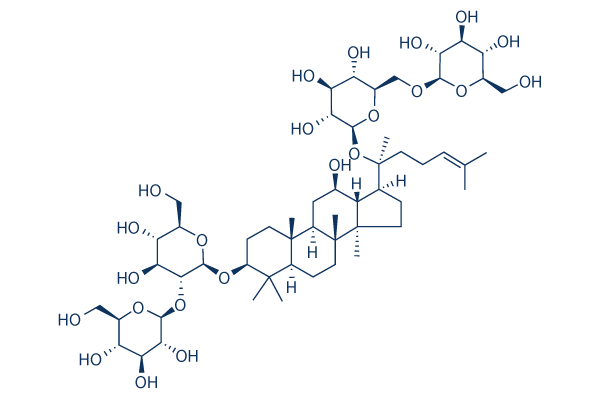
Ginsenoside Rb1 ATPase inhibitor
Cat.No.S3924
Quality Control
| Related Targets | CFTR CRM1 CD markers AChR Calcium Channel Sodium Channel Potassium Channel GABA Receptor TRP Channel GluR |
|---|---|
| Other ATPase Inhibitors | (-)-Blebbistatin Thapsigargin Brefeldin A (BFA chemical) CB-5083 Golgicide A Sodium orthovanadate Bufalin CDN1163 Oligomycin BTB06584 |
Solubility
|
In vitro |
DMSO
: 100 mg/mL
(90.14 mM)
Water : 100 mg/mL Ethanol : Insoluble |
Molarity Calculator
|
In vivo |
|||||
In vivo Formulation Calculator (Clear solution)
Step 1: Enter information below (Recommended: An additional animal making an allowance for loss during the experiment)
Step 2: Enter the in vivo formulation (This is only the calculator, not formulation. Please contact us first if there is no in vivo formulation at the solubility Section.)
Calculation results:
Working concentration: mg/ml;
Method for preparing DMSO master liquid: mg drug pre-dissolved in μL DMSO ( Master liquid concentration mg/mL, Please contact us first if the concentration exceeds the DMSO solubility of the batch of drug. )
Method for preparing in vivo formulation: Take μL DMSO master liquid, next addμL PEG300, mix and clarify, next addμL Tween 80, mix and clarify, next add μL ddH2O, mix and clarify.
Method for preparing in vivo formulation: Take μL DMSO master liquid, next add μL Corn oil, mix and clarify.
Note: 1. Please make sure the liquid is clear before adding the next solvent.
2. Be sure to add the solvent(s) in order. You must ensure that the solution obtained, in the previous addition, is a clear solution before proceeding to add the next solvent. Physical methods such
as vortex, ultrasound or hot water bath can be used to aid dissolving.
Chemical Information, Storage & Stability
| Molecular Weight | 1109.29 | Formula | C54H92O23 |
Storage (From the date of receipt) | |
|---|---|---|---|---|---|
| CAS No. | 41753-43-9 | -- | Storage of Stock Solutions |
|
|
| Synonyms | Gypenoside Ⅲ | SMILES | CC(=CCCC(C)(C1CCC2(C1C(CC3C2(CCC4C3(CCC(C4(C)C)OC5C(C(C(C(O5)CO)O)O)OC6C(C(C(C(O6)CO)O)O)O)C)C)O)C)OC7C(C(C(C(O7)COC8C(C(C(C(O8)CO)O)O)O)O)O)O)C | ||
Read more about storage stability stock solution CAS number SMILES
Mechanism of Action
| Targets/IC50/Ki |
IRAK-1
NF-κB
TLR3
TLR4
TNF-α
IFN-β
iNOS
Na+, K+-ATPase
(Cell-free assay) 6.3 μM
|
|---|---|
| In vitro |
Ginsenoside Rb1 promotes the expressions of Nestin, NSE, GFAP and stimulates the differentiation of NSCs. This compound is found to not only inhibit Aβ-induced ROROS overproduction and lipid peroxidation, but also to increase the Bcl-2/Bax ratio and attenuate caspase-3 activation, thereby improving cell survival. It may therefore act as a ROS scavenger, and such antioxidant properties may play a protective role against Aβ-induced cell injury. |
| In vivo |
Ginsenoside Rb1 can increase the ability of spatial learning and neural regeneration. It has an anti-neuroinflammatory effect in a rat model of AD. Oral ginsenoside Rb1 can metabolize ginsenoside compound K through intestinal bacteria, and then play a pharmacological role together with esterification of fatty acids to prevent memory loss and improve spatial learning. This compound increases synaptic density and the expression of brain-derived neurotrophic factors Bcl-2 and antioxidant enzyme in hippocampus of mice, and inhibits apoptosis and calcium overload. It can stimulate the release of acetylcholine and enhance the expression of choline acetyltransferase mRNA in rat brain, which contributes to the increase of hippocampal neurogenesis. It significantly increased the expression of brain-derived neurotrophic factor (BDNF) in the hippocampus. |
References |
|
Tech Support
Tel: +1-832-582-8158 Ext:3
If you have any other enquiries, please leave a message.
Signaling Pathway Map

Products are for research use only. Not for human use. We do not sell to patients.
©Copyright 2013 Selleck Chemicals. All Rights Reserved.