
-
 Argentina
-
 Australia
-
 Austria
-
 Belgium
-
 Brazil
-
 Canada
-
 China
China
-
 Czech Republic
-
 Denmark
-
 Finland
-
 France
-
 Germany
-
 Greece
-
 Hong Kong
-
 Hungary
-
 Iceland
-
 India
India
-
 Ireland
-
 Israel
-
 Italy
Italy
-
 Japan
Japan
-
 Korea
Korea
-
 Luxembourg
-
 Malaysia
-
 Netherlands
-
 New Zealand
-
 Norway
-
 Poland
-
 Portugal
-
 Qatar
Qatar
-
 Romania
-
 Saudi Arabia
-
 Singapore
-
 Spain
Spain
-
 Sweden
-
 Switzerland
-
 Taiwan
-
 Turkey
-
 United Kingdom
-
 United States
research use only
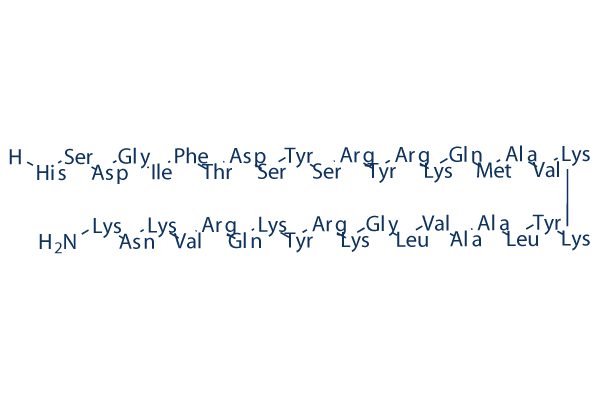
PACAP 1-38 PACAP Receptor Agonist
Cat.No.S8415
Quality Control
| Related Targets | CXCR Hedgehog/Smoothened PKA Adrenergic Receptor AChR 5-HT Receptor Histamine Receptor Dopamine Receptor Ras KRas |
|---|---|
| Other PACAP Receptor Inhibitors | PACAP 6-38 acetate PACAP 1-27 Fipexide |
Solubility
|
In vitro |
Water : 100 mg/mL |
Molarity Calculator
|
In vivo |
|||||
In vivo Formulation Calculator (Clear solution)
Step 1: Enter information below (Recommended: An additional animal making an allowance for loss during the experiment)
Step 2: Enter the in vivo formulation (This is only the calculator, not formulation. Please contact us first if there is no in vivo formulation at the solubility Section.)
Calculation results:
Working concentration: mg/ml;
Method for preparing DMSO master liquid: mg drug pre-dissolved in μL DMSO ( Master liquid concentration mg/mL, Please contact us first if the concentration exceeds the DMSO solubility of the batch of drug. )
Method for preparing in vivo formulation: Take μL DMSO master liquid, next addμL PEG300, mix and clarify, next addμL Tween 80, mix and clarify, next add μL ddH2O, mix and clarify.
Method for preparing in vivo formulation: Take μL DMSO master liquid, next add μL Corn oil, mix and clarify.
Note: 1. Please make sure the liquid is clear before adding the next solvent.
2. Be sure to add the solvent(s) in order. You must ensure that the solution obtained, in the previous addition, is a clear solution before proceeding to add the next solvent. Physical methods such
as vortex, ultrasound or hot water bath can be used to aid dissolving.
Chemical Information, Storage & Stability
| Molecular Weight | 4534.26 | Formula | C203H331N63O53S |
Storage (From the date of receipt) | |
|---|---|---|---|---|---|
| CAS No. | 137061-48-4 | Download SDF | Storage of Stock Solutions |
|
|
| Synonyms | Pituitary Adenylate Cyclase Activating Polypeptide 38 | SMILES | CCC(C)C(NC(=O)CNC(=O)C(CC(O)=O)NC(=O)C(CO)NC(=O)C(N)CC1=CN=C[NH]1)C(=O)NC(CC2=CC=CC=C2)C(=O)NC(C(C)O)C(=O)NC(CC(O)=O)C(=O)NC(CO)C(=O)NC(CC3=CC=C(O)C=C3)C(=O)NC(CO)C(=O)NC(CCCNC(N)=N)C(=O)NC(CC4=CC=C(O)C=C4)C(=O)NC(CCCNC(N)=N)C(=O)NC(CCCCN)C(=O)NC(CCC(N)=O)C(=O)NC(CCSC)C(=O)NC(C)C(=O)NC(C(C)C)C(=O)NC(CCCCN)C(=O)NC(CCCCN)C(=O)C(=O)C(CC5=CC=C(O)C=C5)NC(=O)C(CC(C)C)NC(=O)C(C)NC(=O)C(C)NC(=O)C(NC(=O)C(CC(C)C)NC(=O)CNC(=O)C(CCCCN)NC(=O)C(CCCNC(N)=N)NC(=O)C(CC6=CC=C(O)C=C6)NC(=O)C(CCCCN)NC(=O)C(CCC(N)=O)NC(=O)C(CCCNC(N)=N)NC(=O)C(NC(=O)C(CCCCN)NC(=O)C(CC(N)=O)NC(=O)C(CCCCN)NN)C(C)C)C(C)C | ||
Read more about storage stability stock solution CAS number SMILES
Mechanism of Action
| Targets/IC50/Ki |
PAC1
1.1 nM(Ki)
PAC1s
1.7 nM(Ki)
PAC1vs
121 nM(Ki)
|
|---|---|
| In vitro |
PACAP 1-38 has potent, efficacious, and sustained stimulatory effects on sympathetic neuronal NPY and catecholamine production. It is a pleiotropic neuropeptide, exhibiting a variety of biologic actions, including activities as a neurotransmitter, neuromodulator, neurotrophic factor, as well as an immunomodulator, in immune cells through its effect on MAPK signaling and modulation of activation of NFκB. This compound dramatically prevents injury of cultured renal proximal tubule cells caused by myeloma light chains through suppression of proinflammatory cytokines production, by inhibiting p38 MAPK and translocation of NFκB via both PAC1 and VPAC1 receptors. It inhibits myeloma cell growth directly and may also indirectly by suppressing production of the growth factor, IL-6, from bone marrow stromal cells, that is stimulated by adhesion of myeloma cells. This neuropeptide suppressed release of both IL-6 and TNFα dose dependently. |
| In vivo |
PACAP38 is capable of inhibiting light chain-induced cytokine expression with a great potency and prevented the resulting cell damage in vivo. However, this compound is also considered as an autoregulatory factor for certain tumors, stimulating their growth in an autocrine fashion. |
References |
|
Tech Support
Tel: +1-832-582-8158 Ext:3
If you have any other enquiries, please leave a message.

Products are for research use only. Not for human use. We do not sell to patients.
©Copyright 2013 Selleck Chemicals. All Rights Reserved.