
-
 Australia
-
 Austria
-
 Belgium
-
 Brazil
-
 Canada
-
 China
China
-
 Czech Republic
-
 Denmark
-
 Finland
-
 France
-
 Germany
-
 Greece
-
 Hong Kong
-
 Hungary
-
 Iceland
-
 India
India
-
 Ireland
-
 Israel
-
 Italy
Italy
-
 Japan
Japan
-
 Korea
Korea
-
 Luxembourg
-
 Malaysia
-
 Netherlands
-
 New Zealand
-
 Norway
-
 Poland
-
 Qatar
Qatar
-
 Romania
-
 Saudi Arabia
-
 Singapore
-
 Spain
Spain
-
 Sweden
-
 Switzerland
-
 Taiwan
-
 Turkey
-
 United Kingdom
-
 United States
research use only
Chlorpropamide ATPase inhibitor
Cat.No.S4166
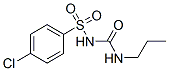
Chemical Structure
Molecular Weight: 276.74
Quality Control
| Related Targets | CFTR CRM1 CD markers AChR Calcium Channel Sodium Channel Potassium Channel GABA Receptor TRP Channel GluR |
|---|---|
| Other ATPase Inhibitors | (-)-Blebbistatin Thapsigargin Brefeldin A (BFA chemical) CB-5083 Golgicide A Sodium orthovanadate Bufalin CDN1163 Ginsenoside Rb1 Oligomycin |
Solubility
|
In vitro |
DMSO
: 55 mg/mL
(198.74 mM)
Ethanol : 55 mg/mL Water : Insoluble |
Molarity Calculator
|
In vivo |
|||||
In vivo Formulation Calculator (Clear solution)
Step 1: Enter information below (Recommended: An additional animal making an allowance for loss during the experiment)
Step 2: Enter the in vivo formulation (This is only the calculator, not formulation. Please contact us first if there is no in vivo formulation at the solubility Section.)
Calculation results:
Working concentration: mg/ml;
Method for preparing DMSO master liquid: mg drug pre-dissolved in μL DMSO ( Master liquid concentration mg/mL, Please contact us first if the concentration exceeds the DMSO solubility of the batch of drug. )
Method for preparing in vivo formulation: Take μL DMSO master liquid, next addμL PEG300, mix and clarify, next addμL Tween 80, mix and clarify, next add μL ddH2O, mix and clarify.
Method for preparing in vivo formulation: Take μL DMSO master liquid, next add μL Corn oil, mix and clarify.
Note: 1. Please make sure the liquid is clear before adding the next solvent.
2. Be sure to add the solvent(s) in order. You must ensure that the solution obtained, in the previous addition, is a clear solution before proceeding to add the next solvent. Physical methods such
as vortex, ultrasound or hot water bath can be used to aid dissolving.
Chemical Information, Storage & Stability
| Molecular Weight | 276.74 | Formula | C10H13ClN2O3S |
Storage (From the date of receipt) | |
|---|---|---|---|---|---|
| CAS No. | 94-20-2 | Download SDF | Storage of Stock Solutions |
|
|
| Synonyms | N/A | Smiles | CCCNC(=O)NS(=O)(=O)C1=CC=C(C=C1)Cl | ||
Mechanism of Action
| Targets/IC50/Ki |
Na(+),K(+)-ATPase
|
|---|---|
| In vitro |
Chlorpropamide acts through a cyclic AMP-independent mechanism. The addition of 0.2 mM this compound to hepatocytes isolated from fed rats, raises the cellular concentration of fructose-2,6-bisphosphate (F-2, 6-P2). The accumulation of F-2, 6-P2 caused by this chemical (1 mM) is parallel to the stimulation of L-lactate production (36.6 versus 26.1 μmol of lactate/g of cells) and to the inhibition of gluconeogenesis (0.57 versus 0.94 μmol of [U-14C]pyruvate converted to glucose/g of cells). This compound enhances the inhibitory action evoked by insulin on glucagon-stimulated gluconeogenesis. This chemical treatment has no effect on insulin binding, altering neither receptor number nor affinity in rat adipocytes. It (175 μg/mL) enhances 2-deoxyglucose transport in both the absence (17%) and presence (20%) of insulin. This compound significantly increases glucose metabolism and total lipids in both the absence (30%) and presence (31%) of insulin. It competitively inhibits antidiuretic hormone (ADH) binding and adenylyl cyclase (AC) stimulation with Ki of 2.8 mM and 250 μM, respectively, in the LLC-PK1 cell line. This chemical (333 μM) increases the apparent Ka of ADH for AC activation (0.31 vs. 0.08 nM) without affecting a maximal response. Twenty-four-hour this compound exposure (100 μM) upregulates the ADH receptors without affecting affinity, which lowers Ka and increases basal AC activity and maximal response (1.86 vs. 1.35 and 14.9 vs. 10.6 fmol cAMP/min/1000 cells). |
References |
|
Tech Support
Tel: +1-832-582-8158 Ext:3
If you have any other enquiries, please leave a message.
Signaling Pathway Map

Products are for research use only. Not for human use. We do not sell to patients.
©Copyright 2013 Selleck Chemicals. All Rights Reserved.