
-
 Argentina
-
 Australia
-
 Austria
-
 Belgium
-
 Brazil
-
 Canada
-
 China
China
-
 Czech Republic
-
 Denmark
-
 Finland
-
 France
-
 Germany
-
 Greece
-
 Hong Kong
-
 Hungary
-
 Iceland
-
 India
India
-
 Ireland
-
 Israel
-
 Italy
Italy
-
 Japan
Japan
-
 Korea
Korea
-
 Luxembourg
-
 Malaysia
-
 Netherlands
-
 New Zealand
-
 Norway
-
 Poland
-
 Qatar
Qatar
-
 Romania
-
 Saudi Arabia
-
 Singapore
-
 Spain
Spain
-
 Sweden
-
 Switzerland
-
 Taiwan
-
 Turkey
-
 United Kingdom
-
 United States
research use only
RAF265 (CHIR-265) Raf inhibitor
Cat.No.S2161
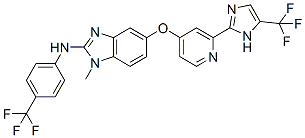
Chemical Structure
Molecular Weight: 518.41
Quality Control
Cell Culture, Treatment & Working Concentration
| Cell Lines | Assay Type | Concentration | Incubation Time | Formulation | Activity Description | PMID |
|---|---|---|---|---|---|---|
| SK-MEL-28 | Growth inhibition assay | Growth inhibition of SK-MEL-28 cells, IC50=0.14μM. | 21576023 | |||
| MALME-3M | Growth inhibition assay | Growth inhibition of MALME-3M cells, IC50=0.14μM. | 21576023 | |||
| A375M | Growth inhibition assay | Growth inhibition of A375M cells, IC50=0.14μM. | 21576023 | |||
| A375 | Function assay | Inhibition of B-RAF V600E mutant in human A375 cells assessed as phosphorylation of ERK, IC50=0.04μM. | 26396681 | |||
| Malme-3M | Function assay | Inhibition of B-RAF V600E mutant in human Malme-3M cells assessed as phosphorylation of ERK, IC50=0.04μM. | 26396681 | |||
| WM-1799 | Function assay | Inhibition of B-RAF V600E mutant in human WM-1799 cells assessed as phosphorylation of ERK, IC50=0.04μM. | 26396681 | |||
| MALME-3M | Antiproliferative assay | Antiproliferative activity against human MALME-3M cells harboring B-RAF V600E mutant, IC50=0.04μM. | 26396681 | |||
| A375 | Antiproliferative assay | Antiproliferative activity against human A375 cells harboring B-RAF V600E mutant, IC50=0.04μM. | 26396681 | |||
| WM1799 | Antiproliferative assay | Antiproliferative activity against human WM1799 cells harboring B-RAF V600E mutant, IC50=0.04μM. | 26396681 | |||
| SK-MEL-28 | Function assay | Inhibition of B-RAF V600E mutant in human SK-MEL-28 cells assessed as phosphorylation of ERK, IC50=0.14μM. | 26396681 | |||
| SK-MEL-28 | Antiproliferative assay | Antiproliferative activity against human SK-MEL-28 cells harboring B-RAF V600E mutant, IC50=0.16μM. | 26396681 | |||
| A375M | Function assay | 100 mg/kg | fCmin in mouse xenografted with human A375M cells at 100 mg/kg, po q2d, fCmin=0.5μM. | 26396681 | ||
| A375M | Function assay | 100 mg/kg | 48 hrs | Inhibition of B-RAF V600E mutant in mouse xenografted with human A375M cells assessed as reduction of phospho-MEK level in tumor at 100 mg/kg, po q24 after 48 hrs by Western blot analysis | 26396681 | |
| A375M | Function assay | 100 mg/kg | 48 hrs | Inhibition of B-RAF V600E mutant in mouse xenografted with human A375M cells assessed as reduction of phospho-MEK level in tumor at 100 mg/kg, po q2d after 48 hrs by Western blot analysis | 26396681 | |
| A375M | Function assay | 30 to 100 mg/kg | 4 hrs | Inhibition of B-RAF V600E mutant in mouse xenografted with human A375M cells assessed as reduction of phospho-MEK level in tumor at 30 to 100 mg/kg, po q2d measured after 4 hrs post-third dose by Western blot analysis | 26396681 | |
| A375M | Antitumor assay | 10 to 100 mg/kg | 30 days | Antitumor activity against human A375M cells xenografted in mouse assessed as tumor regression at 10 to 100 mg/kg, po q2d measured up to 30 days | 26396681 | |
| TC32 | qHTS assay | qHTS of pediatric cancer cell lines to identify multiple opportunities for drug repurposing: Primary screen for TC32 cells | 29435139 | |||
| DAOY | qHTS assay | qHTS of pediatric cancer cell lines to identify multiple opportunities for drug repurposing: Primary screen for DAOY cells | 29435139 | |||
| SJ-GBM2 | qHTS assay | qHTS of pediatric cancer cell lines to identify multiple opportunities for drug repurposing: Primary screen for SJ-GBM2 cells | 29435139 | |||
| A673 | qHTS assay | qHTS of pediatric cancer cell lines to identify multiple opportunities for drug repurposing: Primary screen for A673 cells | 29435139 | |||
| SK-N-MC | qHTS assay | qHTS of pediatric cancer cell lines to identify multiple opportunities for drug repurposing: Primary screen for SK-N-MC cells | 29435139 | |||
| BT-37 | qHTS assay | qHTS of pediatric cancer cell lines to identify multiple opportunities for drug repurposing: Primary screen for BT-37 cells | 29435139 | |||
| NB-EBc1 | qHTS assay | qHTS of pediatric cancer cell lines to identify multiple opportunities for drug repurposing: Primary screen for NB-EBc1 cells | 29435139 | |||
| U-2 OS | qHTS assay | qHTS of pediatric cancer cell lines to identify multiple opportunities for drug repurposing: Primary screen for U-2 OS cells | 29435139 | |||
| Saos-2 | qHTS assay | qHTS of pediatric cancer cell lines to identify multiple opportunities for drug repurposing: Primary screen for Saos-2 cells | 29435139 | |||
| SK-N-SH | qHTS assay | qHTS of pediatric cancer cell lines to identify multiple opportunities for drug repurposing: Primary screen for SK-N-SH cells | 29435139 | |||
| NB1643 | qHTS assay | qHTS of pediatric cancer cell lines to identify multiple opportunities for drug repurposing: Primary screen for NB1643 cells | 29435139 | |||
| LAN-5 | qHTS assay | qHTS of pediatric cancer cell lines to identify multiple opportunities for drug repurposing: Primary screen for LAN-5 cells | 29435139 | |||
| BT-12 | qHTS assay | qHTS of pediatric cancer cell lines to identify multiple opportunities for drug repurposing: Primary screen for BT-12 cells | 29435139 | |||
| RD | qHTS assay | qHTS of pediatric cancer cell lines to identify multiple opportunities for drug repurposing: Primary screen for RD cells | 29435139 | |||
| NB1643 | qHTS assay | qHTS of pediatric cancer cell lines to identify multiple opportunities for drug repurposing: Confirmatory screen for NB1643 cells | 29435139 | |||
| SK-N-MC | qHTS assay | qHTS of pediatric cancer cell lines to identify multiple opportunities for drug repurposing: Confirmatory screen for SK-N-MC cells | 29435139 | |||
| LAN-5 | qHTS assay | qHTS of pediatric cancer cell lines to identify multiple opportunities for drug repurposing: Confirmatory screen for LAN-5 cells | 29435139 | |||
| NB-EBc1 | qHTS assay | qHTS of pediatric cancer cell lines to identify multiple opportunities for drug repurposing: Confirmatory screen for NB-EBc1 cells | 29435139 | |||
| BT-37 | qHTS assay | qHTS of pediatric cancer cell lines to identify multiple opportunities for drug repurposing: Confirmatory screen for BT-37 cells | 29435139 | |||
| TC32 | qHTS assay | qHTS of pediatric cancer cell lines to identify multiple opportunities for drug repurposing: Confirmatory screen for TC32 cells | 29435139 | |||
| MG 63 (6-TG R) | qHTS assay | qHTS of pediatric cancer cell lines to identify multiple opportunities for drug repurposing: Confirmatory screen for MG 63 (6-TG R) cells | 29435139 | |||
| VERO-E6 | Function assay | 48 hrs | Toxicity CC50 against VERO-E6 cells determined at 48 hours by high content imaging (same conditions as 2_LEY without exposure to 0.01 MOI SARS CoV-2 virus), CC50=9.19μM. | ChEMBL | ||
| VERO-E6 | Function assay | 48 hrs | Determination of IC50 values for inhibition of SARS-CoV-2 induced cytotoxicity of VERO-E6 cells after 48 hours exposure to 0.01 MOI SARS CoV-2 virus by high content imaging, IC50=14.64μM. | ChEMBL | ||
| Click to View More Cell Line Experimental Data | ||||||
Solubility
|
In vitro |
DMSO
: 100 mg/mL
(192.89 mM)
Ethanol : 33 mg/mL Water : Insoluble |
Molarity Calculator
|
In vivo |
|||||
In vivo Formulation Calculator (Clear solution)
Step 1: Enter information below (Recommended: An additional animal making an allowance for loss during the experiment)
Step 2: Enter the in vivo formulation (This is only the calculator, not formulation. Please contact us first if there is no in vivo formulation at the solubility Section.)
Calculation results:
Working concentration: mg/ml;
Method for preparing DMSO master liquid: mg drug pre-dissolved in μL DMSO ( Master liquid concentration mg/mL, Please contact us first if the concentration exceeds the DMSO solubility of the batch of drug. )
Method for preparing in vivo formulation: Take μL DMSO master liquid, next addμL PEG300, mix and clarify, next addμL Tween 80, mix and clarify, next add μL ddH2O, mix and clarify.
Method for preparing in vivo formulation: Take μL DMSO master liquid, next add μL Corn oil, mix and clarify.
Note: 1. Please make sure the liquid is clear before adding the next solvent.
2. Be sure to add the solvent(s) in order. You must ensure that the solution obtained, in the previous addition, is a clear solution before proceeding to add the next solvent. Physical methods such
as vortex, ultrasound or hot water bath can be used to aid dissolving.
Chemical Information, Storage & Stability
| Molecular Weight | 518.41 | Formula | C24H16F6N6O |
Storage (From the date of receipt) | |
|---|---|---|---|---|---|
| CAS No. | 927880-90-8 | Download SDF | Storage of Stock Solutions |
|
|
| Synonyms | N/A | Smiles | CN1C2=C(C=C(C=C2)OC3=CC(=NC=C3)C4=NC=C(N4)C(F)(F)F)N=C1NC5=CC=C(C=C5)C(F)(F)F | ||
Mechanism of Action
| Targets/IC50/Ki |
VEGFR2
(Cell-free assay) 30 nM(EC50)
B-Raf
(Cell-free assay) 3 nM-60 nM
|
|---|---|
| In vitro |
RAF265 (CHIR-265) inhibits C-Raf, wild type B-Raf and mutant (V600E) B-Raf. This compound effectively blocks phosphorylation of Raf's downstream substrates MEK and ERK in cells and also kills melanoma and colorectal cancer cell lines harboring B-Raf mutations independent of PTEN mutation status. Raf kinase inhibition by this agent in mutant B-Raf melanoma cell lines causes cell cycle arrest and induces apoptosis, mimicking the effect of Raf RNAi in these cells. It also potently inhibits the phosphorylation of VEGFR2 and proliferation of VEGF-stimulated hMVEC. In HT29 and MDAMB231 cells, this chemical shows inhibitory activity with IC20 of 1 to 3 μM and IC50 of 5 to 10 μM, respectively. While it leads to a significant decrease in clonogenic survival in all tested cell lines, which means that this compound induces a dominant effect on clonogenic survival. Addition of this agent to RAD001 in HCT116 cells could lead to moderately decreased AKT, S6 protein, and 4EBP1 phosphorylation. It markedly reduces the protein level of Bcl-2 and is greatly inhibitory in CM- and NCI-H727 cells, while having no effect on the TRAIL susceptibility of BON1 and GOT1 cells. Protein kinase D3 (PRKD3) that when knocked down could enhance cell killing by this compound in A2058 melanoma cells, which prevent reactivation of MAPK signaling, induce PARP cleavage, increase caspase activity, interrupt cell-cycle progression, and inhibit colony formation.
|
| Kinase Assay |
Assay Protocol
|
|
Raf and Mek are combined at 2 × final concentrations in assay buffer (50 mM Tris, pH 7.5, 15 mM MgCl2. 0.1 mM EDTA and 1 mM DTT) and dispensed 15 μL per well in polypropylene assay plates. Background levels are determined in wells containing Mek and DMSO without Raf. To the Raf/Mek containing wells is added 3 μL of 10 × of this compound diluted in 100% DMSO. The raf kinase activity reaction is started by the addition of 12 μL per well of 2.5 × 33P-ATP diluted in assay buffer. After 45-60 minutes, the reactions are stopped with the addition of 70 μL of stop reagent (30 mM EDTA). Filtration plates are pre-wetted for 5 min with 70% ethanol, and then rinsed by filtration with wash buffer. Samples (90 μL) from the reaction wells are then transferred to the filtration plates. The filtration plates are washed 6 × with wash buffer using Millipore filtration apparatus. The plates are dried and 100 μL per well of scintillation fluid is added. The CPM is then determined using a Wallac Microbeta 1450 reader.
|
|
| In vivo |
RAF265 (CHIR-265) shows 71% to 72% TVI% (tumor volume inhibition percentage) in HCT116 xenografts at 12 mg/kg. While the combination of this compound and RAD001 shows enhanced antitumor activity with increased T10 (time to achieve a relative tumor volume of 10 times the initial tumor volume) and tumor growth delay. The combination of RAD001 and this chemical also significantly enhances the activation of caspase-3 in HCT116 and MDAMB231 but not in A549 xenografts. This compound inhibits FDG (2-deoxy-2-[18F]fluoro-d-glucose) accumulation and decreases the tumor volumes in A375M xenografts by orally dosed of 100 mg/kg.
|
References |
|
Clinical Trial Information
(data from https://clinicaltrials.gov, updated on 2024-05-22)
| NCT Number | Recruitment | Conditions | Sponsor/Collaborators | Start Date | Phases |
|---|---|---|---|---|---|
| NCT01352273 | Completed | Advanced Solid Tumors |
Array Biopharma now a wholly owned subsidiary of Pfizer|Array BioPharma |
June 2011 | Phase 1 |
Tech Support
Tel: +1-832-582-8158 Ext:3
If you have any other enquiries, please leave a message.
Signaling Pathway Map

Products are for research use only. Not for human use. We do not sell to patients.
©Copyright 2013 Selleck Chemicals. All Rights Reserved.