
-
 Argentina
-
 Australia
-
 Austria
-
 Belgium
-
 Brazil
-
 Canada
-
 China
China
-
 Czech Republic
-
 Denmark
-
 Finland
-
 France
-
 Germany
-
 Greece
-
 Hong Kong
-
 Hungary
-
 Iceland
-
 India
India
-
 Ireland
-
 Israel
-
 Italy
Italy
-
 Japan
Japan
-
 Korea
Korea
-
 Luxembourg
-
 Malaysia
-
 Netherlands
-
 New Zealand
-
 Norway
-
 Poland
-
 Portugal
-
 Qatar
Qatar
-
 Romania
-
 Saudi Arabia
-
 Singapore
-
 Spain
Spain
-
 Sweden
-
 Switzerland
-
 Taiwan
-
 Turkey
-
 United Kingdom
-
 United States
research use only
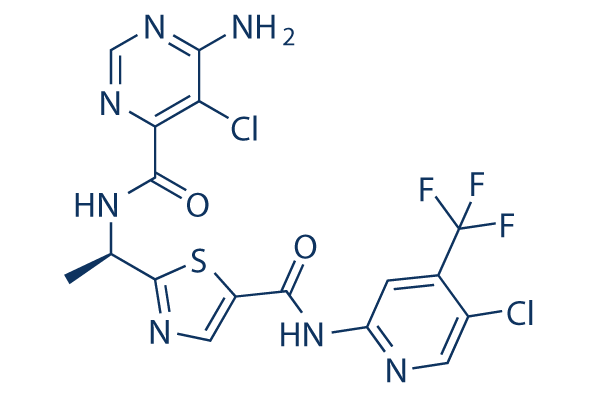
Tovorafenib (MLN2480) Raf Kinase Inhibitor
Cat.No.S7121
Quality Control
| Related Targets | ERK p38 MAPK JNK MEK Ras KRas S6 Kinase MAP4K TAK1 Mixed Lineage Kinase |
|---|---|
| Other Raf Inhibitors | LY3009120 Exarafenib (KIN-2787) GDC-0879 Avutometinib (Ro5126766, CH5126766) PLX-4720 AZ 628 SB590885 TAK-632 GW5074 RAF265 (CHIR-265) |
Cell Culture, Treatment & Working Concentration
| Cell Lines | Assay Type | Concentration | Incubation Time | Formulation | Activity Description | PMID |
|---|---|---|---|---|---|---|
| A673 | qHTS assay | qHTS of pediatric cancer cell lines to identify multiple opportunities for drug repurposing: Primary screen for A673 cells | 29435139 | |||
| SK-N-MC | qHTS assay | qHTS of pediatric cancer cell lines to identify multiple opportunities for drug repurposing: Primary screen for SK-N-MC cells | 29435139 | |||
| NB-EBc1 | qHTS assay | qHTS of pediatric cancer cell lines to identify multiple opportunities for drug repurposing: Primary screen for NB-EBc1 cells | 29435139 | |||
| SK-N-SH | qHTS assay | qHTS of pediatric cancer cell lines to identify multiple opportunities for drug repurposing: Primary screen for SK-N-SH cells | 29435139 | |||
| NB1643 | qHTS assay | qHTS of pediatric cancer cell lines to identify multiple opportunities for drug repurposing: Primary screen for NB1643 cells | 29435139 | |||
| Click to View More Cell Line Experimental Data | ||||||
Solubility
|
In vitro |
DMSO
: 100 mg/mL
(197.51 mM)
Ethanol : 100 mg/mL Water : Insoluble |
Molarity Calculator
|
In vivo |
|||||
In vivo Formulation Calculator (Clear solution)
Step 1: Enter information below (Recommended: An additional animal making an allowance for loss during the experiment)
Step 2: Enter the in vivo formulation (This is only the calculator, not formulation. Please contact us first if there is no in vivo formulation at the solubility Section.)
Calculation results:
Working concentration: mg/ml;
Method for preparing DMSO master liquid: mg drug pre-dissolved in μL DMSO ( Master liquid concentration mg/mL, Please contact us first if the concentration exceeds the DMSO solubility of the batch of drug. )
Method for preparing in vivo formulation: Take μL DMSO master liquid, next addμL PEG300, mix and clarify, next addμL Tween 80, mix and clarify, next add μL ddH2O, mix and clarify.
Method for preparing in vivo formulation: Take μL DMSO master liquid, next add μL Corn oil, mix and clarify.
Note: 1. Please make sure the liquid is clear before adding the next solvent.
2. Be sure to add the solvent(s) in order. You must ensure that the solution obtained, in the previous addition, is a clear solution before proceeding to add the next solvent. Physical methods such
as vortex, ultrasound or hot water bath can be used to aid dissolving.
Chemical Information, Storage & Stability
| Molecular Weight | 506.29 | Formula | C17H12Cl2F3N7O2S |
Storage (From the date of receipt) | |
|---|---|---|---|---|---|
| CAS No. | 1096708-71-2 | Download SDF | Storage of Stock Solutions |
|
|
| Synonyms | BIIB-024, TAK580, AMG-2112819, BSK1369, DAY-101 | SMILES | CC(C1=NC=C(S1)C(=O)NC2=NC=C(C(=C2)C(F)(F)F)Cl)NC(=O)C3=C(C(=NC=N3)N)Cl | ||
Read more about storage stability stock solution CAS number SMILES
Mechanism of Action
| Targets/IC50/Ki |
Raf
|
|---|---|
| In vitro |
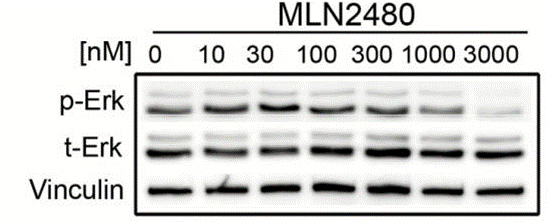
Tovorafenib (MLN2480) inhibits MAPK pathway signaling in BRAF mutant and some RAS mutant preclinical cancer models at concentrations that are tolerated in vivo. It is found to activate phosphorylated MEK at very low concentrations, but inhibits this same activity at higher concentrations. The inhibitory effects of this compound are found to vary across models and genetic contexts. In vitro analysis of the drug combination of MLN2480 and TAK-733 (an investigational allosteric MEK kinase inhibitor) in cell proliferation assays demonstrates synergistic activity. In addition, western blot analysis demonstrates the effect of it in reversing feedback activation of MEK in response to TAK-733, leading to more concerted MAPK pathway inhibition. It only modestly inhibits PRAK. |
| In vivo |
In vivo, Tovorafenib (MLN2480) shows antitumor activity in melanoma, colon, lung, and pancreatic cancer xenograft models. This compound (37.5 mg/kg) is well tolerated in a tumor xenograft model. The combination of it (12.5 mg) and TAK-733 (1 mg/kg) is effective in an SK-MEL-30 xenograft model, but monotherapy with either compound produces negligible effects. |
References |
|
Applications
| Methods | Biomarkers | Images | PMID |
|---|---|---|---|
| Western blot | p-ERK / ERK |
|
28082416 |
Clinical Trial Information
(data from https://clinicaltrials.gov, updated on 2026-07-31)
| NCT Number | Recruitment | Conditions | Sponsor/Collaborators | Start Date | Phases |
|---|---|---|---|---|---|
| NCT07206849 | NOT_YET_RECRUITING | High Grade Glioma (HGG) of the Brain With BRAF Aberration; High Grade Glioma (III or IV); Diffuse Intrinsic Pontine Glioma; High Grade Glioma; WHO Grade 3 Glioma; WHO Grade 4 Glioma; Metastatic Brain Tumor |
Nationwide Children's Hospital |
2026-11 | PHASE2 |
| NCT07441707 | ACTIVE_NOT_RECRUITING | Low-grade Glioma |
Ipsen |
2026-03-10 | PHASE1 |
| NCT06965114 | RECRUITING | Hairy Cell Leukemia; Recurrent Hairy Cell Leukemia; Refractory Hairy Cell Leukemia |
National Cancer Institute (NCI) |
2026-05-29 | PHASE1; PHASE2 |
| NCT05828069 | RECRUITING | Recurrent Langerhans Cell Histiocytosis; Refractory Langerhans Cell Histiocytosis |
National Cancer Institute (NCI) |
2024-03-28 | PHASE2 |
| NCT05566795 | ACTIVE_NOT_RECRUITING | Low-grade Glioma; Rapidly Accelerated Fibrosarcoma (RAF) Altered Glioma; Pediatric Low-grade Glioma |
Day One Biopharmaceuticals, Inc. |
2023-02-27 | PHASE3 |
| NCT04775485 | RECRUITING | Low-grade Glioma; Advanced Solid Tumor |
Day One Biopharmaceuticals, Inc. |
2021-04-22 | PHASE2 |
Read more about Clinical Trials
Tech Support
Tel: +1-832-582-8158 Ext:3
If you have any other enquiries, please leave a message.
Signaling Pathway Map

Products are for research use only. Not for human use. We do not sell to patients.
©Copyright 2013 Selleck Chemicals. All Rights Reserved.