
-
 Argentina
-
 Australia
-
 Austria
-
 Belgium
-
 Brazil
-
 Canada
-
 China
China
-
 Czech Republic
-
 Denmark
-
 Finland
-
 France
-
 Germany
-
 Greece
-
 Hong Kong
-
 Hungary
-
 Iceland
-
 India
India
-
 Ireland
-
 Israel
-
 Italy
Italy
-
 Japan
Japan
-
 Korea
Korea
-
 Luxembourg
-
 Malaysia
-
 Netherlands
-
 New Zealand
-
 Norway
-
 Poland
-
 Qatar
Qatar
-
 Romania
-
 Saudi Arabia
-
 Singapore
-
 Spain
Spain
-
 Sweden
-
 Switzerland
-
 Taiwan
-
 Turkey
-
 United Kingdom
-
 United States
research use only
TAK-632 Raf inhibitor
Cat.No.S7291
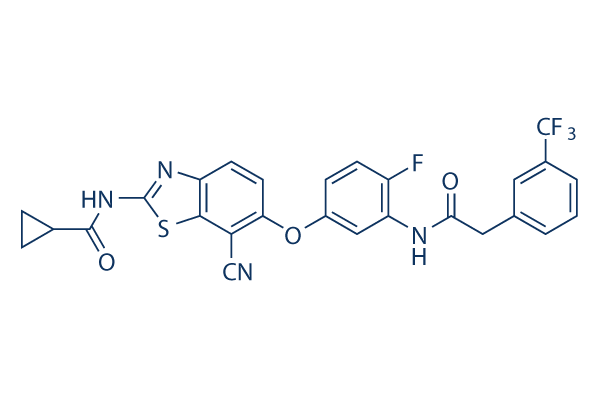
Chemical Structure
Molecular Weight: 554.52
Quality Control
| Related Targets | ERK p38 MAPK JNK MEK Ras KRas S6 Kinase MAP4K TAK1 Mixed Lineage Kinase |
|---|---|
| Other Raf Inhibitors | LY3009120 Exarafenib (KIN-2787) GDC-0879 Avutometinib (Ro5126766, CH5126766) PLX-4720 AZ 628 SB590885 GW5074 RAF265 (CHIR-265) PLX7904 |
Cell Culture, Treatment & Working Concentration
| Cell Lines | Assay Type | Concentration | Incubation Time | Formulation | Activity Description | PMID |
|---|---|---|---|---|---|---|
| human A375 cells | Function assay | 2 h | Inhibition of BRAF V600E mutant in human A375 cells assessed as phosphorylation of MEK after 2 hrs by Western blotting analysis, IC50=12 nM | |||
| human HMVII cells | Function assay | 2 h | Inhibition of NRASQ61k/BRAFG469V-mutant in human HMVII cells assessed as phosphorylation of MEK after 2 hrs by Western blotting analysis, IC50=49 nM | |||
| human HT-29 cells | Function assay | Inhibition of BRAF V600E mutant in human HT-29 cells assessed as phosphorylation of MEK, IC50=75 nM | ||||
| human HMVII cells | Proliferation assay | 72 h | Antiproliferative activity against human HMVII cells assessed as growth inhibition after 72 hrs by chemi-luminescence cell viability assay, GI50=0.2 μM | |||
| 293 cells | Function assay | 20 mins | Inhibition of N-terminal GST-tagged MEK1 (unknown origin) expressed in 293 cells using GST-ERK1(K71A) as substrate after 20 mins, IC50=3.7 μM | |||
| Click to View More Cell Line Experimental Data | ||||||
Solubility
|
In vitro |
DMSO
: 100 mg/mL
(180.33 mM)
Ethanol : 2 mg/mL Water : Insoluble |
Molarity Calculator
|
In vivo |
|||||
In vivo Formulation Calculator (Clear solution)
Step 1: Enter information below (Recommended: An additional animal making an allowance for loss during the experiment)
Step 2: Enter the in vivo formulation (This is only the calculator, not formulation. Please contact us first if there is no in vivo formulation at the solubility Section.)
Calculation results:
Working concentration: mg/ml;
Method for preparing DMSO master liquid: mg drug pre-dissolved in μL DMSO ( Master liquid concentration mg/mL, Please contact us first if the concentration exceeds the DMSO solubility of the batch of drug. )
Method for preparing in vivo formulation: Take μL DMSO master liquid, next addμL PEG300, mix and clarify, next addμL Tween 80, mix and clarify, next add μL ddH2O, mix and clarify.
Method for preparing in vivo formulation: Take μL DMSO master liquid, next add μL Corn oil, mix and clarify.
Note: 1. Please make sure the liquid is clear before adding the next solvent.
2. Be sure to add the solvent(s) in order. You must ensure that the solution obtained, in the previous addition, is a clear solution before proceeding to add the next solvent. Physical methods such
as vortex, ultrasound or hot water bath can be used to aid dissolving.
Chemical Information, Storage & Stability
| Molecular Weight | 554.52 | Formula | C27H18F4N4O3S |
Storage (From the date of receipt) | |
|---|---|---|---|---|---|
| CAS No. | 1228591-30-7 | Download SDF | Storage of Stock Solutions |
|
|
| Synonyms | N/A | Smiles | C1CC1C(=O)NC2=NC3=C(S2)C(=C(C=C3)OC4=CC(=C(C=C4)F)NC(=O)CC5=CC(=CC=C5)C(F)(F)F)C#N | ||
Mechanism of Action
| Features |
Orally bioavailable, pan-raf inhibitor that targets both wild-type and mutant forms.
|
|---|---|
| Targets/IC50/Ki |
C-Raf
(Cell-free assay) 1.4 nM
B-Raf
(Cell-free assay) 8.3 nM
Aurora B
(Cell-free assay) 66 nM
PDGFRβ
(Cell-free assay) 120 nM
FGFR3
(Cell-free assay) 280 nM
GSK-3β
(Cell-free assay) 500 nM
CDK2
(Cell-free assay) 580 nM
p38α
(Cell-free assay) 600 nM
PDGFRα
(Cell-free assay) 610 nM
|
| In vitro |
TAK-632 inhibits phosphorylation of MEK and ERK in melanoma A375 cells (BRAFV600E) with IC50 of 12 nM and 16 nM, respectively. In human melanoma HMVII cells (NRASQ61K/BRAFG469V), this compound also shows strong inhibition of pMEK and pERK with IC50 of 49 nM and 50 nM, respectively. Moreover, it also exhibits antiproliferative activity in both A375 and HMVII cells with GI50 of 66 nM and 200 nM, respectively. This chemical induces RAF dimerization but inhibits the kinase activity of the RAF dimer because of its slow dissociation from RAF. The combination of this compound and TAK-733 exhibits synergistic antiproliferative effects in BRAF- and NRAS-mutated melanoma cells.
|
| Kinase Assay |
Kinase Profile Assay
|
|
Assays for serine/threonine kinases using radio labeled [γ-33P] ATP are performed in 96 well plates. BRAF and c-RAF are expressed as N-terminal FLAG-tagged protein using a baculovirus expression system. The reaction conditions are optimized for each kinase: BRAF (25 ng/well of enzyme, 1 μg/well of GST-MEK1(K96R), 0.1 μCi/well of [γ-32P] ATP, room temperature, 20 min reaction); c-RAF (25 ng/well of enzyme, 1 μg/well of GST-MEK1 (K96R), 0.1 μCi/well of [γ-32P] ATP, room temperature, 20 min reaction). Enzyme reactions are performed in 25 mM HEPES, pH 7.5, 10 mM magnesium acetate, 1 mM dithiothreitol and 0.5 μM ATP containing optimized concentration of enzyme, substrate and radiolabeled ATP as described above in a total volume of 50 μL. Prior to the kinase reaction, this compound and enzyme are incubated for 5 min at reaction temperature as described above. The kinase reactions are initiated by adding ATP. After the reaction period as described above, the reactions are terminated by the addition of 10% (final concentration) trichloroacetic acid. The [γ-33P] or [γ-32P]-phosphorylated proteins are filtered in GFC filter plates with a Cell Harvester and then the plates are washed out with 3% phosphoric acid. The plates are dried, followed by the addition of 40 μL of MicroScint0. The radioactivity is counted by a TopCount scintillation counter.
|
|
| In vivo |
TAK-632 shows superior oral bioavailability in both rats and dogs. This compound (3.9–24.1 mg/kg, p.o.) exhibits dose-dependent antitumor efficacy without severe body weight reduction in a melanoma A375 (BRAFV600E) xenograft model and a human melanoma HMVII (NRASQ61K/BRAFG469V) xenograft in rats. In NRAS-mutant melanoma SK-MEL-2 xenograft model, this chemical (60 or 120 mg/kg, p.o.) also exhibits potent antitumor efficacy without severe toxicity.
|
References |
|
Tech Support
Tel: +1-832-582-8158 Ext:3
If you have any other enquiries, please leave a message.
Signaling Pathway Map

Products are for research use only. Not for human use. We do not sell to patients.
©Copyright 2013 Selleck Chemicals. All Rights Reserved.