
-
 Argentina
-
 Australia
-
 Austria
-
 Belgium
-
 Brazil
-
 Canada
-
 China
China
-
 Czech Republic
-
 Denmark
-
 Finland
-
 France
-
 Germany
-
 Greece
-
 Hong Kong
-
 Hungary
-
 Iceland
-
 India
India
-
 Ireland
-
 Israel
-
 Italy
Italy
-
 Japan
Japan
-
 Korea
Korea
-
 Luxembourg
-
 Malaysia
-
 Netherlands
-
 New Zealand
-
 Norway
-
 Poland
-
 Portugal
-
 Qatar
Qatar
-
 Romania
-
 Saudi Arabia
-
 Singapore
-
 Spain
Spain
-
 Sweden
-
 Switzerland
-
 Taiwan
-
 Turkey
-
 United Kingdom
-
 United States
research use only
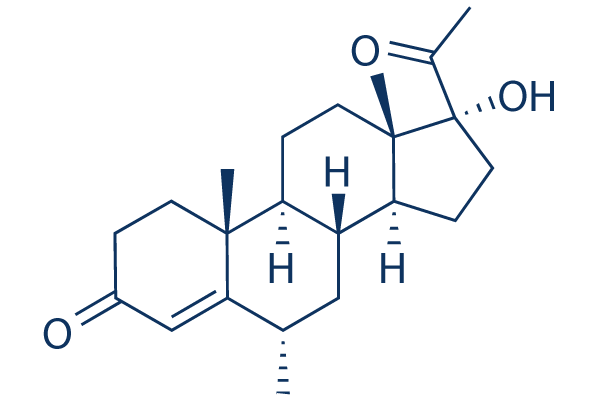
Medroxyprogesterone Estrogen/progestogen Receptor agonist
Cat.No.S3635
Quality Control
| Related Targets | Adrenergic Receptor GPR Androgen Receptor Glucocorticoid Receptor ACE RAAS Progesterone Receptor Opioid Receptor THR PGES |
|---|---|
| Other Estrogen/progestogen Receptor Inhibitors | Elacestrant (RAD1901) Dihydrochloride Vepdegestrant (ARV-471) MPP dihydrochloride Kaempferol Cholesterol PHTPP G15 Licochalcone A Endoxifen HCl Chrysin |
Solubility
|
In vitro |
DMSO
: 68 mg/mL
(197.39 mM)
Ethanol : 14 mg/mL Water : Insoluble |
Molarity Calculator
|
In vivo |
|||||
In vivo Formulation Calculator (Clear solution)
Step 1: Enter information below (Recommended: An additional animal making an allowance for loss during the experiment)
Step 2: Enter the in vivo formulation (This is only the calculator, not formulation. Please contact us first if there is no in vivo formulation at the solubility Section.)
Calculation results:
Working concentration: mg/ml;
Method for preparing DMSO master liquid: mg drug pre-dissolved in μL DMSO ( Master liquid concentration mg/mL, Please contact us first if the concentration exceeds the DMSO solubility of the batch of drug. )
Method for preparing in vivo formulation: Take μL DMSO master liquid, next addμL PEG300, mix and clarify, next addμL Tween 80, mix and clarify, next add μL ddH2O, mix and clarify.
Method for preparing in vivo formulation: Take μL DMSO master liquid, next add μL Corn oil, mix and clarify.
Note: 1. Please make sure the liquid is clear before adding the next solvent.
2. Be sure to add the solvent(s) in order. You must ensure that the solution obtained, in the previous addition, is a clear solution before proceeding to add the next solvent. Physical methods such
as vortex, ultrasound or hot water bath can be used to aid dissolving.
Chemical Information, Storage & Stability
| Molecular Weight | 344.49 | Formula | C22H32O3 |
Storage (From the date of receipt) | |
|---|---|---|---|---|---|
| CAS No. | 520-85-4 | Download SDF | Storage of Stock Solutions |
|
|
| Synonyms | MP | SMILES | CC1CC2C(CCC3(C2CCC3(C(=O)C)O)C)C4(C1=CC(=O)CC4)C | ||
Read more about storage stability stock solution CAS number SMILES
Mechanism of Action
| In vitro |
Medroxyprogesterone acetate (MPA, 10 nM) treatment for 48 h induces proliferation of the cells (1.6-fold induction). MPA induces cyclin D1 expression (3.3-fold induction). MPA increases both the protein level (2.2-fold induction) and promoter activity (2.7-fold induction) of cyclin D1 in MCF-7 cells transfected with PRB but not with PRA. Although MPA transcriptionally activates cyclin D1 expression, cyclin D1 promoter does not have progesterone-responsive element-related sequence. MPA induces the transient phosphorylation of Akt (2.7-fold induction at 5 min) and also phosphorylation of inhibitor of NFkappaBalpha (IkappaBalpha) (2.3-fold induction). MPA activates glucocorticoid receptors, which could mimic part of the anti-atherosclerotic effects of glucocorticoids, and has, on the other hand, also anti-androgenic activity, which might diminish protective oestrogen effects.
|
|---|---|
| In vivo |
Long-term treatment with MPA and MPA + E2 increases arterial thrombosis despite inhibitory effects of MPA on atherosclerosis in ApoE-deficient mice. Increased thrombin formation, reduced smooth muscle content and remodelling of non-collagenous plaque matrix may be involved in the pro-thrombotic effects. Thus, MPA exhibits differential effects on arterial thrombosis and on atherosclerosis. In monkeys, MPA interferes with anti-atherosclerotic oestrogen effects whereas progesterone does not.
|
References |
|
Clinical Trial Information
(data from https://clinicaltrials.gov, updated on 2024-05-22)
| NCT Number | Recruitment | Conditions | Sponsor/Collaborators | Start Date | Phases |
|---|---|---|---|---|---|
| NCT05188222 | Not yet recruiting | Left Ventricular Dysfunction|Quality of Recovery|Right Ventricular Dysfunction |
Jewish General Hospital |
2024-09-01 | Phase 4 |
| NCT06325293 | Not yet recruiting | Community Acquired Pneumonia in Children|Mycoplasma Pneumoniae|Mycoplasma Pneumoniae Pneumonia |
Christoph Berger|University Children''s Hospital Zurich |
2024-07-01 | Not Applicable |
Read more about Clinical Trials
Tech Support
Tel: +1-832-582-8158 Ext:3
If you have any other enquiries, please leave a message.
Signaling Pathway Map

Products are for research use only. Not for human use. We do not sell to patients.
©Copyright 2013 Selleck Chemicals. All Rights Reserved.