
-
 Australia
-
 Austria
-
 Belgium
-
 Brazil
-
 Canada
-
 China
China
-
 Czech Republic
-
 Denmark
-
 Finland
-
 France
-
 Germany
-
 Greece
-
 Hong Kong
-
 Hungary
-
 Iceland
-
 India
India
-
 Ireland
-
 Israel
-
 Italy
Italy
-
 Japan
Japan
-
 Korea
Korea
-
 Luxembourg
-
 Malaysia
-
 Netherlands
-
 New Zealand
-
 Norway
-
 Poland
-
 Qatar
Qatar
-
 Romania
-
 Saudi Arabia
-
 Singapore
-
 Spain
Spain
-
 Sweden
-
 Switzerland
-
 Taiwan
-
 Turkey
-
 United Kingdom
-
 United States
research use only
Pregnenolone Estrogen/progestogen Receptor modulator
Cat.No.S1914
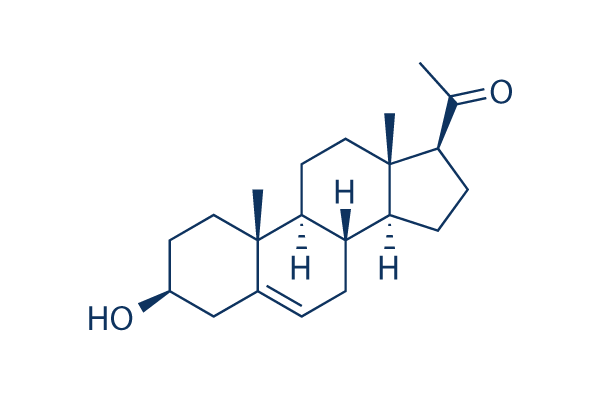
Chemical Structure
Molecular Weight: 316.48
Quality Control
| Related Targets | Adrenergic Receptor GPR Androgen Receptor Glucocorticoid Receptor ACE RAAS Progesterone Receptor Opioid Receptor THR PGES |
|---|---|
| Other Estrogen/progestogen Receptor Inhibitors | Elacestrant (RAD1901) Dihydrochloride Vepdegestrant (ARV-471) MPP dihydrochloride Kaempferol Cholesterol PHTPP G15 Licochalcone A Endoxifen HCl Chrysin |
Solubility
|
In vitro |
DMSO
: 22 mg/mL
(69.51 mM)
Ethanol : 22 mg/mL Water : Insoluble |
Molarity Calculator
|
In vivo |
|||||
In vivo Formulation Calculator (Clear solution)
Step 1: Enter information below (Recommended: An additional animal making an allowance for loss during the experiment)
Step 2: Enter the in vivo formulation (This is only the calculator, not formulation. Please contact us first if there is no in vivo formulation at the solubility Section.)
Calculation results:
Working concentration: mg/ml;
Method for preparing DMSO master liquid: mg drug pre-dissolved in μL DMSO ( Master liquid concentration mg/mL, Please contact us first if the concentration exceeds the DMSO solubility of the batch of drug. )
Method for preparing in vivo formulation: Take μL DMSO master liquid, next addμL PEG300, mix and clarify, next addμL Tween 80, mix and clarify, next add μL ddH2O, mix and clarify.
Method for preparing in vivo formulation: Take μL DMSO master liquid, next add μL Corn oil, mix and clarify.
Note: 1. Please make sure the liquid is clear before adding the next solvent.
2. Be sure to add the solvent(s) in order. You must ensure that the solution obtained, in the previous addition, is a clear solution before proceeding to add the next solvent. Physical methods such
as vortex, ultrasound or hot water bath can be used to aid dissolving.
Chemical Information, Storage & Stability
| Molecular Weight | 316.48 | Formula | C21H32O2 |
Storage (From the date of receipt) | |
|---|---|---|---|---|---|
| CAS No. | 145-13-1 | Download SDF | Storage of Stock Solutions |
|
|
| Synonyms | 3β-Hydroxy-5-pregnen-20-one | Smiles | CC(=O)C1CCC2C1(CCC3C2CC=C4C3(CCC(C4)O)C)C | ||
Mechanism of Action
| Targets/IC50/Ki |
progestogen Receptor
|
|---|---|
| In vitro |
Pregnenolone induces a large, dose-related increase of both the rate and extent of MAP2-induced tubulin assembly, whereas progesterone, inactive per se, counteracted the stimulatory effect of this compound. This compound-increased assembly of microtubules produces a completely normal structure. It preserves microtubule abundance and promotes cell movement during epiboly. This chemical results in dramatic reduction in GR nuclear localization in mouse hippocampal cell line (HT-22). It has neuroprotective effects against both glutamate and amyloid beta protein neuropathology. |
| In vivo |
Pregnenolone sustains its proliferative activity in vivo and stimulates the growth of LNCaP-tumor xenografts in intact male SCID mice as well as in castrated animals. This compound is shown to activate transcription through the LNCaP androgen receptor (AR), but not the wild-type AR. It results in a significant decrease in the accumulation of astrocytes in the proximity of the wound and in a decreased bromodeoxyuridine incorporation in reactive astrocytes of rats. Administration of this chemical results in elevations in downstream neurosteroids such as allopregnanolone, a molecule with neuroprotective effects that also increases neurogenesis, decreases apoptosis and inflammation, modulates the hypothalamic-pituitary-adrenal axis, and markedly increases GABA(A) receptor responses. It elevates pregnenolone sulfate, a neurosteroid that positively modulates NMDA receptors. |
References |
|
Clinical Trial Information
(data from https://clinicaltrials.gov, updated on 2024-05-22)
| NCT Number | Recruitment | Conditions | Sponsor/Collaborators | Start Date | Phases |
|---|---|---|---|---|---|
| NCT05781009 | Recruiting | Alcohol Use Disorder |
Yale University|National Institute on Alcohol Abuse and Alcoholism (NIAAA) |
January 8 2024 | Phase 2 |
| NCT05903716 | Recruiting | Acne Vulgaris |
Marmara University |
September 15 2022 | -- |
| NCT04791124 | Unknown status | Down Syndrome |
Parc de Salut Mar|Aelis Farma|Starlab |
January 11 2021 | -- |
| NCT03801629 | Completed | Drug Effect |
Yale University |
September 12 2019 | Phase 1 |
| NCT03953612 | Completed | Cocaine-Related Disorders |
Yale University|National Institute on Drug Abuse (NIDA) |
March 12 2019 | Early Phase 1 |
Tech Support
Tel: +1-832-582-8158 Ext:3
If you have any other enquiries, please leave a message.
Signaling Pathway Map

Products are for research use only. Not for human use. We do not sell to patients.
©Copyright 2013 Selleck Chemicals. All Rights Reserved.