
-
 Australia
-
 Austria
-
 Belgium
-
 Brazil
-
 Canada
-
 China
China
-
 Czech Republic
-
 Denmark
-
 Finland
-
 France
-
 Germany
-
 Greece
-
 Hong Kong
-
 Hungary
-
 Iceland
-
 India
India
-
 Ireland
-
 Israel
-
 Italy
Italy
-
 Japan
Japan
-
 Korea
Korea
-
 Luxembourg
-
 Malaysia
-
 Netherlands
-
 New Zealand
-
 Norway
-
 Poland
-
 Qatar
Qatar
-
 Romania
-
 Saudi Arabia
-
 Singapore
-
 Spain
Spain
-
 Sweden
-
 Switzerland
-
 Taiwan
-
 Turkey
-
 United Kingdom
-
 United States
research use only
INH1 Microtubule Associated inhibitor
Cat.No.S7493
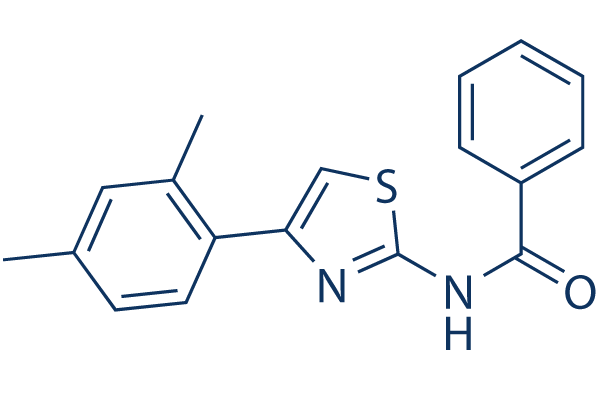
Chemical Structure
Molecular Weight: 308.40
Quality Control
| Related Targets | Akt Wnt/beta-catenin PKC HSP ROCK Integrin Bcr-Abl Actin FAK Kinesin |
|---|---|
| Other Microtubule Associated Inhibitors | Nocodazole Patupilone (Epothilone B) CW069 Combretastatin A4 Lexibulin (CYT997) Epothilone A ABT-751 (E7010) Cucurbitacin B TRx0237 (LMTX) mesylate DM1 (Mertansine) |
Solubility
|
In vitro |
DMSO
: 61 mg/mL
(197.79 mM)
Ethanol : 61 mg/mL Water : Insoluble |
Molarity Calculator
|
In vivo |
|||||
In vivo Formulation Calculator (Clear solution)
Step 1: Enter information below (Recommended: An additional animal making an allowance for loss during the experiment)
Step 2: Enter the in vivo formulation (This is only the calculator, not formulation. Please contact us first if there is no in vivo formulation at the solubility Section.)
Calculation results:
Working concentration: mg/ml;
Method for preparing DMSO master liquid: mg drug pre-dissolved in μL DMSO ( Master liquid concentration mg/mL, Please contact us first if the concentration exceeds the DMSO solubility of the batch of drug. )
Method for preparing in vivo formulation: Take μL DMSO master liquid, next addμL PEG300, mix and clarify, next addμL Tween 80, mix and clarify, next add μL ddH2O, mix and clarify.
Method for preparing in vivo formulation: Take μL DMSO master liquid, next add μL Corn oil, mix and clarify.
Note: 1. Please make sure the liquid is clear before adding the next solvent.
2. Be sure to add the solvent(s) in order. You must ensure that the solution obtained, in the previous addition, is a clear solution before proceeding to add the next solvent. Physical methods such
as vortex, ultrasound or hot water bath can be used to aid dissolving.
Chemical Information, Storage & Stability
| Molecular Weight | 308.40 | Formula | C18H16N2OS |
Storage (From the date of receipt) | |
|---|---|---|---|---|---|
| CAS No. | 313553-47-8 | Download SDF | Storage of Stock Solutions |
|
|
| Synonyms | IBT 13131 | Smiles | CC1=CC(=C(C=C1)C2=CSC(=N2)NC(=O)C3=CC=CC=C3)C | ||
Mechanism of Action
| Targets/IC50/Ki |
Hec1
|
|---|---|
| In vitro |
INH1 reduces the association of Hec1 with kinetochore and decreases global Nek2 protein level in cells. This compound effectively inhibits the proliferation of human breast cancer lines with GI50 of 10-21 μM. Moreover, it also elicits cell killing activity in part through impairing the Hec1/Nek2 pathway for the spindle checkpoint regulation.
|
| Kinase Assay |
Binding assays
|
|
Surface plasma resonance (SPR) assays are performed at 22.5°C in HBSD buffer [10 mmol/L HEPES, 150 mmol/L NaCl, 0.1% DMSO (pH 7.5)] on Biacore 3000. 6×His-Hec1 and GST-Nek2 are purified. NTA sensor chip or glutathione-modified CM5 chip are used to capture His-Hec1 and GST-Nek2, respectively. The capture level is about 140 to 180 resonance units (RU) at the flow rate of 5 μL/min. For the binding assay, chips are sequentially treated with this compound (1 or 20 μmol/L) and then proteins (50 μg/mL). Retained RUs are recorded and processed (triplicate experiments).
|
|
| In vivo |
INH1 (100 mg/kg i.p.) inhibits breast tumor growth in mice bearing MDA-MB-468 human breast cancer xenograft.
|
References |
Tech Support
Tel: +1-832-582-8158 Ext:3
If you have any other enquiries, please leave a message.
Signaling Pathway Map

Products are for research use only. Not for human use. We do not sell to patients.
©Copyright 2013 Selleck Chemicals. All Rights Reserved.