
-
 Argentina
-
 Australia
-
 Austria
-
 Belgium
-
 Brazil
-
 Canada
-
 China
China
-
 Czech Republic
-
 Denmark
-
 Finland
-
 France
-
 Germany
-
 Greece
-
 Hong Kong
-
 Hungary
-
 Iceland
-
 India
India
-
 Ireland
-
 Israel
-
 Italy
Italy
-
 Japan
Japan
-
 Korea
Korea
-
 Luxembourg
-
 Malaysia
-
 Netherlands
-
 New Zealand
-
 Norway
-
 Poland
-
 Portugal
-
 Qatar
Qatar
-
 Romania
-
 Saudi Arabia
-
 Singapore
-
 Spain
Spain
-
 Sweden
-
 Switzerland
-
 Taiwan
-
 Turkey
-
 United Kingdom
-
 United States
research use only
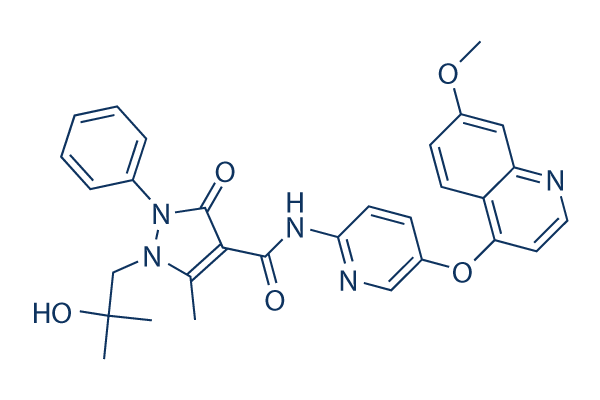
AMG-458 c-Met inhibitor
Cat.No.S2747
Quality Control
| Related Targets | EGFR VEGFR FGFR PDGFR Src MEK CSF-1R FLT3 HER2 c-Kit |
|---|---|
| Other c-Met Inhibitors | Tepotinib (EMD-1214063) Dihexa SGX-523 PHA-665752 Foretinib (GSK1363089, XL880) SU11274 BMS-777607 JNJ-38877605 Tivantinib PF-04217903 |
Solubility
|
In vitro |
DMSO
: 26 mg/mL
(48.18 mM)
Water : Insoluble Ethanol : Insoluble |
Molarity Calculator
|
In vivo |
|||||
In vivo Formulation Calculator (Clear solution)
Step 1: Enter information below (Recommended: An additional animal making an allowance for loss during the experiment)
Step 2: Enter the in vivo formulation (This is only the calculator, not formulation. Please contact us first if there is no in vivo formulation at the solubility Section.)
Calculation results:
Working concentration: mg/ml;
Method for preparing DMSO master liquid: mg drug pre-dissolved in μL DMSO ( Master liquid concentration mg/mL, Please contact us first if the concentration exceeds the DMSO solubility of the batch of drug. )
Method for preparing in vivo formulation: Take μL DMSO master liquid, next addμL PEG300, mix and clarify, next addμL Tween 80, mix and clarify, next add μL ddH2O, mix and clarify.
Method for preparing in vivo formulation: Take μL DMSO master liquid, next add μL Corn oil, mix and clarify.
Note: 1. Please make sure the liquid is clear before adding the next solvent.
2. Be sure to add the solvent(s) in order. You must ensure that the solution obtained, in the previous addition, is a clear solution before proceeding to add the next solvent. Physical methods such
as vortex, ultrasound or hot water bath can be used to aid dissolving.
Chemical Information, Storage & Stability
| Molecular Weight | 539.58 | Formula | C30H29N5O5 |
Storage (From the date of receipt) | |
|---|---|---|---|---|---|
| CAS No. | 913376-83-7 | Download SDF | Storage of Stock Solutions |
|
|
| Synonyms | N/A | SMILES | CC1=C(C(=O)N(N1CC(C)(C)O)C2=CC=CC=C2)C(=O)NC3=NC=C(C=C3)OC4=C5C=CC(=CC5=NC=C4)OC | ||
Read more about storage stability stock solution CAS number SMILES
Mechanism of Action
| Features |
Completely bioavailable across species and the intrinsic half-life is increased in higher mammals.
|
|---|---|
| Targets/IC50/Ki |
c-Met (H1094R)
0.5 nM(Ki)
c-Met (V1092I)
1.1 nM(Ki)
c-Met (Human)
1.2 nM(Ki)
c-Met (Mouse)
2.0 nM(Ki)
c-Met (D1228H)
2.2 nM(Ki)
c-Met (M1250T)
4.1 nM(Ki)
c-Met (Y1230H)
4.5 nM(Ki)
|
| In vitro |
AMG 458 also inhibits HGF-mediated c-Met phosphorylation in PC3 and CT26 cells with IC50 of 60 and 120 nM. AMG 458 is observed to bind covalently to liver microsomal proteins from rats and humans in the absence of NADPH. AMG 458 is believed to react with thiol groups in proteins, producing a methoxy quinoline thioether conjugate. A recent study shows that the constitutive phosphorylation of c-Met in H441 is abrogated by AMG 458. The basal and HGF-induced phosphorylation of c-Met in A549 is attenuated by AMG 458. The combination of radiation therapy and AMG 458 treatment is found to synergistically increase apoptosis in the H441 cell line by reduction of p-Akt and p-Erk levels, but not in A549.
|
| In vivo |
AMG 458 is metabolically stable in the liver microsomes of mouse, rat, dog, monkey, and human with low intrinsic clearances (Clint: <5, 62, 8, 8, 18 (μL/min)/mg, respectively). When administered orally, AMG 458 achieves remarkably high bioavailability in all species tested. Oral dosing of AMG 458 inhibits HGF-mediated c-Met phosphorylation with an approximate ED90 of 30 mg/kg and an associated plasma exposure of approximately 15 μM at 6 hours. AMG 458 significantly inhibits tumor growth in the NIH3T3/TPR-Met and U-87 MG xenograft models at 30 and 100 mg/kg q.d. and 30 mg/kg b.i.d.with no adverse effect on body weight. High concentrations of AMG 458 in some organs may produce toxicity via oxidative stress.
|
References |
|
Tech Support
Tel: +1-832-582-8158 Ext:3
If you have any other enquiries, please leave a message.
Signaling Pathway Map

Products are for research use only. Not for human use. We do not sell to patients.
©Copyright 2013 Selleck Chemicals. All Rights Reserved.