
-
 Argentina
-
 Australia
-
 Austria
-
 Belgium
-
 Brazil
-
 Canada
-
 China
China
-
 Czech Republic
-
 Denmark
-
 Finland
-
 France
-
 Germany
-
 Greece
-
 Hong Kong
-
 Hungary
-
 Iceland
-
 India
India
-
 Ireland
-
 Israel
-
 Italy
Italy
-
 Japan
Japan
-
 Korea
Korea
-
 Luxembourg
-
 Malaysia
-
 Netherlands
-
 New Zealand
-
 Norway
-
 Poland
-
 Qatar
Qatar
-
 Romania
-
 Saudi Arabia
-
 Singapore
-
 Spain
Spain
-
 Sweden
-
 Switzerland
-
 Taiwan
-
 Turkey
-
 United Kingdom
-
 United States
research use only
Laminin α5/LAMA5 Antibody (Mouse mAb) [P21J13]
CatNo: F3673
-
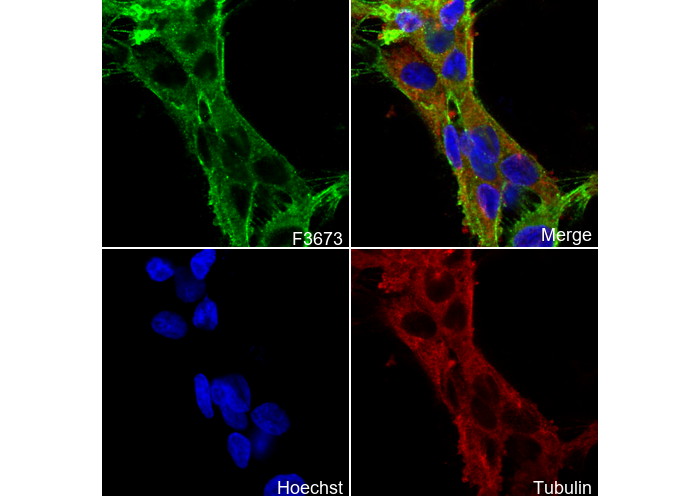 Immunofluorescent analysis of HUVEC cells using F3673 (green, 1:100), Hoechst (blue) and tubulin (Red).
Usage Information
| Dilution |
|---|
|
| Application |
|---|
| WB, IF |
| Reactivity |
|---|
| Human |
| Source |
|---|
| Mouse Monoclonal Antibody |
| Storage Buffer |
|---|
| PBS, pH 7.2+50% Glycerol+0.05% BSA+0.01% NaN3 |
| Storage (from the date of receipt) |
|---|
| -20°C (avoid freeze-thaw cycles), 2 years |
| Predicted MW |
|---|
| 400 kDa |
| Positive Control | Human embryonic lung alveolae epithelium; Human kidney |
|---|---|
| Negative Control |
Experimental Methods
| IF |
|---|
Experimental Protocol:
Sample Preparation
1. Adherent Cells: Place a clean, sterile coverslip in a culture dish. Once the cells grow to near confluence as a monolayer, remove the coverslip for further use.
2. Suspension Cells: Seed the cells onto a clean, sterile slide coated with poly-L-lysine.
3. Frozen Sections: Allow the slide to thaw at room temperature. Wash it with pure water or PBS for 2 times, 3 minutes each time.
4. Paraffin Sections: Deparaffinization and rehydration. Wash the slide with pure water or PBS for 3 times, 3 minutes each time. Then perform antigen retrieval.
Fixation
1. Fix the cell coverslips/spots or tissue sections at room temperature using a fixative such as 4% paraformaldehyde (4% PFA) for 10-15 minutes.
2. Wash the sample with PBS for 3 times, 3 minutes each time.
Permeabilization
1.Add a detergent such as 0.1–0.3% Triton X-100 to the sample and incubate at room temperature for 10–20 minutes.
(Note: This step is only required for intracellular antigens. For antigens expressed on the cell membrane, this step is unnecessary.)
Wash the sample with PBS for 3 times, 3 minutes each time.
Blocking
Add blocking solution and incubate at room temperature for at least 1 hour. (Common blocking solutions include: serum from the same source as the secondary antibody, BSA, or goat serum.)
Note: Ensure the sample remains moist during and after the blocking step to prevent drying, which can lead to high background.
Immunofluorescence Staining (Day 1)
1. Remove the blocking solution and add the diluted primary antibody.
2. Incubate the sample in a humidified chamber at 4°C overnight.
Immunofluorescence Staining (Day 2)
1. Remove the primary antibody and wash with PBST for 3 times, 5 minutes each time.
2. Add the diluted fluorescent secondary antibody and incubate in the dark at 4°C for 1–2 hours.
3. Remove the secondary antibody and wash with PBST for 3 times, 5 minutes each time.
4. Add diluted DAPI and incubate at room temperature in the dark for 5–10 minutes.
5. Wash with PBST for 3 times, 5 minutes each time.
Mounting
1. Mount the sample with an anti-fade mounting medium.
2. Allow the slide to dry at room temperature overnight in the dark.
3. Store the slide in a slide storage box at 4°C, protected from light.
|
Biological Description
| Specificity |
|---|
Laminin α5/LAMA5 Antibody (Mouse mAb) [P21J13] detects endogenous levels of total Laminin α5/LAMA5 protein. |
| Subcellular Location |
|---|
| Basement membrane, Extracellular matrix, Secreted |
| Uniprot ID |
|---|
| O15230 |
| Clone |
|---|
| P21J13 |
| Synonym(s) |
|---|
| KIAA0533 | KIAA1907 | LAMA5 | Laminin subunit alpha-5 | Laminin-10 subunit alpha | Laminin-11 subunit alpha | Laminin-15 subunit alpha |
| Background |
|---|
Laminin α5 (LAMA5), the largest α chain within laminin-511/521/523 heterotrimers that constitute epithelial and endothelial basement membranes, is characterized by an N-terminal LN domain that mediates end-on polymerization through β and γ chain interactions, and a C-terminal region containing five globular LG1–5 subdomains in the long cross-shaped arm. The LG4–5 tandem exposes integrin α3β1/α6β1 and α-dystroglycan binding sites via RGD-like motifs and specific carbohydrate moieties, as well as interfaces for syndecan and Lu-BCAM, while the central coiled-coil (LCC) region stabilizes the α5β1γ1 assembly. LAMA5 self-assembles into networks through LN domain-mediated, zipper-like intertrimer engagement under physiological pH and Ca²⁺, forming a scaffold that orchestrates epithelial-mesenchymal interactions: the LG1–3 tandem anchors integrin signaling, activating FAK/Src/PI3K/Akt pathways to promote cell proliferation and migration, while LG4–5 domains suppress apoptosis via dystroglycan–dystrophin linkage. The short-arm G domains modulate collagen IV and perlecan integration, contributing to filtration barrier formation, and the flexible long arms absorb tensile stress (~10–50 MPa). During organogenesis, LAMA5 patterns kidney glomeruli and the placental labyrinth by constraining epithelial branching, with VEGF-A coregulation facilitating endothelial sprouting. Genetic ablation in mice (Lama5 null) results in embryonic lethality at E10.5 due to defective chorioallantoic fusion and neural tube closure linked to impaired polarity signaling, whereas adult glomerular knockout causes proteinuria and fibrosis. |
| References |
|---|
|
Tech Support
Tel: +1-832-582-8158 Ext:3
If you have any other enquiries, please leave a message.

Products are for research use only. Not for human use. We do not sell to patients.
©Copyright 2013 Selleck Chemicals. All Rights Reserved.