
-
 Australia
-
 Austria
-
 Belgium
-
 Brazil
-
 Canada
-
 China
China
-
 Czech Republic
-
 Denmark
-
 Finland
-
 France
-
 Germany
-
 Greece
-
 Hong Kong
-
 Hungary
-
 Iceland
-
 India
India
-
 Ireland
-
 Israel
-
 Italy
Italy
-
 Japan
Japan
-
 Korea
Korea
-
 Luxembourg
-
 Malaysia
-
 Netherlands
-
 New Zealand
-
 Norway
-
 Poland
-
 Qatar
Qatar
-
 Romania
-
 Saudi Arabia
-
 Singapore
-
 Spain
Spain
-
 Sweden
-
 Switzerland
-
 Taiwan
-
 Turkey
-
 United Kingdom
-
 United States
research use only
CD11b Antibody [F15D4]
Cat.No.: F0040
Application:
Reactivity:
-
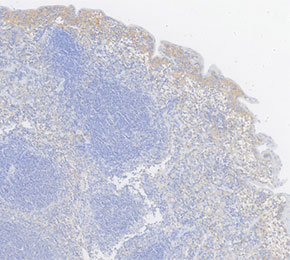 Immunohistochemical analysis of formalin fixed paraffin embedded mouse spleen tissue with F0040 at 1:100 dilution.
Experiment Essentials
This antibody requires an anti-rat secondary antibody.
Usage Information
| Dilution |
|---|
|
| Application |
|---|
| IP, IHC, FCM |
| Reactivity |
|---|
| Mouse |
| Source |
|---|
| Rat Monoclonal Antibody |
| Storage Buffer |
|---|
| PBS, pH 7.2+50% Glycerol+0.05% BSA+0.01% NaN3 |
| Storage (from the date of receipt) |
|---|
| -20°C (avoid freeze-thaw cycles), 2 years |
| Predicted MW |
|---|
| 165-170 kDa |
| Positive Control | Mouse bone marrow; Mouse spleen tissue |
|---|---|
| Negative Control |
Experimental Methods
| IHC |
|---|
Experimental Protocol:
Deparaffinization/Rehydration
1. Deparaffinize/hydrate sections:
2. Incubate sections in three washes of xylene for 5 min each.
3. Incubate sections in two washes of 100% ethanol for 10 min each.
4. Incubate sections in two washes of 95% ethanol for 10 min each.
5. Wash sections two times in dH2O for 5 min each.
6.Antigen retrieval: For Citrate: Heat slides in a microwave submersed in 1X citrate unmasking solution until boiling is initiated; continue with 10 min at a sub-boiling temperature (95°-98°C). Cool slides on bench top for 30 min.
Staining
1. Wash sections in dH2O three times for 5 min each.
2. Incubate sections in 3% hydrogen peroxide for 10 min.
3. Wash sections in dH2O two times for 5 min each.
4. Wash sections in wash buffer for 5 min.
5. Block each section with 100–400 µl of blocking solution for 1 hr at room temperature.
6. Remove blocking solution and add 100–400 µl primary antibody diluent in to each section. Incubate overnight at 4°C.
7. Remove antibody solution and wash sections with wash buffer three times for 5 min each.
8. Cover section with 1–3 drops HRPas needed. Incubate in a humidified chamber for 30 min at room temperature.
9. Wash sections three times with wash buffer for 5 min each.
10. Add DAB Chromogen Concentrate to DAB Diluent and mix well before use.
11. Apply 100–400 µl DAB to each section and monitor closely. 1–10 min generally provides an acceptable staining intensity.
12. Immerse slides in dH2O.
13. If desired, counterstain sections with hematoxylin.
14. Wash sections in dH2O two times for 5 min each.
15. Dehydrate sections: Incubate sections in 95% ethanol two times for 10 sec each; Repeat in 100% ethanol, incubating sections two times for 10 sec each; Repeat in xylene, incubating sections two times for 10 sec each.
16. Mount sections with coverslips and mounting medium.
|
Biological Description
| Specificity |
|---|
| CD11b Antibody [F15D4] detects endogenous levels of total CD11b protein. |
| Subcellular Location |
|---|
| Cytoplasm, Nucleus |
| Uniprot ID |
|---|
| P21127 |
| Clone |
|---|
| F15D4 |
| Synonym(s) |
|---|
| CD11 antigen-like family member B; CD11B (p170); cell surface glycoprotein MAC-1 alpha subunit; cell surface glycoprotein MAC-1 subunit alpha; complement component receptor 3 alpha-a; Mac1A; Cd11b; CD11b/CD18; CR3; CR3A; F730045J24Rik; Ly-40; Mac-1; Mac-1a; MAC1 |
| Background |
|---|
| CD11b, also known as integrin alpha M (ITGAM), is a transmembrane alpha chain protein that non-covalently heterodimerizes with the beta-2 chain CD18 to form the Mac-1 (αMβ2 or CR3) integrin, which is prominently expressed on myeloid cells such as neutrophils, monocytes, macrophages, and dendritic cells, serving as a key marker for these innate immune populations. This integrin contains a β-propeller domain and a ligand-binding inserted (I/A) domain in its alpha subunit, allowing interactions with diverse ligands including iC3b, ICAM-1, and fibrinogen. Disease-associated ITGAM variants such as R77H (rs1143679), P1146S (rs1143678), and A858V (rs1143683) subtly alter the β-propeller structure, reducing ligand affinity without significantly affecting surface expression. CD11b mediates proinflammatory processes like leukocyte adhesion, migration, transmigration, and phagocytosis of opsonized particles (apoptotic cells and immune complexes), while also exerting important anti-inflammatory effects by negatively regulating Toll-like receptor (TLR) signaling, via Src/Syk-mediated phosphorylation and Cbl-b-dependent ubiquitination and degradation of MyD88 and TRIF, to suppress NF-κB activation and proinflammatory cytokine production (IL-6, TNF-α, IL-1β). CD11b also curtails type I interferon (IFN-I) production through an AKT/FOXO3/IRF3/7 pathway, maintaining nuclear FOXO3 to repress IRF7 and IFN-β/IRF7 expression; this mechanism is defective in ITGAM variant carriers, leading to elevated basal IFN-I, uncontrolled TLR responses, impaired B-cell tolerance, enhanced autoreactive B-cell activation, and increased Th17 differentiation. These immune dysregulations confer a high genetic risk for systemic lupus erythematosus (SLE) and lupus nephritis (LN), with ITGAM variants being associated with higher IFN-I serum levels, renal involvement, autoantibody production, glomerular injury, and poor immune complex clearance. |
| References |
|---|
|
Tech Support
Tel: +1-832-582-8158 Ext:3
If you have any other enquiries, please leave a message.

Products are for research use only. Not for human use. We do not sell to patients.
©Copyright 2013 Selleck Chemicals. All Rights Reserved.