
-
 Argentina
-
 Australia
-
 Austria
-
 Belgium
-
 Brazil
-
 Canada
-
 China
China
-
 Czech Republic
-
 Denmark
-
 Finland
-
 France
-
 Germany
-
 Greece
-
 Hong Kong
-
 Hungary
-
 Iceland
-
 India
India
-
 Ireland
-
 Israel
-
 Italy
Italy
-
 Japan
Japan
-
 Korea
Korea
-
 Luxembourg
-
 Malaysia
-
 Netherlands
-
 New Zealand
-
 Norway
-
 Poland
-
 Portugal
-
 Qatar
Qatar
-
 Romania
-
 Saudi Arabia
-
 Singapore
-
 Spain
Spain
-
 Sweden
-
 Switzerland
-
 Taiwan
-
 Turkey
-
 United Kingdom
-
 United States
research use only
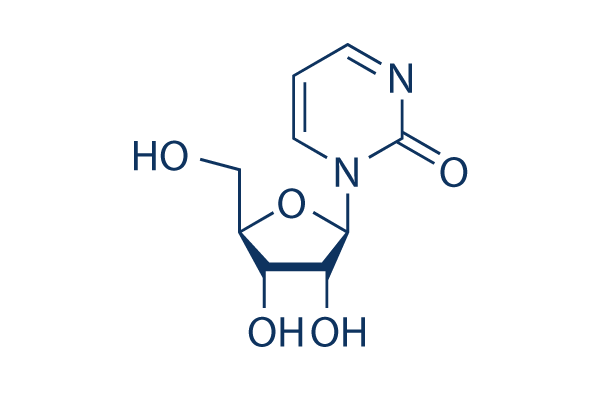
Zebularine (NSC 309132) DNA Methyltransferase inhibitor
Cat.No.S7113
Quality Control
| Related Targets | HDAC JAK BET Histone Methyltransferase PKC PARP HIF PRMT EZH2 AMPK |
|---|---|
| Other DNA Methyltransferase Inhibitors | RG108 (N-Phthalyl-L-Tryptophan) SGI-1027 GSK3685032 Gamma-Oryzanol β-thujaplicin CM272 Bobcat339 GSK-3484862 DC-05 2'-Deoxy-5-Fluorocytidine |
Cell Culture, Treatment & Working Concentration
| Cell Lines | Assay Type | Concentration | Incubation Time | Formulation | Activity Description | PMID |
|---|---|---|---|---|---|---|
| human T24 cells | Function assay | 100 μM | 8 days | Induction of p16 gene expression in human T24 cells at 100 uM after 8 days by real time PCR in presence of 100 mM thymidine | ||
| human HCT15 cells | Function assay | 100 μM | 8 days | Induction of p16 gene expression in human HCT15 cells at 100 uM after 8 days by real time PCR in presence of 100 mM thymidine | ||
| Click to View More Cell Line Experimental Data | ||||||
Solubility
|
In vitro |
DMSO
: 46 mg/mL
(201.57 mM)
Water : 46 mg/mL Ethanol : Insoluble |
Molarity Calculator
|
In vivo |
|||||
In vivo Formulation Calculator (Clear solution)
Step 1: Enter information below (Recommended: An additional animal making an allowance for loss during the experiment)
Step 2: Enter the in vivo formulation (This is only the calculator, not formulation. Please contact us first if there is no in vivo formulation at the solubility Section.)
Calculation results:
Working concentration: mg/ml;
Method for preparing DMSO master liquid: mg drug pre-dissolved in μL DMSO ( Master liquid concentration mg/mL, Please contact us first if the concentration exceeds the DMSO solubility of the batch of drug. )
Method for preparing in vivo formulation: Take μL DMSO master liquid, next addμL PEG300, mix and clarify, next addμL Tween 80, mix and clarify, next add μL ddH2O, mix and clarify.
Method for preparing in vivo formulation: Take μL DMSO master liquid, next add μL Corn oil, mix and clarify.
Note: 1. Please make sure the liquid is clear before adding the next solvent.
2. Be sure to add the solvent(s) in order. You must ensure that the solution obtained, in the previous addition, is a clear solution before proceeding to add the next solvent. Physical methods such
as vortex, ultrasound or hot water bath can be used to aid dissolving.
Chemical Information, Storage & Stability
| Molecular Weight | 228.2 | Formula | C9H12N2O5 |
Storage (From the date of receipt) | |
|---|---|---|---|---|---|
| CAS No. | 3690-10-6 | Download SDF | Storage of Stock Solutions |
|
|
| Synonyms | 4-Deoxyuridine | SMILES | C1=CN(C(=O)N=C1)C2C(C(C(O2)CO)O)O | ||
Read more about storage stability stock solution CAS number SMILES
Mechanism of Action
| Features |
Very stable with half-life of ~44 h at 37°C in PBS at pH 1.0 and approx. 508 h at pH 7.
|
|---|---|
| Targets/IC50/Ki |
DNA methyltransferase
(Cell-free assay) Cytidine deaminase
(Cell-free assay) 2 μM(Ki)
|
| In vitro |
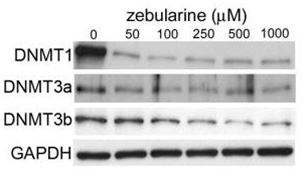
Zebularine (NSC 309132) is a cytidine analogue containing a 2-(1H)-pyrimidinone ring, originally synthesized as a cytidine deaminase inhibitor. It is shown to form a tight, covalent complex with bacterial methyltransferases. In N. crassa, this compound inhibits DNA methylation and reactivates a gene previously silenced by methylation. It is a global inhibitor of DNA methylation, similar to 5-Aza-CR, rather than a selective inhibitor. Zebularine induces the myogenic phenotype in 10T1/2 cells, which is a phenomenon unique to DNA methylation inhibitors. It reactivates a silenced p16 gene and demethylates its promoter region in T24 bladder carcinoma cells, and is only slightly cytotoxic to T24 cells. This compound is preferentially incorporated into DNA and exhibits greater cell growth inhibition and gene expression in cancer cell lines compared to normal fibroblasts. In addition, it preferentially depletes DNA methyltransferase 1 (DNMT1) and induces expression of cancer-related antigen genes in cancer cells relative to normal fibroblasts.
|
| In vivo |
Zebularine (NSC 309132) is only slightly cytotoxic to tumor-bearing mice (average maximal weight change in mice treated with 1000 mg/kg of this compound = 11% [95% CI = 4% to 19%]). Compared with those in control mice, tumor volumes are statistically significantly reduced in mice treated with high-dose zebularine administered by intraperitoneal injection or by oral gavage.
|
References |
|
Applications
| Methods | Biomarkers | Images | PMID |
|---|---|---|---|
| Western blot | DNMT1 / DNMT3a / DNMT3b CDK2 / p-Rb / Rb MeCP2 / MBD2 / MBD3 / Acetyl-H3 / Acetyl-H4 |
|
23320119 |
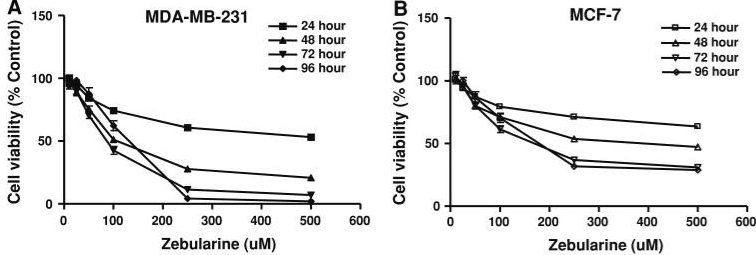
| Growth inhibition assay | Cell viability |
|
19459041 |
Tech Support
Tel: +1-832-582-8158 Ext:3
If you have any other enquiries, please leave a message.
Signaling Pathway Map

Products are for research use only. Not for human use. We do not sell to patients.
©Copyright 2013 Selleck Chemicals. All Rights Reserved.