
-
 Argentina
-
 Australia
-
 Austria
-
 Belgium
-
 Brazil
-
 Canada
-
 China
China
-
 Czech Republic
-
 Denmark
-
 Finland
-
 France
-
 Germany
-
 Greece
-
 Hong Kong
-
 Hungary
-
 Iceland
-
 India
India
-
 Ireland
-
 Israel
-
 Italy
Italy
-
 Japan
Japan
-
 Korea
Korea
-
 Luxembourg
-
 Malaysia
-
 Netherlands
-
 New Zealand
-
 Norway
-
 Poland
-
 Portugal
-
 Qatar
Qatar
-
 Romania
-
 Saudi Arabia
-
 Singapore
-
 Spain
Spain
-
 Sweden
-
 Switzerland
-
 Taiwan
-
 Turkey
-
 United Kingdom
-
 United States
research use only
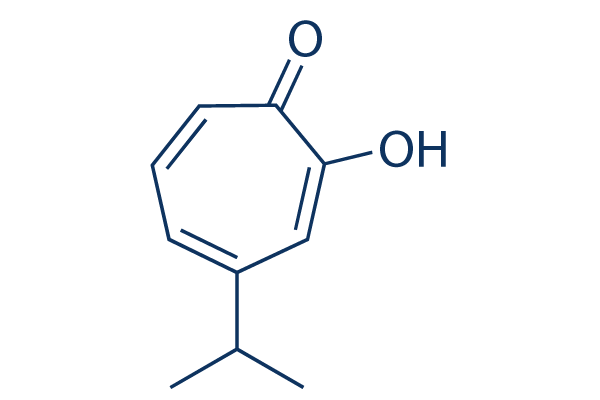
β-thujaplicin DNA Methyltransferase inhibitor
Cat.No.S4771
Quality Control
| Related Targets | HDAC JAK BET Histone Methyltransferase PKC PARP HIF PRMT EZH2 AMPK |
|---|---|
| Other DNA Methyltransferase Inhibitors | RG108 (N-Phthalyl-L-Tryptophan) SGI-1027 Zebularine (NSC 309132) GSK3685032 Gamma-Oryzanol CM272 Bobcat339 GSK-3484862 DC-05 2'-Deoxy-5-Fluorocytidine |
Solubility
|
In vitro |
DMSO
: 32 mg/mL
(194.88 mM)
|
Molarity Calculator
|
In vivo |
|||||
In vivo Formulation Calculator (Clear solution)
Step 1: Enter information below (Recommended: An additional animal making an allowance for loss during the experiment)
Step 2: Enter the in vivo formulation (This is only the calculator, not formulation. Please contact us first if there is no in vivo formulation at the solubility Section.)
Calculation results:
Working concentration: mg/ml;
Method for preparing DMSO master liquid: mg drug pre-dissolved in μL DMSO ( Master liquid concentration mg/mL, Please contact us first if the concentration exceeds the DMSO solubility of the batch of drug. )
Method for preparing in vivo formulation: Take μL DMSO master liquid, next addμL PEG300, mix and clarify, next addμL Tween 80, mix and clarify, next add μL ddH2O, mix and clarify.
Method for preparing in vivo formulation: Take μL DMSO master liquid, next add μL Corn oil, mix and clarify.
Note: 1. Please make sure the liquid is clear before adding the next solvent.
2. Be sure to add the solvent(s) in order. You must ensure that the solution obtained, in the previous addition, is a clear solution before proceeding to add the next solvent. Physical methods such
as vortex, ultrasound or hot water bath can be used to aid dissolving.
Chemical Information, Storage & Stability
| Molecular Weight | 164.20 | Formula | C10H12O2 |
Storage (From the date of receipt) | |
|---|---|---|---|---|---|
| CAS No. | 499-44-5 | Download SDF | Storage of Stock Solutions |
|
|
| Synonyms | Hinokitiol, 4-Isopropyltropolone | SMILES | CC(C)C1=CC(=O)C(=CC=C1)O | ||
Read more about storage stability stock solution CAS number SMILES
Mechanism of Action
| In vitro |
In lung cancer cells, hinokitiol inhibits cell proliferation by inducing the p53-independent DNA damage response, autophagy (not apoptosis), S-phase cell cycle arrest, and senescence. Hinokitiol induces autophagy in lung adenocarcinoma cells but not in human lung stromal fibroblasts. It induces cellular senescence in both human lung cancer cells and lung stromal fibroblasts. Treatment with hinokitiol reveals a concentration-dependent inhibition of migration of B16-F10 melanoma cells. It appears to achieve this effect by reducing the expression of MMP-1 and by suppressing the phosphorylation of mitogen- activated protein kinase (MAPK) signaling molecules such as extracellular signal-regulated kinase (ERK) 1/2, p38 MAPK and c-Jun N-terminal kinases (JNK). On the other hand, hinokitiol treatment reverses IκB-α degradation and inhibits the phosphorylation of p65 nuclear factor kappa B (NF-κB) and cJun in B16-F10 cells. In addition, hinokitiol suppresses the translocation of p65 NF-κB from the cytosol to the nucleus, suggesting reduced NF-κB activation.
|
|---|---|
| In vivo |
Hinokitiol reduces tumor growth, potentially through the attenuation of tumorigenicity, and induces DNA damage and autophagy to suppress tumor progression. In vivo study demonstrates that hinokitiol treatment significantly reduces the total number of mouse lung metastatic nodules and improves histological alterations in B16-F10 injected C57BL/6 mice.
|
References |
|
Tech Support
Tel: +1-832-582-8158 Ext:3
If you have any other enquiries, please leave a message.
Signaling Pathway Map

Products are for research use only. Not for human use. We do not sell to patients.
©Copyright 2013 Selleck Chemicals. All Rights Reserved.