
-
 Argentina
-
 Australia
-
 Austria
-
 Belgium
-
 Brazil
-
 Canada
-
 China
China
-
 Czech Republic
-
 Denmark
-
 Finland
-
 France
-
 Germany
-
 Greece
-
 Hong Kong
-
 Hungary
-
 Iceland
-
 India
India
-
 Ireland
-
 Israel
-
 Italy
Italy
-
 Japan
Japan
-
 Korea
Korea
-
 Luxembourg
-
 Malaysia
-
 Netherlands
-
 New Zealand
-
 Norway
-
 Poland
-
 Qatar
Qatar
-
 Romania
-
 Saudi Arabia
-
 Singapore
-
 Spain
Spain
-
 Sweden
-
 Switzerland
-
 Taiwan
-
 Turkey
-
 United Kingdom
-
 United States
research use only
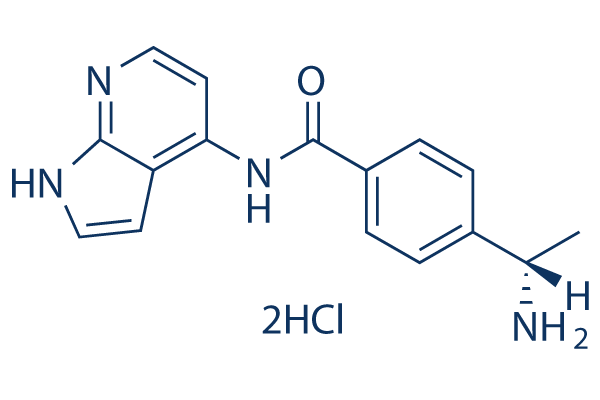
Y-39983 Dihydrochloride ROCK inhibitor
Cat.No.S7935
Quality Control
Cell Culture, Treatment & Working Concentration
| Cell Lines | Assay Type | Concentration | Incubation Time | Formulation | Activity Description | PMID |
|---|---|---|---|---|---|---|
| TM1 | Function assay | Disruption of trabecular meshwork in human TM1 cells assessed as actin fiber length and focal adhesions by Hoechst staining based analysis, IC50 = 0.278 μM. | 27072905 | |||
| GTM3 | Function assay | 2 days | Inhibition of ROCK-2 in human GTM3 cells measured up to 2 days by cell impedance assay, EC50 = 0.15 μM. | 24684843 | ||
| GTM3 | Function assay | Inhibition of ROCK1 in human GTM3 cells by impedance assay, EC50 = 0.79 μM. | 20434334 | |||
| SJ-GBM2 | qHTS assay | qHTS of pediatric cancer cell lines to identify multiple opportunities for drug repurposing: Primary screen for SJ-GBM2 cells | 29435139 | |||
| A673 | qHTS assay | qHTS of pediatric cancer cell lines to identify multiple opportunities for drug repurposing: Primary screen for A673 cells | 29435139 | |||
| SK-N-MC | qHTS assay | qHTS of pediatric cancer cell lines to identify multiple opportunities for drug repurposing: Primary screen for SK-N-MC cells | 29435139 | |||
| Saos-2 | qHTS assay | qHTS of pediatric cancer cell lines to identify multiple opportunities for drug repurposing: Primary screen for Saos-2 cells | 29435139 | |||
| SK-N-SH | qHTS assay | qHTS of pediatric cancer cell lines to identify multiple opportunities for drug repurposing: Primary screen for SK-N-SH cells | 29435139 | |||
| LAN-5 | qHTS assay | qHTS of pediatric cancer cell lines to identify multiple opportunities for drug repurposing: Primary screen for LAN-5 cells | 29435139 | |||
| Click to View More Cell Line Experimental Data | ||||||
Solubility
|
In vitro |
DMSO
: 63 mg/mL
(178.34 mM)
Water : 63 mg/mL Ethanol : 2 mg/mL |
Molarity Calculator
|
In vivo |
|||||
In vivo Formulation Calculator (Clear solution)
Step 1: Enter information below (Recommended: An additional animal making an allowance for loss during the experiment)
Step 2: Enter the in vivo formulation (This is only the calculator, not formulation. Please contact us first if there is no in vivo formulation at the solubility Section.)
Calculation results:
Working concentration: mg/ml;
Method for preparing DMSO master liquid: mg drug pre-dissolved in μL DMSO ( Master liquid concentration mg/mL, Please contact us first if the concentration exceeds the DMSO solubility of the batch of drug. )
Method for preparing in vivo formulation: Take μL DMSO master liquid, next addμL PEG300, mix and clarify, next addμL Tween 80, mix and clarify, next add μL ddH2O, mix and clarify.
Method for preparing in vivo formulation: Take μL DMSO master liquid, next add μL Corn oil, mix and clarify.
Note: 1. Please make sure the liquid is clear before adding the next solvent.
2. Be sure to add the solvent(s) in order. You must ensure that the solution obtained, in the previous addition, is a clear solution before proceeding to add the next solvent. Physical methods such
as vortex, ultrasound or hot water bath can be used to aid dissolving.
Chemical Information, Storage & Stability
| Molecular Weight | 353.25 | Formula | C16H16N4O.2HCl |
Storage (From the date of receipt) | |
|---|---|---|---|---|---|
| CAS No. | 173897-44-4 | Download SDF | Storage of Stock Solutions |
|
|
| Synonyms | Y-33075 Dihydrochloride | SMILES | CC(C1=CC=C(C=C1)C(=O)NC2=C3C=CNC3=NC=C2)N.Cl.Cl | ||
Read more about storage stability stock solution CAS number SMILES
Mechanism of Action
| Targets/IC50/Ki |
ROCK
(Cell-free assay) 3.6 nM
|
|---|---|
| In vitro |
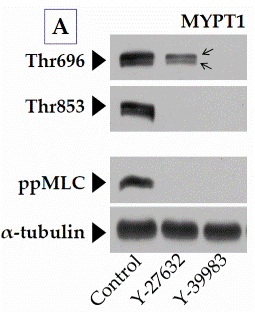
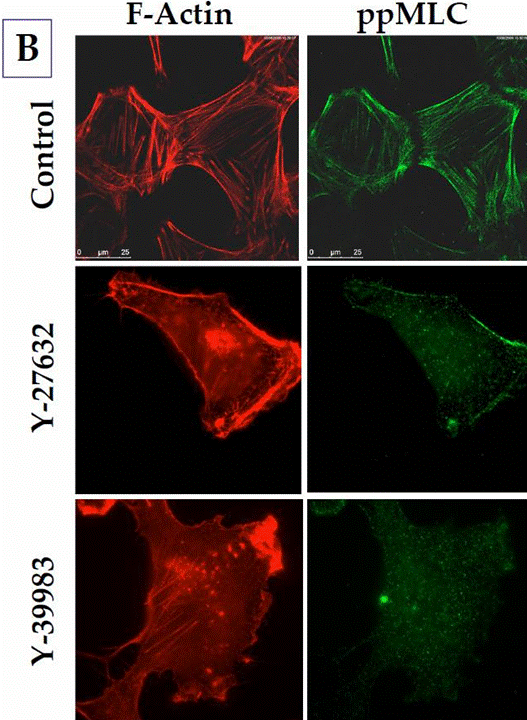
Y-39983 opposes ROCK-dependent phosphorylation of MYPT1 predominantly at Thr853 with a corresponding decrease in MLC phosphorylation. It reduces the phosphorylation at Thr696 and Thr853 and leads to reduced actomyosin contraction. Y-39983 shows an IC50 of ~200 nM for dephosphorylation at Thr696 and only 15 nM for dephosphorylation at Thr853. The IC50 for dephosphorylation of MLC is 14 nM. |
| In vivo |
Y-39983 significantly suppresses clinical symptoms of EAE and prevents its relapse while increasing the amount of myelin proteins. Its treatment results in reduced demyelination with no significant change in axonal damage, which may be due to the inactivation of ROCK substrates, including phosphorylated (p)-MLC, LIMK2 and CRMP-2, which are important for neurite outgrowth, growth cone collapse and remyelination of oligodendrocytes. |
References |
|
Applications
| Methods | Biomarkers | Images | PMID |
|---|---|---|---|
| Western blot | p-MYPT1 / ppMLC |
|
21850162 |
| Immunofluorescence | F-actin / ppMLC |
|
21850162 |
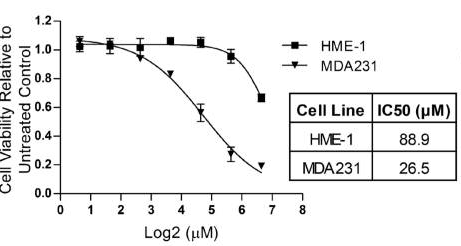
| Growth inhibition assay | Cell viability |
|
27487152 |
Tech Support
Tel: +1-832-582-8158 Ext:3
If you have any other enquiries, please leave a message.
Signaling Pathway Map

Products are for research use only. Not for human use. We do not sell to patients.
©Copyright 2013 Selleck Chemicals. All Rights Reserved.