
-
 Argentina
-
 Australia
-
 Austria
-
 Belgium
-
 Brazil
-
 Canada
-
 China
China
-
 Czech Republic
-
 Denmark
-
 Finland
-
 France
-
 Germany
-
 Greece
-
 Hong Kong
-
 Hungary
-
 Iceland
-
 India
India
-
 Ireland
-
 Israel
-
 Italy
Italy
-
 Japan
Japan
-
 Korea
Korea
-
 Luxembourg
-
 Malaysia
-
 Netherlands
-
 New Zealand
-
 Norway
-
 Poland
-
 Portugal
-
 Qatar
Qatar
-
 Romania
-
 Saudi Arabia
-
 Singapore
-
 Spain
Spain
-
 Sweden
-
 Switzerland
-
 Taiwan
-
 Turkey
-
 United Kingdom
-
 United States
research use only
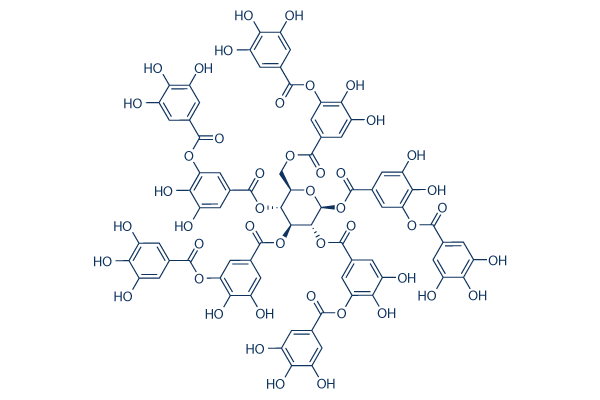
Tannic acid CXCR inhibitor
Cat.No.S3951
Quality Control
| Related Targets | PD-1/PD-L1 STING AhR Immunology & Inflammation related CD markers Interleukins Anti-infection Antioxidant COX Histamine Receptor |
|---|---|
| Other CXCR Inhibitors | AZD5069 SB 225002 Reparixin (Repertaxin) WZ811 Navarixin (SCH-527123) LIT-927 AMG 487 SX-682 SB 265610 LY2510924 |
Cell Culture, Treatment & Working Concentration
| Cell Lines | Assay Type | Concentration | Incubation Time | Formulation | Activity Description | PMID |
|---|---|---|---|---|---|---|
| CHO | Function assay | Ki values for sodium fluorescein (10 uM) uptake in OATP1B1-transfected CHO cells, Ki = 1.46 μM. | 23571415 | |||
| CHO | Function assay | pIC50 values for sodium fluorescein (10 uM) uptake in OATP1B1-transfected CHO cells, IC50 = 2.63027 μM. | 23571415 | |||
| CHO | Function assay | Ki values for sodium fluorescein (10 uM) uptake in OATP1B3-transfected CHO cells, Ki = 3.23 μM. | 23571415 | |||
| CHO | Function assay | pIC50 values for sodium fluorescein (10 uM) uptake in OATP1B3-transfected CHO cells, IC50 = 4.16869 μM. | 23571415 | |||
| Click to View More Cell Line Experimental Data | ||||||
Solubility
|
In vitro |
DMSO
: 94 mg/mL
(55.25 mM)
Water : 94 mg/mL Ethanol : 50 mg/mL |
Molarity Calculator
|
In vivo |
|||||
In vivo Formulation Calculator (Clear solution)
Step 1: Enter information below (Recommended: An additional animal making an allowance for loss during the experiment)
Step 2: Enter the in vivo formulation (This is only the calculator, not formulation. Please contact us first if there is no in vivo formulation at the solubility Section.)
Calculation results:
Working concentration: mg/ml;
Method for preparing DMSO master liquid: mg drug pre-dissolved in μL DMSO ( Master liquid concentration mg/mL, Please contact us first if the concentration exceeds the DMSO solubility of the batch of drug. )
Method for preparing in vivo formulation: Take μL DMSO master liquid, next addμL PEG300, mix and clarify, next addμL Tween 80, mix and clarify, next add μL ddH2O, mix and clarify.
Method for preparing in vivo formulation: Take μL DMSO master liquid, next add μL Corn oil, mix and clarify.
Note: 1. Please make sure the liquid is clear before adding the next solvent.
2. Be sure to add the solvent(s) in order. You must ensure that the solution obtained, in the previous addition, is a clear solution before proceeding to add the next solvent. Physical methods such
as vortex, ultrasound or hot water bath can be used to aid dissolving.
Chemical Information, Storage & Stability
| Molecular Weight | 1701.2 | Formula | C76H52O46 |
Storage (From the date of receipt) | |
|---|---|---|---|---|---|
| CAS No. | 1401-55-4 | Download SDF | Storage of Stock Solutions |
|
|
| Synonyms | Gallotannic acid | SMILES | C1=C(C=C(C(=C1O)O)O)C(=O)OC2=CC(=CC(=C2O)O)C(=O)OCC3C(C(C(C(O3)OC(=O)C4=CC(=C(C(=C4)OC(=O)C5=CC(=C(C(=C5)O)O)O)O)O)OC(=O)C6=CC(=C(C(=C6)OC(=O)C7=CC(=C(C(=C7)O)O)O)O)O)OC(=O)C8=CC(=C(C(=C8)OC(=O)C9=CC(=C(C(=C9)O)O)O)O)O)OC(=O)C1=CC(=C(C(=C1)OC(=O)C1=CC(=C(C(=C1)O)O)O)O)O | ||
Read more about storage stability stock solution CAS number SMILES
Mechanism of Action
| Targets/IC50/Ki |
CXCR4
|
|---|---|
| In vitro |
Tannic acid, at nontoxic concentrations, specifically inhibits CXCL12-induced human monocyte migration (IC50, 7.5 μg/ml) but does not inhibit CCL2-, CCL3-, CCL5-, formylmethionylleucylphenylalanine (fMLP)-, or C5a-induced migration. This compound markedly blocks CXCL12 binding to THP-1 cells (IC50, 0.36 μg/ml). It also inhibits CXCL12-induced, but not epidermal growth factor-induced, migration of MDA 231 breast tumor cells. Additionally, 0.5 μg/ml of this chemical selectively inhibits CXCL12-mediated, but not basic fibroblast growth factor- or endothelial cell growth supplement-mediated, bovine aorta endothelial cell capillary tube formation.
|
| In vivo |
Given in drinking water, this compound enhances the survival rate of mice bearing syngeneic tumors.
|
References |
Tech Support
Tel: +1-832-582-8158 Ext:3
If you have any other enquiries, please leave a message.
Signaling Pathway Map

Products are for research use only. Not for human use. We do not sell to patients.
©Copyright 2013 Selleck Chemicals. All Rights Reserved.