
-
 Argentina
-
 Australia
-
 Austria
-
 Belgium
-
 Brazil
-
 Canada
-
 China
China
-
 Czech Republic
-
 Denmark
-
 Finland
-
 France
-
 Germany
-
 Greece
-
 Hong Kong
-
 Hungary
-
 Iceland
-
 India
India
-
 Ireland
-
 Israel
-
 Italy
Italy
-
 Japan
Japan
-
 Korea
Korea
-
 Luxembourg
-
 Malaysia
-
 Netherlands
-
 New Zealand
-
 Norway
-
 Poland
-
 Portugal
-
 Qatar
Qatar
-
 Romania
-
 Saudi Arabia
-
 Singapore
-
 Spain
Spain
-
 Sweden
-
 Switzerland
-
 Taiwan
-
 Turkey
-
 United Kingdom
-
 United States
research use only
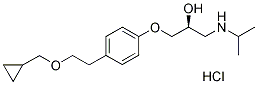
Levobetaxolol HCl Adrenergic Receptor antagonist
Cat.No.S4085
Quality Control
| Related Targets | CXCR Hedgehog/Smoothened PKA AChR 5-HT Receptor Histamine Receptor Dopamine Receptor Ras KRas GPR |
|---|---|
| Other Adrenergic Receptor Inhibitors | ICI 118551 Hydrochloride (Zenidolol) L755507 Yohimbine HCl Atipamezole Higenamine hydrochloride Noradrenaline bitartrate monohydrate Fenoterol hydrobromide Medetomidine HCl Isoprenaline L-Adrenaline |
Solubility
|
In vitro |
DMSO
: 69 mg/mL
(200.64 mM)
Water : 69 mg/mL Ethanol : 69 mg/mL |
Molarity Calculator
|
In vivo |
|||||
In vivo Formulation Calculator (Clear solution)
Step 1: Enter information below (Recommended: An additional animal making an allowance for loss during the experiment)
Step 2: Enter the in vivo formulation (This is only the calculator, not formulation. Please contact us first if there is no in vivo formulation at the solubility Section.)
Calculation results:
Working concentration: mg/ml;
Method for preparing DMSO master liquid: mg drug pre-dissolved in μL DMSO ( Master liquid concentration mg/mL, Please contact us first if the concentration exceeds the DMSO solubility of the batch of drug. )
Method for preparing in vivo formulation: Take μL DMSO master liquid, next addμL PEG300, mix and clarify, next addμL Tween 80, mix and clarify, next add μL ddH2O, mix and clarify.
Method for preparing in vivo formulation: Take μL DMSO master liquid, next add μL Corn oil, mix and clarify.
Note: 1. Please make sure the liquid is clear before adding the next solvent.
2. Be sure to add the solvent(s) in order. You must ensure that the solution obtained, in the previous addition, is a clear solution before proceeding to add the next solvent. Physical methods such
as vortex, ultrasound or hot water bath can be used to aid dissolving.
Chemical Information, Storage & Stability
| Molecular Weight | 343.89 | Formula | C18H29NO3.HCl |
Storage (From the date of receipt) | |
|---|---|---|---|---|---|
| CAS No. | 116209-55-3 | Download SDF | Storage of Stock Solutions |
|
|
| Synonyms | AL 1577A,(S)-Betaxolol hydrochloride | SMILES | CC(C)NCC(COC1=CC=C(C=C1)CCOCC2CC2)O.Cl | ||
Read more about storage stability stock solution CAS number SMILES
Mechanism of Action
| Features |
An estimated 89-fold more β1-selective vs. β2.
|
|---|---|
| Targets/IC50/Ki |
β1-adrenergic receptor
0.76 nM(Ki)
β2-adrenergic receptor
32.6 nM(Ki)
|
| In vitro |
Levobetaxolol potently antagonizes functional activities at cloned human β1 and β2 receptors, and also at guinea pig atrial β1, tracheal β2 and rat colonic β3 receptors with IC50s of 33.2 nM, 2970 nM and 709 nM, respectively. Levobetaxolol (Ki = 16.4 nM) is more potent than dextrobetaxolol (Ki = 2.97 μM) at inhibiting isoproterenol-induced cAMP production in human non-pigmented ciliary epithelial cells. Levobetaxolol (topically applied) has been shown to reach the back of the eye in sufficient quantities to protect retinal ganglion cells from various types of insults. Levobetaxolol displaces [3H]-nitrendipine for L-type voltage-dependent calcium channel receptor with IC50 of 29.5 μM in rat cortex. Levobetaxolol reduces NMDA-stimulated 45Ca2+ influx by 47.3%. Levobetaxolol (topically applied) reduces the b-wave amplitude caused by ischaemia/reperfusion. |
| In vivo |
Levobetaxolol (150 mg/eye) is more potent than dextrobetaxolol, reducing intraocular pressure by 25.9% in conscious ocular hypertensive cynomolgus monkeys. Levobetaxolol (20 mg/kg) significant protects retinal function and results in significantly thicker the RPE and outer nuclear layer in a photic-induced retinopathy rat model. Levobetaxolol (20 mg/kg) results in a 10-fold up-regulation of bFGF and a two-fold up-regulation of CNTF mRNA levels, trophic factors that have been shown to inhibit retinal degeneration in a number of species. |
References |
|
Tech Support
Tel: +1-832-582-8158 Ext:3
If you have any other enquiries, please leave a message.
Signaling Pathway Map

Products are for research use only. Not for human use. We do not sell to patients.
©Copyright 2013 Selleck Chemicals. All Rights Reserved.