
-
 Argentina
-
 Australia
-
 Austria
-
 Belgium
-
 Brazil
-
 Canada
-
 China
China
-
 Czech Republic
-
 Denmark
-
 Finland
-
 France
-
 Germany
-
 Greece
-
 Hong Kong
-
 Hungary
-
 Iceland
-
 India
India
-
 Ireland
-
 Israel
-
 Italy
Italy
-
 Japan
Japan
-
 Korea
Korea
-
 Luxembourg
-
 Malaysia
-
 Netherlands
-
 New Zealand
-
 Norway
-
 Poland
-
 Qatar
Qatar
-
 Romania
-
 Saudi Arabia
-
 Singapore
-
 Spain
Spain
-
 Sweden
-
 Switzerland
-
 Taiwan
-
 Turkey
-
 United Kingdom
-
 United States
research use only
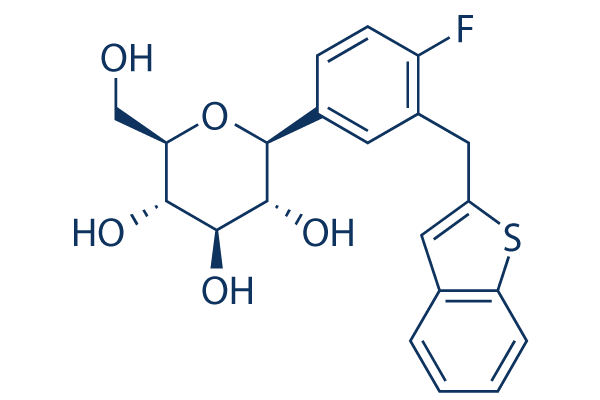
Ipragliflozin (ASP1941) SGLT inhibitor
Cat.No.S8637
Quality Control
Solubility
|
In vitro |
DMSO
: 80 mg/mL
(197.79 mM)
Ethanol : 80 mg/mL Water : Insoluble |
Molarity Calculator
|
In vivo |
|||||
In vivo Formulation Calculator (Clear solution)
Step 1: Enter information below (Recommended: An additional animal making an allowance for loss during the experiment)
Step 2: Enter the in vivo formulation (This is only the calculator, not formulation. Please contact us first if there is no in vivo formulation at the solubility Section.)
Calculation results:
Working concentration: mg/ml;
Method for preparing DMSO master liquid: mg drug pre-dissolved in μL DMSO ( Master liquid concentration mg/mL, Please contact us first if the concentration exceeds the DMSO solubility of the batch of drug. )
Method for preparing in vivo formulation: Take μL DMSO master liquid, next addμL PEG300, mix and clarify, next addμL Tween 80, mix and clarify, next add μL ddH2O, mix and clarify.
Method for preparing in vivo formulation: Take μL DMSO master liquid, next add μL Corn oil, mix and clarify.
Note: 1. Please make sure the liquid is clear before adding the next solvent.
2. Be sure to add the solvent(s) in order. You must ensure that the solution obtained, in the previous addition, is a clear solution before proceeding to add the next solvent. Physical methods such
as vortex, ultrasound or hot water bath can be used to aid dissolving.
Chemical Information, Storage & Stability
| Molecular Weight | 404.45 | Formula | C21H21FOS |
Storage (From the date of receipt) | |
|---|---|---|---|---|---|
| CAS No. | 761423-87-4 | Download SDF | Storage of Stock Solutions |
|
|
| Synonyms | N/A | SMILES | C1=CC=C2C(=C1)C=C(S2)CC3=C(C=CC(=C3)C4C(C(C(C(O4)CO)O)O)O)F | ||
Read more about storage stability stock solution CAS number SMILES
Mechanism of Action
| Targets/IC50/Ki |
mouse SGLT2
(cell-free) 5.64 nM
rat SGLT2
(cell-free) 6.73 nM
hSGLT2
(cell-free) 7.4 nM
|
|---|---|
| In vitro |
Ipragliflozin (ASP1941) concentration-dependently inhibits mouse, rat, and human SGLT2 activity at nanomolar concentrations. Furthermore, it does not potently inhibit human SGLT4 and SGLT5 isoforms (IC50>1,000 nM). In addition, this compound does not inhibit several glucose transporter (GLUT) isoforms, including GLUT1 and GLUT4, in mouse 3T3-L1, rat L6, human Caco-2, and HepG2 cells (IC50>1,000 nM). It does not interact with various receptors, ion channels, and transporters such as adrenergic (α1, α2, and β), muscarinic (M1, M2, and non-selective), angiotensin(AT1 and AT2), calcium channel (L-type and N-type), potassium channel (KATP and SKCa), sodium channel (site 2), cholecystokinin (CCKA and CCKB), dopamine (D1, D2, and transporter), endothelin (ETA and ETB), gamma-aminobutyric acid (GABAA and GABAB), glutamate (AMPA, kainate, and NMDA), serotonin (5-HT1, 5HT2B, and transporter), histamine (H1, H2, and H3), and neurokinin (NK1, NK2, and NK3), exhibiting IC50 values >3,000 nM. It is stable against mouse intestinal glucosidases.
|
| In vivo |
Single oral doses (0.01-10 mg/kg) of ipragliflozin (ASP1941) induce urinary glucose excretion in a dose-dependent manner in both normal and KK-Ay mice, a type 2 diabetes model. Single administrations of this compound (0.1, 0.3 and 1 mg/kg) dose-dependently reduce blood glucose level in both KK-Ay mice and STZ rats. Administration of a single 0.3 mg/kg dose intravenously and a single 1 mg/kg dose orally to rats reveal that it has good bioavailability with a value of 71.7%. It shows good pharmacokinetic properties following oral dosing, and dose-dependently increases urinary glucose excretion, which lasts for over 12 h in normal mice. Single administration results in dose-dependent and sustained antihyperglycemic effects in both diabetic models. It has a low risk of hypoglycemia. After oral administration (3 mg/kg) to normal mice, plasma concentrations reach a maximum at 1 h and then gradually decrease. Obvious plasma concentrations are detected even 8 h after administration. In the pharmacokinetic studies in mice, it shows good oral bioavailability and exhibits high drug concentrations for long periods. The absolute bioavailabilities are 71.7-90.7% and 74.5-75.3% in rats and monkeys, respectively .
|
References |
|
Clinical Trial Information
(data from https://clinicaltrials.gov, updated on 2022-10-04)
| NCT Number | Recruitment | Conditions | Sponsor/Collaborators | Start Date | Phases |
|---|---|---|---|---|---|
| NCT03076112 | COMPLETED | Type 2 Diabetes Mellitus |
Seoul National University Bundang Hospital |
2017-04-25 | PHASE3 |
| NCT03118713 | TERMINATED | Type 2 Diabetes Mellitus |
Astellas Pharma Korea, Inc. |
2017-04-25 | PHASE4 |
| NCT02847091 | COMPLETED | Type 2 Diabetes Mellitus |
Astellas Pharma Inc |
2016-07-29 | PHASE4 |
| NCT02897219 | COMPLETED | Type 1 Diabetes Mellitus |
Astellas Pharma Inc |
2016-08-29 | PHASE3 |
| NCT02875821 | COMPLETED | Type 2 Diabetes With Non-alcoholic Fatty Liver (NAFLD) |
Yonsei University |
2016-04-26 | PHASE4 |
| NCT02564211 | COMPLETED | Type 2 Diabetes Mellitus |
Merck Sharp & Dohme LLC |
2015-10-26 | PHASE3 |
Read more about Clinical Trials
Tech Support
Tel: +1-832-582-8158 Ext:3
If you have any other enquiries, please leave a message.
Signaling Pathway Map

Products are for research use only. Not for human use. We do not sell to patients.
©Copyright 2013 Selleck Chemicals. All Rights Reserved.