
-
 Argentina
-
 Australia
-
 Austria
-
 Belgium
-
 Brazil
-
 Canada
-
 China
China
-
 Czech Republic
-
 Denmark
-
 Finland
-
 France
-
 Germany
-
 Greece
-
 Hong Kong
-
 Hungary
-
 Iceland
-
 India
India
-
 Ireland
-
 Israel
-
 Italy
Italy
-
 Japan
Japan
-
 Korea
Korea
-
 Luxembourg
-
 Malaysia
-
 Netherlands
-
 New Zealand
-
 Norway
-
 Poland
-
 Portugal
-
 Qatar
Qatar
-
 Romania
-
 Saudi Arabia
-
 Singapore
-
 Spain
Spain
-
 Sweden
-
 Switzerland
-
 Taiwan
-
 Turkey
-
 United Kingdom
-
 United States
research use only
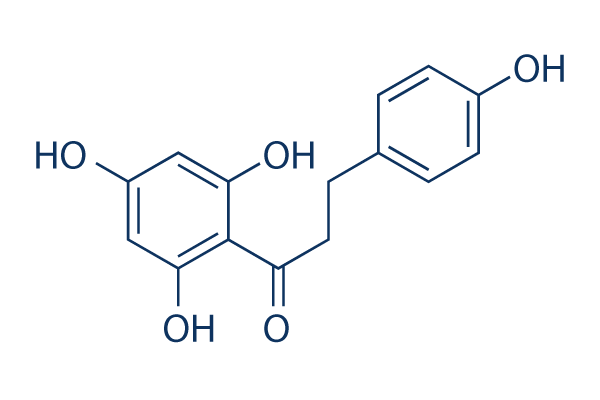
Phloretin (RJC 02792) SGLT inhibitor
Cat.No.S2342
Quality Control
Cell Culture, Treatment & Working Concentration
| Cell Lines | Assay Type | Concentration | Incubation Time | Formulation | Activity Description | PMID |
|---|---|---|---|---|---|---|
| H1299 cells | Function assay | 30 mins | Inhibition of GLUT1 in human H1299 cells assessed as inhibition of 2-deoxy-D-[3H]-glucose uptake incubated for 15 mins prior to 2-deoxy-D-[3H]-glucose addition measured after 30 mins by liquid scintillation counting analysis, IC50=21.4 Μm | |||
| PK15NTD cells | Function assay | Binding affinity to human recombinant CNT3 expressed in pig PK15NTD cells assessed as [3H]uridine uptake by beta-scintillation, Ki=32.28 μM | ||||
| Click to View More Cell Line Experimental Data | ||||||
Solubility
|
In vitro |
DMSO
: 55 mg/mL
(200.53 mM)
Ethanol : 55 mg/mL Water : Insoluble |
Molarity Calculator
|
In vivo |
|||||
In vivo Formulation Calculator (Clear solution)
Step 1: Enter information below (Recommended: An additional animal making an allowance for loss during the experiment)
Step 2: Enter the in vivo formulation (This is only the calculator, not formulation. Please contact us first if there is no in vivo formulation at the solubility Section.)
Calculation results:
Working concentration: mg/ml;
Method for preparing DMSO master liquid: mg drug pre-dissolved in μL DMSO ( Master liquid concentration mg/mL, Please contact us first if the concentration exceeds the DMSO solubility of the batch of drug. )
Method for preparing in vivo formulation: Take μL DMSO master liquid, next addμL PEG300, mix and clarify, next addμL Tween 80, mix and clarify, next add μL ddH2O, mix and clarify.
Method for preparing in vivo formulation: Take μL DMSO master liquid, next add μL Corn oil, mix and clarify.
Note: 1. Please make sure the liquid is clear before adding the next solvent.
2. Be sure to add the solvent(s) in order. You must ensure that the solution obtained, in the previous addition, is a clear solution before proceeding to add the next solvent. Physical methods such
as vortex, ultrasound or hot water bath can be used to aid dissolving.
Chemical Information, Storage & Stability
| Molecular Weight | 274.27 | Formula | C15H14O5 |
Storage (From the date of receipt) | |
|---|---|---|---|---|---|
| CAS No. | 60-82-2 | Download SDF | Storage of Stock Solutions |
|
|
| Synonyms | NSC 407292, Dihydronaringenin | SMILES | C1=CC(=CC=C1CCC(=O)C2=C(C=C(C=C2O)O)O)O | ||
Read more about storage stability stock solution CAS number SMILES
Mechanism of Action
| Targets/IC50/Ki |
SGLT1
SGLT2
|
|---|---|
| In vitro |
Phloretin (RJC 02792) is a dihydrochalcone found in the bark of pear (Pyrus communis), apple, cherry and other fruit trees. It inhibits the active transport of glucose into cells by SGLT1 and SGLT2, though the inhibition is weaker than by its glycoside phlorizin. Orally consumed phlorizin is nearly entirely converted into phloretin by hydrolytic enzymes in the small intestine. An important effect of this is the inhibition of glucose absorption by the small intestine and the inhibition of renal glucose reabsorption. This compound also inhibits a variety of urea transporters. It induces urea loss and diuresis when coupled with high protein diets.
|
References |
|
Clinical Trial Information
(data from https://clinicaltrials.gov, updated on 2024-05-22)
| NCT Number | Recruitment | Conditions | Sponsor/Collaborators | Start Date | Phases |
|---|---|---|---|---|---|
| NCT05073523 | Completed | Healthy |
Chalmers University of Technology |
2021-09-27 | Not Applicable |
Read more about Clinical Trials
Tech Support
Tel: +1-832-582-8158 Ext:3
If you have any other enquiries, please leave a message.
Signaling Pathway Map

Products are for research use only. Not for human use. We do not sell to patients.
©Copyright 2013 Selleck Chemicals. All Rights Reserved.