
-
 Argentina
-
 Australia
-
 Austria
-
 Belgium
-
 Brazil
-
 Canada
-
 China
China
-
 Czech Republic
-
 Denmark
-
 Finland
-
 France
-
 Germany
-
 Greece
-
 Hong Kong
-
 Hungary
-
 Iceland
-
 India
India
-
 Ireland
-
 Israel
-
 Italy
Italy
-
 Japan
Japan
-
 Korea
Korea
-
 Luxembourg
-
 Malaysia
-
 Netherlands
-
 New Zealand
-
 Norway
-
 Poland
-
 Portugal
-
 Qatar
Qatar
-
 Romania
-
 Saudi Arabia
-
 Singapore
-
 Spain
Spain
-
 Sweden
-
 Switzerland
-
 Taiwan
-
 Turkey
-
 United Kingdom
-
 United States
research use only
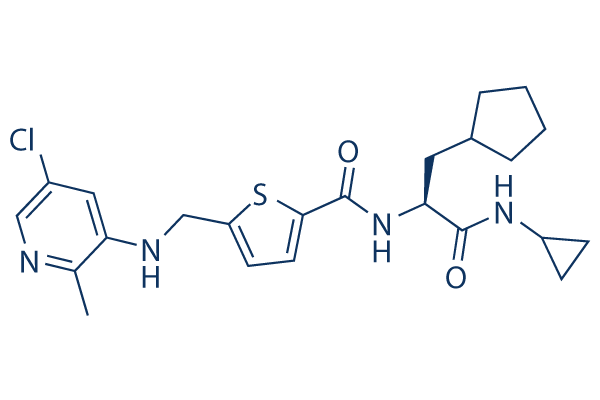
GSK2830371 phosphatase inhibitor
Cat.No.S7573
Quality Control
Cell Culture, Treatment & Working Concentration
| Cell Lines | Assay Type | Concentration | Incubation Time | Formulation | Activity Description | PMID |
|---|---|---|---|---|---|---|
| MCF7 cells | Function assay | 24 h | Inhibition of cell proliferation of human MCF7 cells incubated for 24 hrs, IC50=9.5 μM | 26358280 | ||
| Escherichia coli BL21 (DE3) pLysS cells | Function assay | Inhibition of His-tagged PPM1D (1 to 420 residues) (unknown origin) expressed in Escherichia coli BL21 (DE3) pLysS cells using Ac-VEPPLS(P)QETFSDLW-NH2 substrate, IC50=0.0863 μM | 26358280 | |||
| SF9 | Function assay | 5 mins | Inhibition of human Wip1 (2 to 420 residues) expressed in baculovirus-infected insect SF9 cells assessed as diphosphate hydrolysis after 5 mins by assay, IC50=0.006μM | 26914744 | ||
| Click to View More Cell Line Experimental Data | ||||||
Solubility
|
In vitro |
DMSO
: 92 mg/mL
(199.55 mM)
Ethanol : 92 mg/mL Water : Insoluble |
Molarity Calculator
|
In vivo |
|||||
In vivo Formulation Calculator (Clear solution)
Step 1: Enter information below (Recommended: An additional animal making an allowance for loss during the experiment)
Step 2: Enter the in vivo formulation (This is only the calculator, not formulation. Please contact us first if there is no in vivo formulation at the solubility Section.)
Calculation results:
Working concentration: mg/ml;
Method for preparing DMSO master liquid: mg drug pre-dissolved in μL DMSO ( Master liquid concentration mg/mL, Please contact us first if the concentration exceeds the DMSO solubility of the batch of drug. )
Method for preparing in vivo formulation: Take μL DMSO master liquid, next addμL PEG300, mix and clarify, next addμL Tween 80, mix and clarify, next add μL ddH2O, mix and clarify.
Method for preparing in vivo formulation: Take μL DMSO master liquid, next add μL Corn oil, mix and clarify.
Note: 1. Please make sure the liquid is clear before adding the next solvent.
2. Be sure to add the solvent(s) in order. You must ensure that the solution obtained, in the previous addition, is a clear solution before proceeding to add the next solvent. Physical methods such
as vortex, ultrasound or hot water bath can be used to aid dissolving.
Chemical Information, Storage & Stability
| Molecular Weight | 461.02 | Formula | C23H29ClN4O2S |
Storage (From the date of receipt) | |
|---|---|---|---|---|---|
| CAS No. | 1404456-53-6 | Download SDF | Storage of Stock Solutions |
|
|
| Synonyms | N/A | SMILES | CC1=C(C=C(C=N1)Cl)NCC2=CC=C(S2)C(=O)NC(CC3CCCC3)C(=O)NC4CC4 | ||
Read more about storage stability stock solution CAS number SMILES
Mechanism of Action
| Targets/IC50/Ki |
Wip1 phosphatase
(Cell-free assay) 6 nM
|
|---|---|
| In vitro |
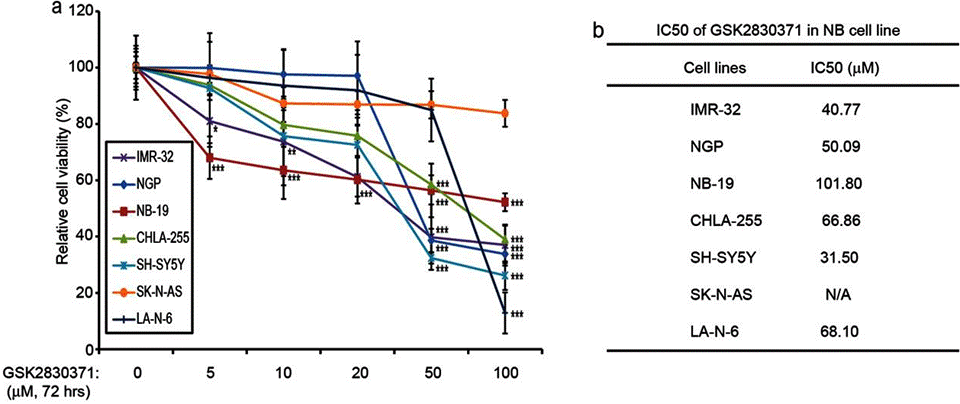
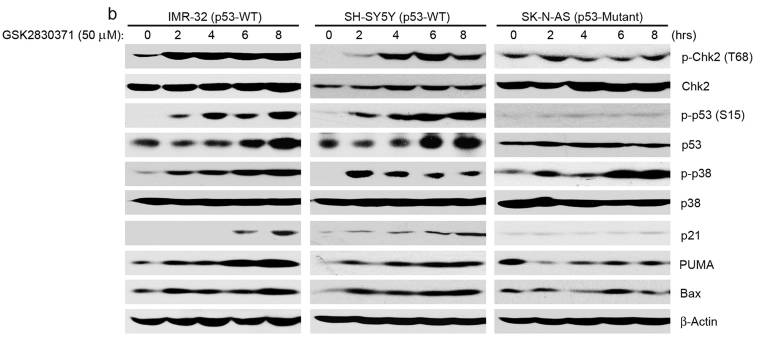
In the PPM1D-amplified MCF7 breast carcinoma cells, GSK2830371 increases the phosphorylation of multiple Wip1 substrates, including p53 (S15), Chk2 (T68), H2AX (S139) and ATM (S1981). This compound shows selective antiproliferative activity in a subset of lymphoid cell lines, all of which carry a wild-type TP53 allele. Furthermore, co-treatment of doxorubicin and this chemical results in a synergistic antiproliferative effect in DOHH2 and MX-1 tumor cells. |
| Kinase Assay |
In vitro phosphatase assays
|
|
50 μM FDP substrate with this compound or DMSO is added at room temperature before addition of 10 nM Wip1 in assay buffer (50 mM TRIS, pH 7.5, 30 mM MgCl2, 0.8 mM CHAPS, 0.05 mg/ml BSA). Fluorescent signal is detected on a Spectramax microplate reader (485/530 nm).
|
|
| In vivo |
In vivo, GSK2830371 increases phosphorylation of Chk2 (T68) and p53 (S15) and decreases Wip1 protein concentrations in DOHH2 tumors. This compound (150 mg/kg p.o.) also inhibits the growth of DOHH2 tumor xenografts via inhibition of Wip1. |
References |
Applications
| Methods | Biomarkers | Images | PMID |
|---|---|---|---|
| Growth inhibition assay | Cell viability |
|
27991505 |
| Western blot | p-Chk2 / Chk2 / p-p53 / p53 / p-p38 / p38 / p21 Wip1 / γH2AX / Mdm2 |
|
27991505 |
Tech Support
Tel: +1-832-582-8158 Ext:3
If you have any other enquiries, please leave a message.

Products are for research use only. Not for human use. We do not sell to patients.
©Copyright 2013 Selleck Chemicals. All Rights Reserved.