
-
 Argentina
-
 Australia
-
 Austria
-
 Belgium
-
 Brazil
-
 Canada
-
 China
China
-
 Czech Republic
-
 Denmark
-
 Finland
-
 France
-
 Germany
-
 Greece
-
 Hong Kong
-
 Hungary
-
 Iceland
-
 India
India
-
 Ireland
-
 Israel
-
 Italy
Italy
-
 Japan
Japan
-
 Korea
Korea
-
 Luxembourg
-
 Malaysia
-
 Netherlands
-
 New Zealand
-
 Norway
-
 Poland
-
 Portugal
-
 Qatar
Qatar
-
 Romania
-
 Saudi Arabia
-
 Singapore
-
 Spain
Spain
-
 Sweden
-
 Switzerland
-
 Taiwan
-
 Turkey
-
 United Kingdom
-
 United States
research use only
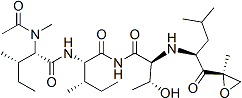
Epoxomicin (BU-4061T) Proteasome inhibitor
Cat.No.S7038
Quality Control
| Related Targets | HDAC Caspase Secretase MMP HCV Protease Cysteine Protease Tyrosinase HIV Protease DPP Serine Protease |
|---|---|
| Other Proteasome Inhibitors | MG132 ONX-0914 (PR-957) Oprozomib Delanzomib VR23 PI-1840 Marizomib (Salinosporamide A) MG-115 KSQ-4279 (USP1-IN-1) Isoginkgetin |
Cell Culture, Treatment & Working Concentration
| Cell Lines | Assay Type | Concentration | Incubation Time | Formulation | Activity Description | PMID |
|---|---|---|---|---|---|---|
| PC3 | Antiproliferative assay | Antiproliferative activity against human PC3 cell line, IC50 = 0.001 μM. | 16686537 | |||
| WM266.4 | Cytotoxicity assay | 72 hrs | Cytotoxicity against human WM266.4 cells after 72 hrs by ATPlite assay, IC50 = 0.0048 μM. | 22206869 | ||
| lymphoblastoid cells | Function assay | Inhibition of chymotrypsin like 20S proteasome activity in lymphoblastoid cells, IC50 = 0.005 μM. | 17996987 | |||
| LCL | Function assay | 12 hrs | Inhibition of chymotrypsin-like activity of 20S proteasome beta2 in human LCL cells after 12 hrs, IC50 = 0.005 μM. | 20687609 | ||
| DLD1 | Function assay | 6 hrs | Inhibition of chymotrypsin-like activity of 20S proteasome in human DLD1 cells transfected with 4Ub-Luc gene using Succinyl-Leu-Leu-Val-Tyr-AMC as substrate after 6 hrs by spectrofluorometric analysis, IC50 = 0.006 μM. | 22206869 | ||
| HEK293 | Function assay | 2 hrs | Inhibition of chymotrypsin-like activity of proteasome beta-5 subunit in HEK293 cells using Suc-LLVY-Glo as substrate incubated for 2 hrs prior to substrate addition measured after 10 mins by cell-based proteasome-Glo beta5 assay, IC50 = 0.026 μM. | 23540790 | ||
| DLD1 | Function assay | 6 hrs | Inhibition of peptide-glutamyl-peptide-hydrolyzing activity of 20S proteasome in human DLD1 cells transfected with 4Ub-Luc gene using Z-Leu-Leu-Glu-AMC as substrate after 6 hrs by spectrofluorometric analysis, IC50 = 0.06 μM. | 22206869 | ||
| lymphoblastoid cells | Function assay | Inhibition of trypsin like 20S proteasome activity in lymphoblastoid cells, IC50 = 0.284 μM. | 17996987 | |||
| LCL | Function assay | 12 hrs | Inhibition of trypsin-like activity of 20S proteasome beta2 in human LCL cells after 12 hrs, IC50 = 0.284 μM. | 20687609 | ||
| HEK293 | Function assay | 2 hrs | Inhibition of postacid activity of 20s proteasome beta-1 subunit in HEK293 cells using Z-nLPnLD-Glo as substrate incubated for 2 hrs prior to substrate addition measured after 10 mins by cell-based proteasome-Glo beta1 assay, IC50 = 0.3 μM. | 23540790 | ||
| KB-8-5-11 | Function assay | P-glycoprotein substrates identified in KB-8-5-11 adenocarcinoma cell line, qHTS therapeutic library screen, Potency = 2.5929 μM. | 31515284 | |||
| lymphoblastoid cells | Function assay | Inhibition of caspase like 20S proteasome activity in lymphoblastoid cells, IC50 = 4.56 μM. | 17996987 | |||
| LCL | Function assay | 12 hrs | Inhibition of PGPH catalytic activity of 20S proteasome beta2 in human LCL cells after 12 hrs, IC50 = 4.56 μM. | 20687609 | ||
| KB-3-1 | Function assay | P-glycoprotein substrates identified in KB-3-1 adenocarcinoma cell line, qHTS therapeutic library screen | 31515284 | |||
| Click to View More Cell Line Experimental Data | ||||||
Solubility
|
In vitro |
DMSO
: 100 mg/mL
(180.27 mM)
Ethanol : 100 mg/mL Water : Insoluble |
Molarity Calculator
|
In vivo |
|||||
In vivo Formulation Calculator (Clear solution)
Step 1: Enter information below (Recommended: An additional animal making an allowance for loss during the experiment)
Step 2: Enter the in vivo formulation (This is only the calculator, not formulation. Please contact us first if there is no in vivo formulation at the solubility Section.)
Calculation results:
Working concentration: mg/ml;
Method for preparing DMSO master liquid: mg drug pre-dissolved in μL DMSO ( Master liquid concentration mg/mL, Please contact us first if the concentration exceeds the DMSO solubility of the batch of drug. )
Method for preparing in vivo formulation: Take μL DMSO master liquid, next addμL PEG300, mix and clarify, next addμL Tween 80, mix and clarify, next add μL ddH2O, mix and clarify.
Method for preparing in vivo formulation: Take μL DMSO master liquid, next add μL Corn oil, mix and clarify.
Note: 1. Please make sure the liquid is clear before adding the next solvent.
2. Be sure to add the solvent(s) in order. You must ensure that the solution obtained, in the previous addition, is a clear solution before proceeding to add the next solvent. Physical methods such
as vortex, ultrasound or hot water bath can be used to aid dissolving.
Chemical Information, Storage & Stability
| Molecular Weight | 554.72 | Formula | C28H50N4O7 |
Storage (From the date of receipt) | |
|---|---|---|---|---|---|
| CAS No. | 134381-21-8 | Download SDF | Storage of Stock Solutions |
|
|
| Synonyms | Aids010837 | SMILES | CCC(C)C(C(=O)NC(C(C)O)C(=O)NC(CC(C)C)C(=O)C1(CO1)C)NC(=O)C(C(C)CC)N(C)C(=O)C | ||
Read more about storage stability stock solution CAS number SMILES
Mechanism of Action
| Features |
Epoxomicin is a natural product isolated from an Actinomycetes species.
|
|---|---|
| Targets/IC50/Ki |
20S proteasome
|
| In vitro |
Epoxomicin (BU-4061T) covalently binds to the LMP7, X, MECL1, and Z catalytic subunits of the proteasome. This compound (100 nM) results in a 30-fold increase in the levels of p53 protein, a known target of the proteasome, in HUVECs. It (10 μM) results in the accumulation of ubiquitinated proteins in HeLa cells, inhibits IκBα degradation by 10-fold, and produces a significant dose-dependent reduction in TNF-α-stimulated NF-κB DNA-binding activity in the same cell line. It inhibits proliferating of EL4 lymphoma cells with biotinylated chimerae with IC50 of 4 nM. At 1 μM, it leads to a reduction of LCMV GP33 presentation and an enhancement of GP276 presentation. This compound inhibits growth of Babesia bigemina with IC50 of 4 nM. It (0.5 mg/kg and 0.05 mg/kg) results in peak parasitemia levels of 34.8% and 42.3% in B. microti. Epoxomicin (100 nM) decreases the total parasitemia by 78%, 86% and 77% in Plasmodium falciparum. At 10 μM, it inhibits gametogenesis and exflagellation as well as development into oocysts of anopheles mosquitoes. |
| Kinase Assay |
Enzyme Kinetic Assays
|
|
For proteasome inhibition assays, peptide-AMC substrates (5 μM Suc-LLVY-AMC, 5 μM Z-LLE-AMC, and 5 μM Boc-LRR-AMC) and Epoxomicin (BU-4061T) in DMSO are added to assay solutions at a final DMSO concentration of 1%. The following assay buffer is used: 20 mM Tris⋅HCl, pH 8.0/0.5 mM EDTA (plus 0.035% SDS for Suc-LLVY-AMC and Z-LLE-AMC assays). Bovine red blood cell proteasome is added to the assay buffer containing substrates and this compound at a final volume of 100 μL at room temperature (23℃) in a Dynex Microfluor II 96-well plate and the fluorescence emission immediately is measured at 460 nm (λex, 360 nM) by using a Cytofluor fluorescence plate reader for 50 min.
|
|
| In vivo |
Epoxomicin (BU-4061T) (0.58 mg/kg per day) reduces the CS response by 44% relative to the control group of mice treated with vehicle alone. This compound (2.9 mg/kg) potently inhibits the irritant-associated inflammatory response by 95% when ear edema measurements are made 24 hours postchallenge in mice. |
References |
|
Tech Support
Tel: +1-832-582-8158 Ext:3
If you have any other enquiries, please leave a message.
Signaling Pathway Map

Products are for research use only. Not for human use. We do not sell to patients.
©Copyright 2013 Selleck Chemicals. All Rights Reserved.