
-
 Australia
-
 Austria
-
 Belgium
-
 Brazil
-
 Canada
-
 China
China
-
 Czech Republic
-
 Denmark
-
 Finland
-
 France
-
 Germany
-
 Greece
-
 Hong Kong
-
 Hungary
-
 Iceland
-
 India
India
-
 Ireland
-
 Israel
-
 Italy
Italy
-
 Japan
Japan
-
 Korea
Korea
-
 Luxembourg
-
 Malaysia
-
 Netherlands
-
 New Zealand
-
 Norway
-
 Poland
-
 Qatar
Qatar
-
 Romania
-
 Saudi Arabia
-
 Singapore
-
 Spain
Spain
-
 Sweden
-
 Switzerland
-
 Taiwan
-
 Turkey
-
 United Kingdom
-
 United States
research use only
Delanzomib Proteasome inhibitor
Cat.No.S1157
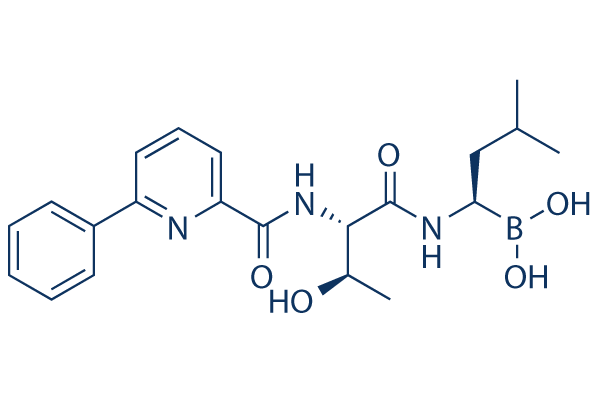
Chemical Structure
Molecular Weight: 413.28
Quality Control
| Related Targets | HDAC Caspase Secretase MMP HCV Protease Cysteine Protease Tyrosinase HIV Protease DPP Serine Protease |
|---|---|
| Other Proteasome Inhibitors | MG132 Epoxomicin (BU-4061T) ONX-0914 (PR-957) Oprozomib VR23 PI-1840 Marizomib (Salinosporamide A) MG-115 KSQ-4279 (USP1-IN-1) Isoginkgetin |
Solubility
|
In vitro |
DMSO
: 83 mg/mL
(200.83 mM)
Ethanol : 83 mg/mL Water : Insoluble |
Molarity Calculator
|
In vivo |
|||||
In vivo Formulation Calculator (Clear solution)
Step 1: Enter information below (Recommended: An additional animal making an allowance for loss during the experiment)
Step 2: Enter the in vivo formulation (This is only the calculator, not formulation. Please contact us first if there is no in vivo formulation at the solubility Section.)
Calculation results:
Working concentration: mg/ml;
Method for preparing DMSO master liquid: mg drug pre-dissolved in μL DMSO ( Master liquid concentration mg/mL, Please contact us first if the concentration exceeds the DMSO solubility of the batch of drug. )
Method for preparing in vivo formulation: Take μL DMSO master liquid, next addμL PEG300, mix and clarify, next addμL Tween 80, mix and clarify, next add μL ddH2O, mix and clarify.
Method for preparing in vivo formulation: Take μL DMSO master liquid, next add μL Corn oil, mix and clarify.
Note: 1. Please make sure the liquid is clear before adding the next solvent.
2. Be sure to add the solvent(s) in order. You must ensure that the solution obtained, in the previous addition, is a clear solution before proceeding to add the next solvent. Physical methods such
as vortex, ultrasound or hot water bath can be used to aid dissolving.
Chemical Information, Storage & Stability
| Molecular Weight | 413.28 | Formula | C21H28BN3O5 |
Storage (From the date of receipt) | |
|---|---|---|---|---|---|
| CAS No. | 847499-27-8 | Download SDF | Storage of Stock Solutions |
|
|
| Synonyms | CEP-18770 | Smiles | B(C(CC(C)C)NC(=O)C(C(C)O)NC(=O)C1=CC=CC(=N1)C2=CC=CC=C2)(O)O | ||
Mechanism of Action
| Targets/IC50/Ki |
Chymotrypsin-like proteasome
3.8 nM
|
|---|---|
| In vitro |
CEP-18770 demonstrates marginal prevention of the tryptic and peptidyl gultamyl activities of the protesome. CEP-18770 inhibits A2780 ovarian cancer cells, PC3 prostate cancer, H460, LoVo colon cancer, RPMI8226 multiple myeloma cancer and HS-Sultan anaplastic non-Hodgkin lymphoma with IC50 values of 13.7, 22.2, 34.2 11.3, 5.6 and 8.2 nM, respectively. CEP-18770 blocks the ubiquitin-proteasome pathway in several MM and in the chronic myelogenous leukemia cell line, K562. CEP-18770 causes an accumulation of ubiquitinated proteins over 4 to 8 hours. IκBα degradation is completely blocked by pretreatment with CEP-18770. CEP-18770 significantly inhibits high levels of NF-κB activity in both RPMI-8226 and U266 cells. The time- and concentration-dependent suppression of NF-kB DNA-binding activity in MM cell lines by CEP-18770 leads to a decrease of expression of several NF-κB-modulated genes mediating the growth and survival of tumor cells including IkBα itself, the X-chromosome-linked inhibitor-of-apoptosis protein (XIAP), the pro-inflammatory cytokines TNF-α and interleukin-1β (IL-1β), the intracellular adhesion molecule (ICAM1), and the pro-angiogeneic factor vascular endothelial growth factor. The expression of these NF-κB–mediated genes are associated with more favorable clinical responsiveness to this agent, highlighting their potential prognostic value in response to CEP-18770 exposure. The proapoptotic activity of CEP-18770 against MM is not limited solely to tumor-derived MM cell lines, but extends to primary MM explants from relapsed or refractory patients. In addition, CEP-18770 in combination produces synergistic inhibition of MM cell viability in vitro. |
| Kinase Assay |
Probing proteasome activity in cell extracts
|
|
Human multiple myeloma cells are washed twice with cold phosphate-buffered saline, pelleted and lysed with one volume of glass beads (<106 microns, acid-washed) and an equal volume of homogenization buffer (50 mM Tris (pH 7.4), 1 mM dithiothreitol, 5 mM MgCl2, 2 mM ATP and 250 mM sucrose) by vortexing at high speed for 15-30 min at 4 °C. Beads, membrane fractions, nuclei and cell debris are then removed from the supernatant by centrifugation at 16,000g for 5 min. The protein content of extracts is quantitated using the Bradford assay. Proteasome activity is assayed as described below. Equal amounts (typically 60 g) of protein are denatured by boiling in reducing sample buffer, separated by 12.5% SDS-PAGE and electrotransferred onto polyvinylidene difluoride (PVDF) membranes. Immunoblotting is performed using a dansyl-sulfonamidohexanoyl polyclonal antibody (1:7,500, rabbit) and horseradish peroxidase–coupled goat or swine anti-rabbit secondary antibody followed by enhanced chemiluminescence.
|
|
| In vivo |
CEP-18770 reveals sustained dose-related relative tumor weight inhibition. CEP-18770 leads to dose-related complete tumor regressions, which results in a 50% incidence of CR at its maximally tolerated dose (MTD) of 1.2 mg/kg intravenously. CEP-18770 reveals dose-related increase in the incidence of tumor-free mice by the completion of these studies (120 days after tumor transplantation). Oral administration of CEP-18770 produces a marked decrease in tumor weight and notable dose-related incidence of complete tumor regression with minimal changes in animal body weight over the course of the 120 day studies. Equiactive doses of CEP-18770 reveal a greater and more sustained dose-related inhibition of tumor proteasome activity, corresponding temporarily with maximum induction of caspase-3 and 7 activity. The maximum apoptotic signal is 2.5 fold greater for CEP-18770. In contrast, proteasome inhibition profiles of CEP-18870 are comparable in the normal peripheral mouse tissues examined (liver, lungs, whole blood, and brain [no activity]) in both their magnitude and their duration. No proteasome inhibition is detected in brain tissue at any time point for either CEP-18770 or. Single agent CEP-18770 PO also shows marked anti-MM effects in these xenograft models |
References |
|
Clinical Trial Information
(data from https://clinicaltrials.gov, updated on 2024-05-22)
| NCT Number | Recruitment | Conditions | Sponsor/Collaborators | Start Date | Phases |
|---|---|---|---|---|---|
| NCT01348919 | Completed | Multiple Myeloma |
Teva Branded Pharmaceutical Products R&D Inc. |
August 3 2011 | Phase 1|Phase 2 |
| NCT01023880 | Terminated | Multiple Myeloma |
Cephalon|Teva Branded Pharmaceutical Products R&D Inc. |
January 2010 | Phase 1|Phase 2 |
| NCT00572637 | Completed | Solid Tumors|Lymphoma Non-Hodgkin |
Ethical Oncology Science |
November 2007 | Phase 1 |
Tech Support
Tel: +1-832-582-8158 Ext:3
If you have any other enquiries, please leave a message.
Signaling Pathway Map

Products are for research use only. Not for human use. We do not sell to patients.
©Copyright 2013 Selleck Chemicals. All Rights Reserved.