
-
 Argentina
-
 Australia
-
 Austria
-
 Belgium
-
 Brazil
-
 Canada
-
 China
China
-
 Czech Republic
-
 Denmark
-
 Finland
-
 France
-
 Germany
-
 Greece
-
 Hong Kong
-
 Hungary
-
 Iceland
-
 India
India
-
 Ireland
-
 Israel
-
 Italy
Italy
-
 Japan
Japan
-
 Korea
Korea
-
 Luxembourg
-
 Malaysia
-
 Netherlands
-
 New Zealand
-
 Norway
-
 Poland
-
 Portugal
-
 Qatar
Qatar
-
 Romania
-
 Saudi Arabia
-
 Singapore
-
 Spain
Spain
-
 Sweden
-
 Switzerland
-
 Taiwan
-
 Turkey
-
 United Kingdom
-
 United States
research use only
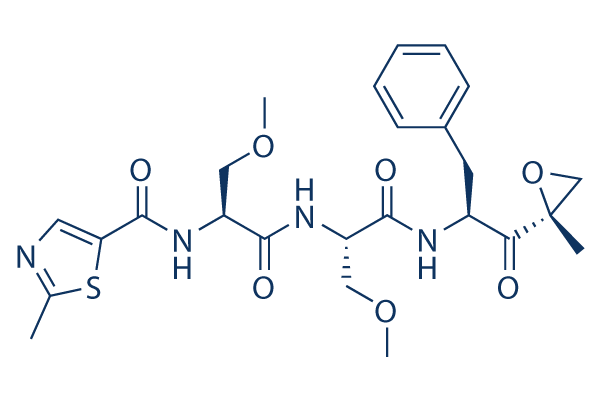
Oprozomib Proteasome inhibitor
Cat.No.S7049
Quality Control
| Related Targets | HDAC Caspase Secretase MMP HCV Protease Cysteine Protease Tyrosinase HIV Protease DPP Serine Protease |
|---|---|
| Other Proteasome Inhibitors | MG132 Epoxomicin (BU-4061T) ONX-0914 (PR-957) Delanzomib VR23 PI-1840 Marizomib (Salinosporamide A) MG-115 KSQ-4279 (USP1-IN-1) Isoginkgetin |
Solubility
|
In vitro |
DMSO
: 100 mg/mL
(187.75 mM)
Water : Insoluble Ethanol : Insoluble |
Molarity Calculator
|
In vivo |
|||||
In vivo Formulation Calculator (Clear solution)
Step 1: Enter information below (Recommended: An additional animal making an allowance for loss during the experiment)
Step 2: Enter the in vivo formulation (This is only the calculator, not formulation. Please contact us first if there is no in vivo formulation at the solubility Section.)
Calculation results:
Working concentration: mg/ml;
Method for preparing DMSO master liquid: mg drug pre-dissolved in μL DMSO ( Master liquid concentration mg/mL, Please contact us first if the concentration exceeds the DMSO solubility of the batch of drug. )
Method for preparing in vivo formulation: Take μL DMSO master liquid, next addμL PEG300, mix and clarify, next addμL Tween 80, mix and clarify, next add μL ddH2O, mix and clarify.
Method for preparing in vivo formulation: Take μL DMSO master liquid, next add μL Corn oil, mix and clarify.
Note: 1. Please make sure the liquid is clear before adding the next solvent.
2. Be sure to add the solvent(s) in order. You must ensure that the solution obtained, in the previous addition, is a clear solution before proceeding to add the next solvent. Physical methods such
as vortex, ultrasound or hot water bath can be used to aid dissolving.
Chemical Information, Storage & Stability
| Molecular Weight | 532.61 | Formula | C25H32N4O7S |
Storage (From the date of receipt) | |
|---|---|---|---|---|---|
| CAS No. | 935888-69-0 | -- | Storage of Stock Solutions |
|
|
| Synonyms | ONX 0912, PR-047 | SMILES | CC1=NC=C(S1)C(=O)NC(COC)C(=O)NC(COC)C(=O)NC(CC2=CC=CC=C2)C(=O)C3(CO3)C | ||
Read more about storage stability stock solution CAS number SMILES
Mechanism of Action
| Targets/IC50/Ki |
20S proteasome β5
36 nM
20S proteasome LMP7
82 nM
|
|---|---|
| In vitro |
The anti-MM activity of Oprozomib is associated with activation of caspase-8, caspase-9, caspase-3, and PARP, as well as inhibition of migration of MM cells and angiogenesis.
|
| Kinase Assay |
ELISA-based active site binding assay
|
|
Samples (lysed cells or tissue homogenates) are treated for 1 h at room temperature with the biotinylated active site probe PR-584 (5-15 μM). Samples are denatured by addition of SDS (0.9% final) and heating to 100 °C for 5 min. The denatured samples are transferred to a 96-well or 384-well filter plat, mixed with streptavidin-sepharose beads (2.5-5 μL packed beads/well), and incubated for 1 h at room temperature on a plate shaker. The beads are washed 5 times with 100-200 μL /well of ELISA buffer (PBS, 1% bovine serum albumin, 0.1% Tween-20) by vacuum filtration. The beads are incubated overnight at 4 °C on a plate shaker with the following antibodies recognizing the six catalytic subunits diluted into ELISA buffer: β5, β1, and β2 diluted 1:3000, LMP7 and LMP2 diluted 1:5000, and MECL-1 diluted 1:1000. The beads are washed 5 times with 100-200 μL /well of ELISA buffer and incubated with HRP-conjugated secondary antibody diluted 1:5000 in ELISA buffer and incubated 2 h at room temperature on a plate shaker. The beads are washed 5 times with 100-200 μL /well of ELISA buffer and developed for chemiluminsecence signal using the supersignal ELISA pico substrate following the manufacturer's instructions. Luminescence is measured on a plate reader and converted to ng of proteasome or μg/ml of lysate by comparison with 20S proteasome or untreated cell lysate standard curves. For proteasome inhibitor studies, active site probe binding values are expressed as the percent of binding relative to DMSO treated cells.
|
|
| In vivo |
Oprozomib is demonstrated an absolute bioavailability of up to 39% in rodents and dogs. It is well tolerated with repeated oral administration at doses resulting in >80% proteasome inhibition in most tissues and elicited an antitumor response in multiple human tumor xenograft and mouse syngeneic models .
|
References |
|
Applications
| Methods | Biomarkers | Images | PMID |
|---|---|---|---|
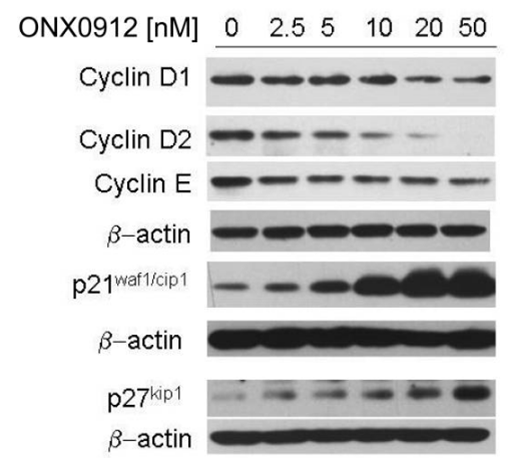
| Western blot | Cyclin D1 / Cyclin D2 / Cyclin E / p21(waf1/cip1) / p27(kip1) β-catenin / GRP94 / PERK / p-EIF2α / BiP / PDI / ATF4 Bcl-2 / Bcl-xL / Mcl-1 / Bik / Bim / Bax / Bak |
|
20110419 |
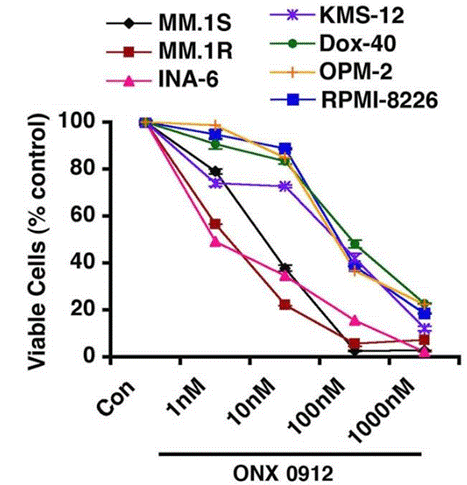
| Growth inhibition assay | Cell viability |
|
20805366 |
Clinical Trial Information
(data from https://clinicaltrials.gov, updated on 2024-09-26)
| NCT Number | Recruitment | Conditions | Sponsor/Collaborators | Start Date | Phases |
|---|---|---|---|---|---|
| NCT02939183 | COMPLETED | Relapsed or Refractory Multiple Myeloma |
Amgen |
2017-01-17 | PHASE1 |
| NCT01881789 | TERMINATED | Multiple Myeloma |
Amgen |
2013-10-28 | PHASE1; PHASE2 |
| NCT01832727 | TERMINATED | Multiple Myeloma |
Amgen |
2013-07-02 | PHASE1; PHASE2 |
| NCT01999335 | TERMINATED | Multiple Myeloma |
Amgen |
2014-07-30 | PHASE1 |
| NCT01416428 | TERMINATED | Multiple Myeloma; Waldenstrom Macroglobulinemia |
Amgen |
2011-10-15 | PHASE1; PHASE2 |
| NCT02244112 | TERMINATED | Advanced Non-Central Nervous System (CNS) Malignancies |
Amgen |
2014-08 | PHASE1 |
Read more about Clinical Trials
Tech Support
Tel: +1-832-582-8158 Ext:3
If you have any other enquiries, please leave a message.
Signaling Pathway Map

Products are for research use only. Not for human use. We do not sell to patients.
©Copyright 2013 Selleck Chemicals. All Rights Reserved.