
-
 Argentina
-
 Australia
-
 Austria
-
 Belgium
-
 Brazil
-
 Canada
-
 China
China
-
 Czech Republic
-
 Denmark
-
 Finland
-
 France
-
 Germany
-
 Greece
-
 Hong Kong
-
 Hungary
-
 Iceland
-
 India
India
-
 Ireland
-
 Israel
-
 Italy
Italy
-
 Japan
Japan
-
 Korea
Korea
-
 Luxembourg
-
 Malaysia
-
 Netherlands
-
 New Zealand
-
 Norway
-
 Poland
-
 Portugal
-
 Qatar
Qatar
-
 Romania
-
 Saudi Arabia
-
 Singapore
-
 Spain
Spain
-
 Sweden
-
 Switzerland
-
 Taiwan
-
 Turkey
-
 United Kingdom
-
 United States
research use only
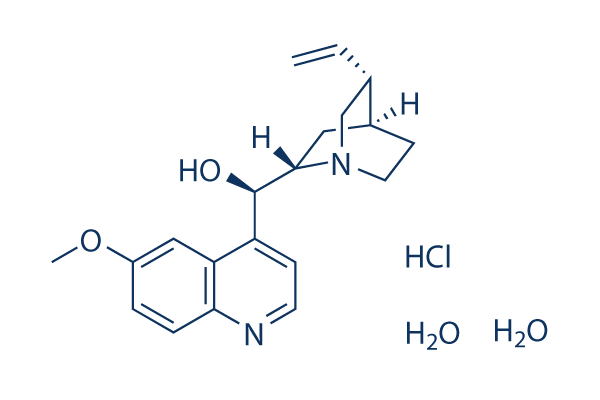
Quinine HCl Dihydrate Potassium Channel inhibitor
Cat.No.S2502
Quality Control
| Related Targets | CFTR CRM1 CD markers AChR Calcium Channel Sodium Channel GABA Receptor TRP Channel ATPase GluR |
|---|---|
| Other Potassium Channel Inhibitors | Nigericin TRAM-34 Nicorandil ML133 HCl Hydralazine HCl Sophocarpine Senicapoc (ICA-17043) Gliquidone Butamben PAP-1 |
Solubility
|
In vitro |
DMSO
: 79 mg/mL
(199.03 mM)
Ethanol : 79 mg/mL Water : 43 mg/mL |
Molarity Calculator
|
In vivo |
|||||
In vivo Formulation Calculator (Clear solution)
Step 1: Enter information below (Recommended: An additional animal making an allowance for loss during the experiment)
Step 2: Enter the in vivo formulation (This is only the calculator, not formulation. Please contact us first if there is no in vivo formulation at the solubility Section.)
Calculation results:
Working concentration: mg/ml;
Method for preparing DMSO master liquid: mg drug pre-dissolved in μL DMSO ( Master liquid concentration mg/mL, Please contact us first if the concentration exceeds the DMSO solubility of the batch of drug. )
Method for preparing in vivo formulation: Take μL DMSO master liquid, next addμL PEG300, mix and clarify, next addμL Tween 80, mix and clarify, next add μL ddH2O, mix and clarify.
Method for preparing in vivo formulation: Take μL DMSO master liquid, next add μL Corn oil, mix and clarify.
Note: 1. Please make sure the liquid is clear before adding the next solvent.
2. Be sure to add the solvent(s) in order. You must ensure that the solution obtained, in the previous addition, is a clear solution before proceeding to add the next solvent. Physical methods such
as vortex, ultrasound or hot water bath can be used to aid dissolving.
Chemical Information, Storage & Stability
| Molecular Weight | 396.91 | Formula | C20H24N2O2.HCl.2H2O |
Storage (From the date of receipt) | |
|---|---|---|---|---|---|
| CAS No. | 6119-47-7 | Download SDF | Storage of Stock Solutions |
|
|
| Synonyms | N/A | SMILES | COC1=CC2=C(C=CN=C2C=C1)C(C3CC4CCN3CC4C=C)O.O.O.Cl | ||
Read more about storage stability stock solution CAS number SMILES
Mechanism of Action
| Targets/IC50/Ki |
Potassium channel
|
|---|---|
| In vitro |
Quinine blocks Cx36 and Cx50 junctional currents in a reversible and concentration-dependent manner with half maximal blocking concentrations of 32 mM and 73 mM, respectively. Quinine induces slow transitions between open and fully closed states that decreased open probability of the channel. Quinine thus offers a potentially useful method to block certain types of gap junction channels, including those between neurons that are formed by Cx36. Quinine, a K+ channel blocker, prevents formation of tumor necrosis factor (TNF) as well as the subsequent hepatic DNA fragmentation and liver enzyme leakage. Quinine elicits Fos-like immunoreactivity (FLI) concentrated in the medial third of the nucleus; acid elicited more broadly distributed FLI concentrated farther laterally. Quinine has a relatively weak effect on doxorubicin accumulation but was able to completely restore doxorubicin sensitivity in the resistant cells. Quinine also modifies the intracellular tolerance to doxorubicin, which suggests that it is able to modify drug distribution within the cells. Quinine primarily blocks the whole cell potassium currents (IK) in a voltage-dependent manner. Quinine also reduces the size of sodium currents (INa) in a use-dependent manner, while leaving calcium currents (ICa) relatively unaffected.
|
References |
|
Clinical Trial Information
(data from https://clinicaltrials.gov, updated on 2026-05-14)
| NCT Number | Recruitment | Conditions | Sponsor/Collaborators | Start Date | Phases |
|---|---|---|---|---|---|
| NCT07572396 | RECRUITING | High-risk HPV (Any Strain); LSIL, Low Grade Squamous Intraepithelial Lesion; ASC-US; HPV Infection; Cervical Abnormalities; Uterine Cervical Dysplasia |
Amplexd Therapeutics, Inc. |
2026-04-30 | PHASE2 |
| NCT02902198 | RECRUITING | Obesity |
University Hospital, Basel, Switzerland |
2014-12 | |
| NCT04873011 | UNKNOWN | Obesity |
Universitaire Ziekenhuizen KU Leuven |
2020-10-29 | PHASE1 |
| NCT05682339 | COMPLETED | Healthy |
University of Adelaide |
2023-06-19 | |
| NCT05720390 | COMPLETED | Healthy |
University of Adelaide |
2023-02-02 | |
| NCT06472258 | COMPLETED | Malaria |
RESnTEC, Institute of Research |
2023-03-01 |
Read more about Clinical Trials
Tech Support
Tel: +1-832-582-8158 Ext:3
If you have any other enquiries, please leave a message.
Signaling Pathway Map

Products are for research use only. Not for human use. We do not sell to patients.
©Copyright 2013 Selleck Chemicals. All Rights Reserved.