
-
 Argentina
-
 Australia
-
 Austria
-
 Belgium
-
 Brazil
-
 Canada
-
 China
China
-
 Czech Republic
-
 Denmark
-
 Finland
-
 France
-
 Germany
-
 Greece
-
 Hong Kong
-
 Hungary
-
 Iceland
-
 India
India
-
 Ireland
-
 Israel
-
 Italy
Italy
-
 Japan
Japan
-
 Korea
Korea
-
 Luxembourg
-
 Malaysia
-
 Netherlands
-
 New Zealand
-
 Norway
-
 Poland
-
 Portugal
-
 Qatar
Qatar
-
 Romania
-
 Saudi Arabia
-
 Singapore
-
 Spain
Spain
-
 Sweden
-
 Switzerland
-
 Taiwan
-
 Turkey
-
 United Kingdom
-
 United States
research use only
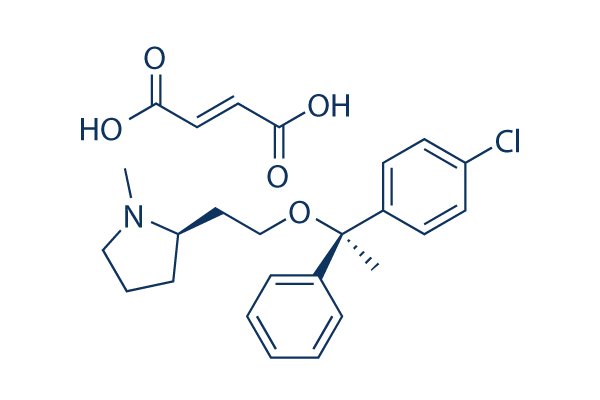
Clemastine (HS-592) Fumarate H1 Receptor Antagonist
Cat.No.S1847
Quality Control
| Related Targets | Adrenergic Receptor AChR 5-HT Receptor COX Calcium Channel Dopamine Receptor GABA Receptor TRP Channel Cholinesterase (ChE) GluR |
|---|---|
| Other Histamine Receptor Inhibitors | GSK2879552 Dihydrochloride JNJ-7777120 Mianserin HCl Ebastine Astemizole Ciproxifan Maleate Rupatadine Lafutidine Cloperastine hydrochloride Mizolastine |
Solubility
|
In vitro |
DMSO
: 11 mg/mL
(23.91 mM)
Water : Insoluble Ethanol : Insoluble |
Molarity Calculator
|
In vivo |
|||||
In vivo Formulation Calculator (Clear solution)
Step 1: Enter information below (Recommended: An additional animal making an allowance for loss during the experiment)
Step 2: Enter the in vivo formulation (This is only the calculator, not formulation. Please contact us first if there is no in vivo formulation at the solubility Section.)
Calculation results:
Working concentration: mg/ml;
Method for preparing DMSO master liquid: mg drug pre-dissolved in μL DMSO ( Master liquid concentration mg/mL, Please contact us first if the concentration exceeds the DMSO solubility of the batch of drug. )
Method for preparing in vivo formulation: Take μL DMSO master liquid, next addμL PEG300, mix and clarify, next addμL Tween 80, mix and clarify, next add μL ddH2O, mix and clarify.
Method for preparing in vivo formulation: Take μL DMSO master liquid, next add μL Corn oil, mix and clarify.
Note: 1. Please make sure the liquid is clear before adding the next solvent.
2. Be sure to add the solvent(s) in order. You must ensure that the solution obtained, in the previous addition, is a clear solution before proceeding to add the next solvent. Physical methods such
as vortex, ultrasound or hot water bath can be used to aid dissolving.
Chemical Information, Storage & Stability
| Molecular Weight | 459.96 | Formula | C21H26ClNO.C4H4O4 |
Storage (From the date of receipt) | |
|---|---|---|---|---|---|
| CAS No. | 14976-57-9 | Download SDF | Storage of Stock Solutions |
|
|
| Synonyms | HS-592 fumarate, Meclastine fumarate | SMILES | CC(C1=CC=CC=C1)(C2=CC=C(C=C2)Cl)OCCC3CCCN3C.C(=CC(=O)O)C(=O)O | ||
Read more about storage stability stock solution CAS number SMILES
Mechanism of Action
| Targets/IC50/Ki |
mTOR
Histamine H1 receptor
3 nM
|
|---|---|
| In vitro |
Clemastine Fumarate inhibits histamine induced rise in [Ca2+]i in HL-60 cells with an IC50 of 3 nM as compared with that of chlorpheniramine or diphenhydramine with IC50 values of 20 nM and 100 nM, respectively. At concentrations of ≥25 μM, Clemastine Fumarate significantly blocks NK and ADCC reactions of lymphocytes against the human erythroleukemia cell line K562 and human B-lymphoblast cell line SB, respectively. Clemastine Fumarate inhibits histamine-induced contraction of guinea pig ileum with an IC50 of 231 nM. Clemastine Fumarate potently inhibits the HERG K+ channel in a concentration-dependent manner in HEK 293 cells stably expressing HERG channels with an IC50 of 12 nM, which can be attenuated by the Y652A or F656A mutation of HERG. Clemastine Fumarate significantly potentiates ATP-induced increase in [Ca2+]i in HEKhP2X7 cells not relying on histamine receptor blockage but on sensitizing P2X7 receptor in a concentration-dependent manner with an EC50 of 10 μM, and increases the IL-1β release from LPS-induced human macrophages. |
| Kinase Assay |
Inhibition of [Ca2+]i
|
|
HL-60 cells are suspended at 1×10⁷ cells/mL in a buffer consisting of 138 mM NaCl, 6 mM KC1, 1 mM MgSO4, 1 mM Na2HPO4, 5 mM NaHCO3, 5.5 mM glucose, and 20 mM HEPES-NaOH, pH 7.4, supplemented with 0.1% (w/v) bovine serum albumin. The dye fura-2/AM is added at a concentration of 4 μM, and cells are incubated for 10 minutes at 37 °C. Thereafter, cells are diluted with the aforementioned buffer to a concentration of 5×10⁶ cells/mL and incubated for 45 minutes at 37 °C. Subsequently, cells are diluted with the aforementioned buffer to a final concentration of 0.5 × 10⁶ cells/mL and centrifuged at 250 g for 10 minutes at 20 °C. Cells are suspended at 1.0 × 10⁶ cells/mL in the aforementioned buffer and kept at 20 °C until measurement. HL-60 cells are used for up to 4 hours after loading with fura-2/AM, and suspended in 2 mL of the aforementioned buffer, using acryl fluorescence cuvettes. HL-60 cells are incubated for 3 minutes at 37 °C, in the presence of 1 mM Ca2+ and various concentrations of Clemastine Fumarate, before the addition of histamine (100 μM). Fluorescence is determined at 37 °C, with constant stirring of the cells at 1×10³ rpm, using a Ratio II spectrofluorometer. The basal fluorescence (basal [Ca2+]i) is measured for 1 minute. The basal [Ca2+]i values are subtracted from the corresponding peak [Ca2+]i values, to calculate the increase in [Ca2+]i. The excitation and emission wavelengths are 340 and 500 nm, respectively. The IC50 value is assessed from competitive curve.
|
|
| In vivo |
Administration of Clemastine Fumarate (5-20 mg/kg) displays significantly inhibitory effect on simultaneously induced zymosan paw oedema and croton oil ear oedema in rats in a dose-dependent manner, with the inhibition of 53.6% and 46.8%, respectively, at the dose of 20 mg/kg, and with ID50 values of 18.0 mg/kg and 20.5 mg/kg, respectively. Clemastine Fumarate treatment strongly reduces innate immune responses to Listeria monocytogenes in mice by interfering with the extracellular signal-regulated kinase (ERK)-mediated production of proinflammatory cytokines such as TNF-α and IL-6 surprisingly not dependent on blocking the histamine H1 receptor, leading to significantly higher mortality. |
References |
|
Clinical Trial Information
(data from https://clinicaltrials.gov, updated on 2026-03-11)
| NCT Number | Recruitment | Conditions | Sponsor/Collaborators | Start Date | Phases |
|---|---|---|---|---|---|
| NCT06065670 | NOT_YET_RECRUITING | Demyelinating Diseases; Demyelination; Corpus Callosum; Multiple Sclerosis Brain Lesion; Multiple Sclerosis Acute and Progressive; Clinically Isolated Syndrome, CNS Demyelinating |
University of California, San Francisco |
2026-09-15 | PHASE1; PHASE2 |
| NCT02521311 | RECRUITING | Optic Neuritis |
University of California, San Francisco |
2017-02-28 | PHASE2 |
| NCT07304024 | RECRUITING | Central Auditory Processing Disorder; Hearing Impaired (Partially); Hearing; Hearing Abnormality; Hearing Disability; Hearing Disorder; Hearing Disorders; Hearing Impairment, Sensorineural; Hearing Handicap; Hearing Impaired; Hearing Impairment; Hearing Loss; Central Auditory Disease; Noise Exposure; Noise Induced Hearing Loss; Noise-Induced Hearing Loss; Sound Perception; Myelin Degeneration; Myelinopathy; Myelin Integrity; Remyelination; Hidden Hearing Loss; Cocktail Party Skill; Cocktail Party Syndrome; CAPD; Age Problem |
University of Colorado, Denver |
2025-03-31 | PHASE1; PHASE2 |
| NCT07688746 | RECRUITING | White Matter Injury; Brain Injury, Fetus and Neonate; Neonatal Brain Injury; Periventricular Leukomalacia; Periventricular White Matter Abnormalities |
Bridget LaMonica Ostrem, M.D., Ph.D. |
2026-07-26 | PHASE1 |
| NCT05359653 | RECRUITING | Multiple Sclerosis (MS); Multiple Sclerosis, Relapsing-Remitting; Multiple Sclerosis, Primary Progressive; Multiple Sclerosis, Chronic Progressive; Multiple Sclerosis Relapse; Multiple Sclerosis Brain Lesion; Multiple Sclerosis Benign |
University of California, San Francisco |
2023-08-01 | PHASE1; PHASE2 |
| NCT06591091 | RECRUITING | Depression |
University of Illinois at Chicago |
2025-12-10 | PHASE2 |
Read more about Clinical Trials
Tech Support
Tel: +1-832-582-8158 Ext:3
If you have any other enquiries, please leave a message.
Signaling Pathway Map

Products are for research use only. Not for human use. We do not sell to patients.
©Copyright 2013 Selleck Chemicals. All Rights Reserved.