
-
 Argentina
-
 Australia
-
 Austria
-
 Belgium
-
 Brazil
-
 Canada
-
 China
China
-
 Czech Republic
-
 Denmark
-
 Finland
-
 France
-
 Germany
-
 Greece
-
 Hong Kong
-
 Hungary
-
 Iceland
-
 India
India
-
 Ireland
-
 Israel
-
 Italy
Italy
-
 Japan
Japan
-
 Korea
Korea
-
 Luxembourg
-
 Malaysia
-
 Netherlands
-
 New Zealand
-
 Norway
-
 Poland
-
 Portugal
-
 Qatar
Qatar
-
 Romania
-
 Saudi Arabia
-
 Singapore
-
 Spain
Spain
-
 Sweden
-
 Switzerland
-
 Taiwan
-
 Turkey
-
 United Kingdom
-
 United States
research use only
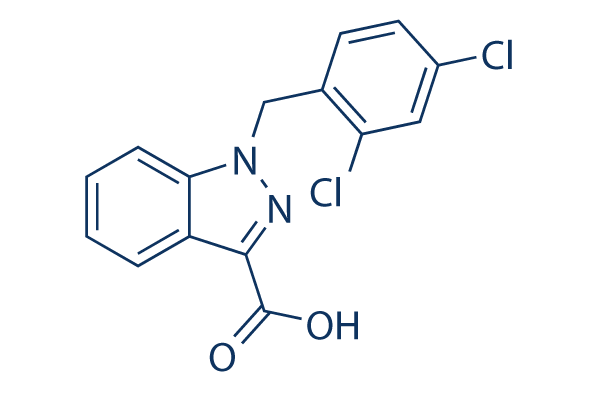
Lonidamine (AF 1890) Hexokinase Inhibitor
Cat.No.S2610
Quality Control
Solubility
|
In vitro |
DMSO
: 64 mg/mL
(199.27 mM)
Water : Insoluble Ethanol : Insoluble |
Molarity Calculator
|
In vivo |
|||||
In vivo Formulation Calculator (Clear solution)
Step 1: Enter information below (Recommended: An additional animal making an allowance for loss during the experiment)
Step 2: Enter the in vivo formulation (This is only the calculator, not formulation. Please contact us first if there is no in vivo formulation at the solubility Section.)
Calculation results:
Working concentration: mg/ml;
Method for preparing DMSO master liquid: mg drug pre-dissolved in μL DMSO ( Master liquid concentration mg/mL, Please contact us first if the concentration exceeds the DMSO solubility of the batch of drug. )
Method for preparing in vivo formulation: Take μL DMSO master liquid, next addμL PEG300, mix and clarify, next addμL Tween 80, mix and clarify, next add μL ddH2O, mix and clarify.
Method for preparing in vivo formulation: Take μL DMSO master liquid, next add μL Corn oil, mix and clarify.
Note: 1. Please make sure the liquid is clear before adding the next solvent.
2. Be sure to add the solvent(s) in order. You must ensure that the solution obtained, in the previous addition, is a clear solution before proceeding to add the next solvent. Physical methods such
as vortex, ultrasound or hot water bath can be used to aid dissolving.
Chemical Information, Storage & Stability
| Molecular Weight | 321.16 | Formula | C15H10Cl2N2O2 |
Storage (From the date of receipt) | |
|---|---|---|---|---|---|
| CAS No. | 50264-69-2 | Download SDF | Storage of Stock Solutions |
|
|
| Synonyms | AF-1890, Diclondazolic Acid, DICA | SMILES | C1=CC=C2C(=C1)C(=NN2CC3=C(C=C(C=C3)Cl)Cl)C(=O)O | ||
Read more about storage stability stock solution CAS number SMILES
Mechanism of Action
| Targets/IC50/Ki |
hexokinase
|
|---|---|
| In vitro |
Lonidamine reduces the oxygen consumption in both normal and neoplastic cells, while it increases the aerobic glycolysis of normal cells but inhibited that of tumor cells. This compound induces the permeabilization of ANT proteoliposomes in a cell-free system, yet has no effect on protein-free liposomes. It adds to synthetic planar lipid bilayers containing ANT, eliciting ANT channel activities with clearly distinct conductance levels. It provokes a disruption of the mitochondrial transmembrane potential which precedes signs of nuclear apoptosis and cytolysis. This chemical causes the dissipation of the mitochondrial inner transmembrane potential and the release of apoptogenic factors capable of inducing nuclear apoptosis in vitro. This compound (50 mg/mL) induces apoptosis in resistant cells (MCF-7 ADR(r) human breast cancer cell line, and LB9 glioblastoma multiform cell line), as demonstrated by sub-G1 peaks in DNA content histograms, condensation of nuclear chromatin, and internucleosomal DNA fragmentation. It has a stronger effect on glioblastoma cell proliferation and metabolism in vitro than did either agent used alone. |
| In vivo |
Lonidamine (160 mg/kg) in combination is significantly more effective in reducing glioblastoma tumor growth than either drug alone in mice, this tumor growth retardation is maintained as long as treatment is given. |
References |
|
Clinical Trial Information
(data from https://clinicaltrials.gov, updated on 2024-05-22)
| NCT Number | Recruitment | Conditions | Sponsor/Collaborators | Start Date | Phases |
|---|---|---|---|---|---|
| NCT02758860 | Completed | Colonic Diverticula |
University of Roma La Sapienza |
2016-06 | -- |
| NCT00435448 | TERMINATED | Benign Prostatic Hyperplasia; Enlarged Prostate |
Threshold Pharmaceuticals |
2005-06 | PHASE3 |
| NCT00237536 | TERMINATED | Benign Prostatic Hyperplasia |
Threshold Pharmaceuticals |
2005-06 | PHASE2 |
| NCT00182078 | Completed | Posttraumatic Stress Disorder|Depression |
Massachusetts General Hospital |
2002-11 | Phase 4 |
Read more about Clinical Trials
Tech Support
Tel: +1-832-582-8158 Ext:3
If you have any other enquiries, please leave a message.
Frequently Asked Questions
Question 1:
Could you please test an in vivo formulation for this compound? Can it be administrated via i.p. injection?
Answer:
The suggested IP formula of S2610 is 5%DMSO+30%PEG300+5%Tween-80+ddH2O.

Products are for research use only. Not for human use. We do not sell to patients.
©Copyright 2013 Selleck Chemicals. All Rights Reserved.