
-
 Argentina
-
 Australia
-
 Austria
-
 Belgium
-
 Brazil
-
 Canada
-
 China
China
-
 Czech Republic
-
 Denmark
-
 Finland
-
 France
-
 Germany
-
 Greece
-
 Hong Kong
-
 Hungary
-
 Iceland
-
 India
India
-
 Ireland
-
 Israel
-
 Italy
Italy
-
 Japan
Japan
-
 Korea
Korea
-
 Luxembourg
-
 Malaysia
-
 Netherlands
-
 New Zealand
-
 Norway
-
 Poland
-
 Qatar
Qatar
-
 Romania
-
 Saudi Arabia
-
 Singapore
-
 Spain
Spain
-
 Sweden
-
 Switzerland
-
 Taiwan
-
 Turkey
-
 United Kingdom
-
 United States
research use only
Epinastine HCl Histamine Receptor inhibitor
Cat.No.S4253
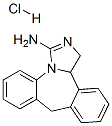
Chemical Structure
Molecular Weight: 285.77
Quality Control
| Related Targets | Adrenergic Receptor AChR 5-HT Receptor COX Calcium Channel Dopamine Receptor GABA Receptor TRP Channel Cholinesterase (ChE) GluR |
|---|---|
| Other Histamine Receptor Inhibitors | GSK2879552 Dihydrochloride JNJ-7777120 Mianserin HCl Ebastine Astemizole Ciproxifan Maleate Rupatadine Lafutidine Cloperastine hydrochloride Mizolastine |
Solubility
|
In vitro |
DMSO
: 57 mg/mL
(199.46 mM)
Water : 57 mg/mL Ethanol : 57 mg/mL |
Molarity Calculator
|
In vivo |
|||||
In vivo Formulation Calculator (Clear solution)
Step 1: Enter information below (Recommended: An additional animal making an allowance for loss during the experiment)
Step 2: Enter the in vivo formulation (This is only the calculator, not formulation. Please contact us first if there is no in vivo formulation at the solubility Section.)
Calculation results:
Working concentration: mg/ml;
Method for preparing DMSO master liquid: mg drug pre-dissolved in μL DMSO ( Master liquid concentration mg/mL, Please contact us first if the concentration exceeds the DMSO solubility of the batch of drug. )
Method for preparing in vivo formulation: Take μL DMSO master liquid, next addμL PEG300, mix and clarify, next addμL Tween 80, mix and clarify, next add μL ddH2O, mix and clarify.
Method for preparing in vivo formulation: Take μL DMSO master liquid, next add μL Corn oil, mix and clarify.
Note: 1. Please make sure the liquid is clear before adding the next solvent.
2. Be sure to add the solvent(s) in order. You must ensure that the solution obtained, in the previous addition, is a clear solution before proceeding to add the next solvent. Physical methods such
as vortex, ultrasound or hot water bath can be used to aid dissolving.
Chemical Information, Storage & Stability
| Molecular Weight | 285.77 | Formula | C16H15N3.HCl |
Storage (From the date of receipt) | |
|---|---|---|---|---|---|
| CAS No. | 108929-04-0 | Download SDF | Storage of Stock Solutions |
|
|
| Synonyms | WAL-801CL HCl | Smiles | C1C2C3=CC=CC=C3CC4=CC=CC=C4N2C(=N1)N.Cl | ||
Mechanism of Action
| Targets/IC50/Ki |
Histamine receptor
|
|---|---|
| In vitro |
Epinastine shows a high affinity to H1-receptors in receptor binding studies in the guinea pig ileum. Epinastine is able to displace specific [3H]NC-5Z binding at low concentrations in the locust nervous tissue. Epinastine binds to the honey bees neuronal octopamine receptor with Ki of 1.1 nM. Epinastine antagonises octopamine-induced cAMP formation in the insect brain. Epinastine causes an inhibition of histamine release from rat peritoneal mast cells induced by both antigen-antibody reaction and compound 48/80. Epinastine is similarly effective in inhibiting compound 48/80-induced histamine release not only from isolated rat peritoneal mast cells but also from rat mesenterial pieces. Epinastine is effective in inhibiting not only Ca2+ uptake into lung mast cells in actively sensitized guinea pigs but also Ca2+ release from the intracellular Ca store of rat peritoneal mast cells exposed to both compound 48/80 and substance P. Epinastine shows a dose- and time-dependent suppressive effect on IL-8, one of the chemokines for eosinophils, released from eosinophils isolated from atopic diseases.
|
| In vivo |
Epinastine inhibits histamine-induced reactions in the skin or the lung of rats, dogs and guinea pigs.
|
References |
|
Clinical Trial Information
(data from https://clinicaltrials.gov, updated on 2024-05-22)
| NCT Number | Recruitment | Conditions | Sponsor/Collaborators | Start Date | Phases |
|---|---|---|---|---|---|
| NCT02260037 | Completed | Healthy |
Boehringer Ingelheim |
August 2001 | Phase 1 |
| NCT02182570 | Completed | Dermatitis Atopic |
Boehringer Ingelheim |
June 2001 | Phase 3 |
Tech Support
Tel: +1-832-582-8158 Ext:3
If you have any other enquiries, please leave a message.
Signaling Pathway Map

Products are for research use only. Not for human use. We do not sell to patients.
©Copyright 2013 Selleck Chemicals. All Rights Reserved.