
-
 Argentina
-
 Australia
-
 Austria
-
 Belgium
-
 Brazil
-
 Canada
-
 China
China
-
 Czech Republic
-
 Denmark
-
 Finland
-
 France
-
 Germany
-
 Greece
-
 Hong Kong
-
 Hungary
-
 Iceland
-
 India
India
-
 Ireland
-
 Israel
-
 Italy
Italy
-
 Japan
Japan
-
 Korea
Korea
-
 Luxembourg
-
 Malaysia
-
 Netherlands
-
 New Zealand
-
 Norway
-
 Poland
-
 Portugal
-
 Qatar
Qatar
-
 Romania
-
 Saudi Arabia
-
 Singapore
-
 Spain
Spain
-
 Sweden
-
 Switzerland
-
 Taiwan
-
 Turkey
-
 United Kingdom
-
 United States
research use only
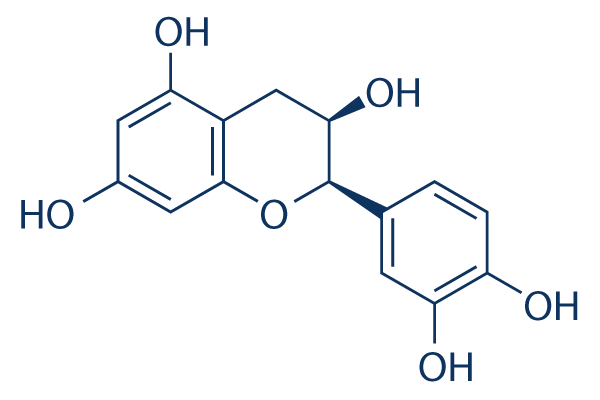
(-)Epicatechin Antioxidant chemical
Cat.No.S4723
Quality Control
Solubility
|
In vitro |
DMSO
: 58 mg/mL
(199.81 mM)
Water : Insoluble Ethanol : Insoluble |
Molarity Calculator
|
In vivo |
|||||
In vivo Formulation Calculator (Clear solution)
Step 1: Enter information below (Recommended: An additional animal making an allowance for loss during the experiment)
Step 2: Enter the in vivo formulation (This is only the calculator, not formulation. Please contact us first if there is no in vivo formulation at the solubility Section.)
Calculation results:
Working concentration: mg/ml;
Method for preparing DMSO master liquid: mg drug pre-dissolved in μL DMSO ( Master liquid concentration mg/mL, Please contact us first if the concentration exceeds the DMSO solubility of the batch of drug. )
Method for preparing in vivo formulation: Take μL DMSO master liquid, next addμL PEG300, mix and clarify, next addμL Tween 80, mix and clarify, next add μL ddH2O, mix and clarify.
Method for preparing in vivo formulation: Take μL DMSO master liquid, next add μL Corn oil, mix and clarify.
Note: 1. Please make sure the liquid is clear before adding the next solvent.
2. Be sure to add the solvent(s) in order. You must ensure that the solution obtained, in the previous addition, is a clear solution before proceeding to add the next solvent. Physical methods such
as vortex, ultrasound or hot water bath can be used to aid dissolving.
Chemical Information, Storage & Stability
| Molecular Weight | 290.27 | Formula | C15H14O6 |
Storage (From the date of receipt) | 3 years -20°C powder (seal) |
|---|---|---|---|---|---|
| CAS No. | 490-46-0 | Download SDF | Storage of Stock Solutions | Solutions are unstable. Prepare fresh or purchase small, pre-packaged sizes. Repackage upon receipt. | |
| Synonyms | L-Epicatechin, (-)-Epicatechol | SMILES | C1C(C(OC2=CC(=CC(=C21)O)O)C3=CC(=C(C=C3)O)O)O | ||
Read more about storage stability CAS number SMILES
Mechanism of Action
| In vitro |
(-)-Epicatechin stimulates mitochondrial respiration and oxygen consumption in Panc-1 cells. Human normal fibroblasts are not affected. (-)-Epicatechin sensitizes Panc-1, U87, and MIA PaCa-2 cells with an average radiation enhancement factor (REF) of 1.7, 1.5, and 1.2, respectively. (-)-Epicatechin does not sensitize normal fibroblast cells to ionizing radiation with a REF of 0.9, suggesting cancer cell selectivity. (-)-Epicatechin enhances Chk2 phosphorylation and p21 induction when combined with radiation in cancer, but not normal cells. |
|---|---|
| In vivo |
Aging has deleterious effects on modulators of muscle growth/differentiation, the consumption of modest amounts of the flavanol (−)-epicatechin can partially reverse these changes. In mice, myostatin and senescence-associated β-galactosidase levels increase with aging, while those of follistatin and Myf5 decrease. (−)-Epicatechin decreases myostatin and β-galactosidase and increases levels of markers of muscle growth. In humans, myostatin and β-galactosidase increase with aging while follistatin, MyoD and myogenin decrease. Treatment for 7 days with (−)-epicatechin increases hand grip strength and the ratio of plasma follistatin/myostatin. Low-dose (−)-epicatechin treatment resulted in significant increases in skeletal muscle capillarity, mitochondrial biogenesis, and oxidative enzyme activity, which corresponded to lower muscle fatigue and higher endurance capacity when compared to the placebo group. (−)-epicatechin may potentially regulate the protein expression between angiogenic and antiangiogenic factors, such as VEGF-A and TSP-1, respectively. |
References |
|
Clinical Trial Information
(data from https://clinicaltrials.gov, updated on 2026-05-08)
| NCT Number | Recruitment | Conditions | Sponsor/Collaborators | Start Date | Phases |
|---|---|---|---|---|---|
| NCT07161726 | RECRUITING | Mobility Disability |
University of Alabama at Birmingham |
2026-04-21 | PHASE1; PHASE2 |
| NCT07149506 | ENROLLING_BY_INVITATION | Radiation Dermatitis Acute; Radiation Dermatitis; Fibrosis; Skin |
CARLOS FRANCISCO SAAVEDRA GARCIA |
2025-09-01 | PHASE3 |
| NCT06631820 | RECRUITING | Chronic Kidney Disease(CKD); Myosteatosis; Mitochondrial Dysfunction; Muscle Function; Muscle Mass |
Karolinska Institutet |
2025-01-17 | |
| NCT06086145 | Recruiting | Adults |
University of California Davis|Mars Inc. |
2023-11-02 | -- |
| NCT05113498 | COMPLETED | Diet Modification |
University Ghent |
2021-11-01 | |
| NCT04386304 | COMPLETED | Becker Muscular Dystrophy |
Epirium Bio Inc. |
2020-07-13 | PHASE1 |
Read more about Clinical Trials
Tech Support
Tel: +1-832-582-8158 Ext:3
If you have any other enquiries, please leave a message.

Products are for research use only. Not for human use. We do not sell to patients.
©Copyright 2013 Selleck Chemicals. All Rights Reserved.