
-
 Argentina
-
 Australia
-
 Austria
-
 Belgium
-
 Brazil
-
 Canada
-
 China
China
-
 Czech Republic
-
 Denmark
-
 Finland
-
 France
-
 Germany
-
 Greece
-
 Hong Kong
-
 Hungary
-
 Iceland
-
 India
India
-
 Ireland
-
 Israel
-
 Italy
Italy
-
 Japan
Japan
-
 Korea
Korea
-
 Luxembourg
-
 Malaysia
-
 Netherlands
-
 New Zealand
-
 Norway
-
 Poland
-
 Portugal
-
 Qatar
Qatar
-
 Romania
-
 Saudi Arabia
-
 Singapore
-
 Spain
Spain
-
 Sweden
-
 Switzerland
-
 Taiwan
-
 Turkey
-
 United Kingdom
-
 United States
research use only
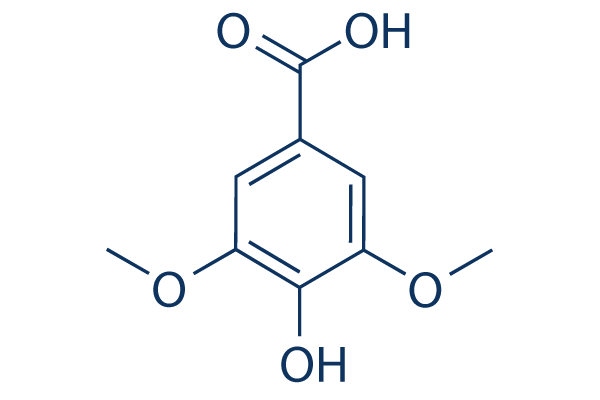
Syringic acid Antioxidant chemical
Cat.No.S3629
Quality Control
| Related Targets | EGFR VEGFR JAK FGFR PDGFR Src HIF FLT3 HER2 FLT |
|---|---|
| Other Antioxidant Inhibitors | Elamipretide (SS-31, MTP-131) EGCG ((-)-Epigallocatechin Gallate) Tangeretin Silymarin Gipsoside (+)-Catechin Hydroxygenkwanin Rutin (trihydrate) Oleuropein (-)Epicatechin |
Solubility
|
In vitro |
DMSO
: 39 mg/mL
(196.8 mM)
Ethanol : 39 mg/mL Water : 1 mg/mL |
Molarity Calculator
|
In vivo |
|||||
In vivo Formulation Calculator (Clear solution)
Step 1: Enter information below (Recommended: An additional animal making an allowance for loss during the experiment)
Step 2: Enter the in vivo formulation (This is only the calculator, not formulation. Please contact us first if there is no in vivo formulation at the solubility Section.)
Calculation results:
Working concentration: mg/ml;
Method for preparing DMSO master liquid: mg drug pre-dissolved in μL DMSO ( Master liquid concentration mg/mL, Please contact us first if the concentration exceeds the DMSO solubility of the batch of drug. )
Method for preparing in vivo formulation: Take μL DMSO master liquid, next addμL PEG300, mix and clarify, next addμL Tween 80, mix and clarify, next add μL ddH2O, mix and clarify.
Method for preparing in vivo formulation: Take μL DMSO master liquid, next add μL Corn oil, mix and clarify.
Note: 1. Please make sure the liquid is clear before adding the next solvent.
2. Be sure to add the solvent(s) in order. You must ensure that the solution obtained, in the previous addition, is a clear solution before proceeding to add the next solvent. Physical methods such
as vortex, ultrasound or hot water bath can be used to aid dissolving.
Chemical Information, Storage & Stability
| Molecular Weight | 198.17 | Formula | C9H10O5 |
Storage (From the date of receipt) | 3 years -20°C powder (seal) |
|---|---|---|---|---|---|
| CAS No. | 530-57-4 | Download SDF | Storage of Stock Solutions | Solutions are unstable. Prepare fresh or purchase small, pre-packaged sizes. Repackage upon receipt. | |
| Synonyms | 3,5-dimethyl ether Gallic Acid, 3,5-dimethoxy-4-hydroxy Benzoic Acid, NSC 2129, SYRA | SMILES | COC1=CC(=CC(=C1O)OC)C(=O)O | ||
Read more about storage stability CAS number SMILES
Mechanism of Action
| In vitro |
Syringic acid ameliorates the expressions of TH, DAT and VMAT2 and also significantly attenuates MPTP/p2 induced increased inflammatory markers expression. This compound pretreatment obviously inhibits H2O2-induced RGC-5 cell injury and also decreases H2O2-induced ROS production and MDA content. It may protect RGC-5 cells against apoptosis induced by H2O2 through the activation of PI3K/Akt signaling pathway. This chemical shows a time- and dose-dependent (IC50 = 0.95-1.2 mg/mL) antimitogenic effect against cancer cells with little cytotoxicity on normal fibroblasts (≤20%). It alters cell cycle (S/G2-M or G1/G2-M phases) in a time-dependent manner, induces apoptosis, inhibits DNA-binding activity of NFκB (p ≤ 0.0001), chymotrypsin-like/PGPH (peptidyl-glutamyl peptide-hydrolyzing) (p ≤ 0.0001) and the trypsin-like (p ≤ 0.002) activities of 26S proteasome and angiogenesis. It also differentially sensitizes cancer cells to standard chemotherapies with a marked increase in their sensitivity to camptothecin (500-fold), 5FU (20,000-fold), doxorubicin (210-fold), taxol (3134-fold), vinblastine (1000-fold), vincristine (130-fold) and amsacrine (107-fold) compared to standard drugs alone. This compound exerts its chemotherapeutic and chemo-sensitizing effects through an array of mechanisms including cell-cycle arrest, apoptosis induction, inhibition of cell proliferation, cell migration, angiogenesis, NFκB DNA-binding and proteasome activities. |
|---|---|
| In vivo |
Syringic acid has hepatoprotective effects in various animal models. Oral administration of this compound (10mg/kg of body weight) is reported partial recovery of learning and memory impairment by amyloid β induced neurotoxicity in mice. It also facilitates protective effects on kidney in renal ischemia-reperfusion injury. Antimicrobial activities of this chemical are also reported against various pathogens. Anticancer effects of it are explored on A549 lung carcinoma cells and is found to show apoptotic effects with an IC50 of 30 μM. This acid attenuates the elevation of glycoprotein components in normal and diabetic rats. It may increase insulin secretion of pancreatic β-cells and normalize the plasma glucose level. |
References |
|
Clinical Trial Information
(data from https://clinicaltrials.gov, updated on 2024-05-22)
| NCT Number | Recruitment | Conditions | Sponsor/Collaborators | Start Date | Phases |
|---|---|---|---|---|---|
| NCT05025189 | Completed | Healthy |
University of California Los Angeles|The California Table grape Commission |
2020-10-05 | Not Applicable |
Read more about Clinical Trials
Tech Support
Tel: +1-832-582-8158 Ext:3
If you have any other enquiries, please leave a message.

Products are for research use only. Not for human use. We do not sell to patients.
©Copyright 2013 Selleck Chemicals. All Rights Reserved.