Opioid receptors, which belong to G-protein-coupled super family, include mu-opioid receptor, delta-opioid receptor, and kappa-opioid receptor. Opioid receptors are receptor for opiate drugs. Opioid receptors can be found in the mammalian central nervous system and some other tissues, including the immune system. After opiate drugs binding to the specific receptor sites of opioid receptors, opioid receptors can executive function such as analgesia, sedation and so on.

-
 Australia
-
 Austria
-
 Belgium
-
 Brazil
-
 Canada
-
 China
China
-
 Czech Republic
-
 Denmark
-
 Finland
-
 France
-
 Germany
-
 Greece
-
 Hong Kong
-
 Hungary
-
 Iceland
-
 India
India
-
 Ireland
-
 Israel
-
 Italy
Italy
-
 Japan
Japan
-
 Korea
Korea
-
 Luxembourg
-
 Malaysia
-
 Netherlands
-
 New Zealand
-
 Norway
-
 Poland
-
 Qatar
Qatar
-
 Romania
-
 Saudi Arabia
-
 Singapore
-
 Spain
Spain
-
 Sweden
-
 Switzerland
-
 Taiwan
-
 Turkey
-
 United Kingdom
-
 United States
Opioid Receptor
Other GPCR & G Protein Related Inhibitors
Isoform-selective Products
| Cat.No. | Product Name | Information | Product Use Citations | Product Validations |
|---|---|---|---|---|
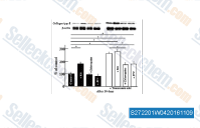
| S2722 | JTC-801 | JTC-801 is a selective opioid receptor-like1 (ORL1) receptor antagonist with IC50 of 94 nM, weakly inhibits receptors δ, κ, and μ. |
|
|
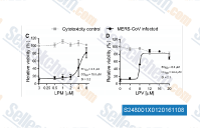
| S2480 | Loperamide HCl | Loperamide HCl (ADL 2-1294,R-18553 hydrochloride) is a selective μ-opioid receptor agonist opioid with Ki of 3.3 nM, 15-fold and 350-fold selective over the δ subtype and the κ subtype of the opioid receptor, used against diarrhea resulting from gastroenteritis or inflammatory bowel disease. |
|
|
| S2322 | (+)-Matrine | Matrine((+)-Matrine) is an alkaloid found in plants from the Sophora family, which has a variety of pharmacological effects, including anti-cancer effects, and action as a kappa opioid receptor agonist. |
|
|
| S2085 | Trimebutine | Trimebutine (Mebutin) is an agonist of peripheral mu, kappa and delta opiate receptors, used as spasmolytic agent for treatment of both acute and chronic abdominal pain. |
|
|
| S5935 | Alvimopan | Alvimopan (LY 246736, ADL 8-2698) is a potent, relatively nonselective opioid antagonist with Ki values of 0.77, 4.4, and 40 nM for the μ, δ, and κ opioid receptors, respectively, displaying >100-fold selectivity over other aminergic G-protein-coupled receptors. |
|
|
| S2503 | Racecadotril | Racecadotril (Acetorphan) is a peripherally acting enkephalinase inhibitor with an IC50 of 4.5 μM. | ||
| S0009 | Asimadoline hydrochloride | Asimadoline hydrochloride (EMD-61753 hydrochloride) is an orally active, selective and peripherally active κ-opioid agonist with IC50s of 5.6 nM (guinea pig) and 1.2 nM (human recombinant). | ||
| E0472 | BMS-986122 | BMS-986122 is a selective, potent positive allosteric modulator of the mu-opioid receptor (µ-OR), shows potentiation of orthosteric agonist-mediated β-arrestin recruitment, adenylyl cyclase inhibition, and G protein activation, and potentiates DAMGO-mediated [35S]GTPγS binding in mouse brain membranes. | ||
| S5701 | Alvimopan dihydrate (LY246736 dihydrate) | Alvimopan (LY-246736) is a potent, relatively nonselective opioid antagonist with Ki values of 0.77, 4.4, and 40 nM for the μ, δ, and κ opioid receptors, respectively, displaying >100-fold selectivity over other aminergic G-protein-coupled receptors. | ||
| E4647 | Aticaprant | Aticaprant (CERC-501, LY-2456302) is a potent, orally bioavailable, centrally-penetrant antagonist of the kappa opioid receptor with a Ki of 0.807 nM. It exhibits an antidepressant effect with the potential to treat major depressive disorder (MDD). | ||
Signaling Pathway Map

Products are for research use only. Not for human use. We do not sell to patients.
©Copyright 2013 Selleck Chemicals. All Rights Reserved.