
-
 Australia
-
 Austria
-
 Belgium
-
 Brazil
-
 Canada
-
 China
China
-
 Czech Republic
-
 Denmark
-
 Finland
-
 France
-
 Germany
-
 Greece
-
 Hong Kong
-
 Hungary
-
 Iceland
-
 India
India
-
 Ireland
-
 Israel
-
 Italy
Italy
-
 Japan
Japan
-
 Korea
Korea
-
 Luxembourg
-
 Malaysia
-
 Netherlands
-
 New Zealand
-
 Norway
-
 Poland
-
 Qatar
Qatar
-
 Romania
-
 Saudi Arabia
-
 Singapore
-
 Spain
Spain
-
 Sweden
-
 Switzerland
-
 Taiwan
-
 Turkey
-
 United Kingdom
-
 United States
research use only
JTC-801 Opioid Receptor antagonist
Cat.No.S2722
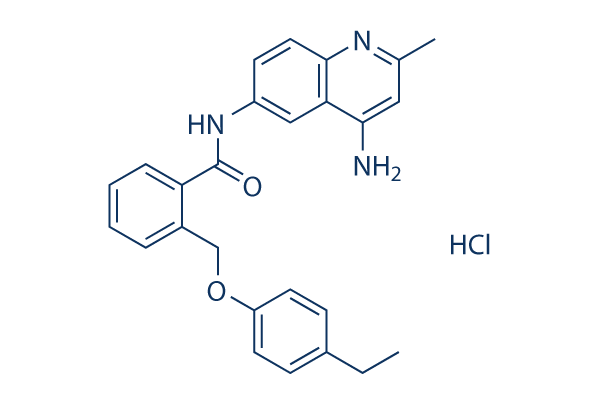
Chemical Structure
Molecular Weight: 447.96
Quality Control
Solubility
|
In vitro |
DMSO
: 90 mg/mL
(200.91 mM)
Ethanol : 31 mg/mL Water : Insoluble |
Molarity Calculator
|
In vivo |
|||||
In vivo Formulation Calculator (Clear solution)
Step 1: Enter information below (Recommended: An additional animal making an allowance for loss during the experiment)
Step 2: Enter the in vivo formulation (This is only the calculator, not formulation. Please contact us first if there is no in vivo formulation at the solubility Section.)
Calculation results:
Working concentration: mg/ml;
Method for preparing DMSO master liquid: mg drug pre-dissolved in μL DMSO ( Master liquid concentration mg/mL, Please contact us first if the concentration exceeds the DMSO solubility of the batch of drug. )
Method for preparing in vivo formulation: Take μL DMSO master liquid, next addμL PEG300, mix and clarify, next addμL Tween 80, mix and clarify, next add μL ddH2O, mix and clarify.
Method for preparing in vivo formulation: Take μL DMSO master liquid, next add μL Corn oil, mix and clarify.
Note: 1. Please make sure the liquid is clear before adding the next solvent.
2. Be sure to add the solvent(s) in order. You must ensure that the solution obtained, in the previous addition, is a clear solution before proceeding to add the next solvent. Physical methods such
as vortex, ultrasound or hot water bath can be used to aid dissolving.
Chemical Information, Storage & Stability
| Molecular Weight | 447.96 | Formula | C26H25N3O2.HCl |
Storage (From the date of receipt) | |
|---|---|---|---|---|---|
| CAS No. | 244218-51-7 | Download SDF | Storage of Stock Solutions |
|
|
| Synonyms | N/A | Smiles | CCC1=CC=C(C=C1)OCC2=CC=CC=C2C(=O)NC3=CC4=C(C=C(N=C4C=C3)C)N.Cl | ||
Mechanism of Action
| Targets/IC50/Ki |
Opioid receptor-like1 (ORL1)
94 nM
|
|---|---|
| In vitro |
JTC-801 displays about 12.5-, 129-, and 1055-fold selectivity for ORL1 receptor (Ki = 8.2 nM) over μ-, κ-, and δ-opioid receptors, respectively. This compound does not inhibit forskolin-stimulated cyclic AMP accumulation in human ORL1 receptor-expressing HeLa cells, but it prevents nociceptin-induced inhibition of cyclic AMP accumulation, indicating that this chemical possesses full antagonistic activity. In rat cerebrocortical membrane, this compound inhibits ORL1 receptor with IC50 of 472 nM and μ-receptor with IC50 of 1831 nM. It completely antagonizes the suppression of nociceptin on forskolin-induced accumulation of cyclic AMP with IC50 of 2.58 μM in HeLa cells expressing ORL1 receptor.
|
| In vivo |
Oral administration of JTC-801 (0.3-3 mg/kg) antagonizes nociceptin-induced allodynia in mice, and shows analgesic effect in a hot plate test using mice and in a formalin test using rats. In mouse hot-plate test, this compound prolongs escape response latency (ERL) or exposed heat stimulus with minimum effective doses (MED) of 0.01 mg/kg by i.v. or 1 mg/kg by p.o. In the rat formalin test, it reduces both the first and second phases of the nociceptive response with MED of 0.01 mg/kg71 by i.v. or 1 mg/kg by p.o. This chemical dose-dependently normalizes paw withdrawal latency (PWL). Although it does not inhibit a chronic constriction injury (CCI)-induced decrease in bone mineral content (BMC) and bone mineral density (BMD), it inhibits an increase in the number of osteoclasts. Tactile allodynia induced by L5/L6 spinal nerve ligation is reversed by both systemic (3-30 mg/kg) and spinal (22.5 and 45 pg) administration of this compound in a dose-dependent manner. Furthermore, systemic treatment reduces Fos-like immunoreactivity in the dorsal horn of the spinal cord (laminae I/II). It produces dose-dependent mechanical and cold anti-allodynic effects with ED50 of 0.83 mg/kg and 1.02 mg/kg, respectively.
|
References |
|
Tech Support
Tel: +1-832-582-8158 Ext:3
If you have any other enquiries, please leave a message.
Signaling Pathway Map

Products are for research use only. Not for human use. We do not sell to patients.
©Copyright 2013 Selleck Chemicals. All Rights Reserved.