
-
 Argentina
-
 Australia
-
 Austria
-
 Belgium
-
 Brazil
-
 Canada
-
 China
China
-
 Czech Republic
-
 Denmark
-
 Finland
-
 France
-
 Germany
-
 Greece
-
 Hong Kong
-
 Hungary
-
 Iceland
-
 India
India
-
 Ireland
-
 Israel
-
 Italy
Italy
-
 Japan
Japan
-
 Korea
Korea
-
 Luxembourg
-
 Malaysia
-
 Netherlands
-
 New Zealand
-
 Norway
-
 Poland
-
 Portugal
-
 Qatar
Qatar
-
 Romania
-
 Saudi Arabia
-
 Singapore
-
 Spain
Spain
-
 Sweden
-
 Switzerland
-
 Taiwan
-
 Turkey
-
 United Kingdom
-
 United States
research use only
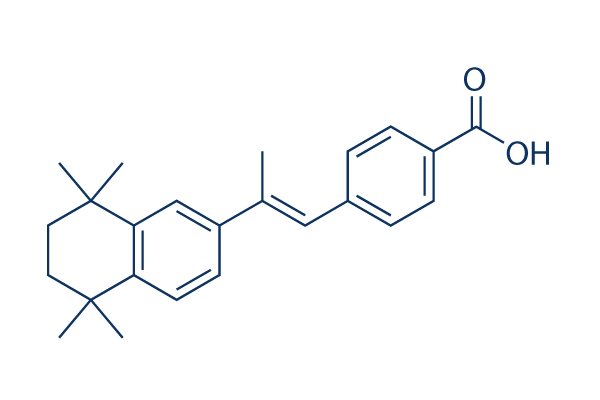
TTNPB (Arotinoid acid) RAR Agonist
Cat.No.S4627
Quality Control
| Related Targets | Dehydrogenase HSP Transferase P450 (e.g. CYP17) PDE phosphatase PPAR Vitamin Carbohydrate Metabolism Mitochondrial Metabolism |
|---|---|
| Other Retinoid Receptor Inhibitors | Tamibarotene AM580 Fenretinide BMS493 SR 11237 UVI 3003 AR7 Palovarotene CD1530 YCT529 |
Cell Culture, Treatment & Working Concentration
| Cell Lines | Assay Type | Concentration | Incubation Time | Formulation | Activity Description | PMID |
|---|---|---|---|---|---|---|
| HEK293 cells | Function assay | Agonist activity at human RARalpha expressed in HEK293 cells by luciferase reporter gene assay, EC50=0.18 nM | ||||
| CV-1 cells | Function assay | Binding affinity against retinoic Acid gamma receptors co-transfected into CV-1 cells, EC50=0.002 Μm | ||||
| HL60 cells | Cytotoxicity assay | In vitro cytotoxicity against HL60 cells, IC50=46 μM | ||||
| HeLa cells | Function assay | Agonist activity at human RARalpha expressed in human HeLa cells assessed as relative luminescence units at >=10 uM by luciferase assay relative to control | ||||
| Click to View More Cell Line Experimental Data | ||||||
Solubility
|
In vitro |
DMSO
: 15 mg/mL
(43.04 mM)
Water : Insoluble Ethanol : Insoluble |
Molarity Calculator
|
In vivo |
|||||
In vivo Formulation Calculator (Clear solution)
Step 1: Enter information below (Recommended: An additional animal making an allowance for loss during the experiment)
Step 2: Enter the in vivo formulation (This is only the calculator, not formulation. Please contact us first if there is no in vivo formulation at the solubility Section.)
Calculation results:
Working concentration: mg/ml;
Method for preparing DMSO master liquid: mg drug pre-dissolved in μL DMSO ( Master liquid concentration mg/mL, Please contact us first if the concentration exceeds the DMSO solubility of the batch of drug. )
Method for preparing in vivo formulation: Take μL DMSO master liquid, next addμL PEG300, mix and clarify, next addμL Tween 80, mix and clarify, next add μL ddH2O, mix and clarify.
Method for preparing in vivo formulation: Take μL DMSO master liquid, next add μL Corn oil, mix and clarify.
Note: 1. Please make sure the liquid is clear before adding the next solvent.
2. Be sure to add the solvent(s) in order. You must ensure that the solution obtained, in the previous addition, is a clear solution before proceeding to add the next solvent. Physical methods such
as vortex, ultrasound or hot water bath can be used to aid dissolving.
Chemical Information, Storage & Stability
| Molecular Weight | 348.48 | Formula | C24H28O2 |
Storage (From the date of receipt) | |
|---|---|---|---|---|---|
| CAS No. | 71441-28-6 | Download SDF | Storage of Stock Solutions |
|
|
| Synonyms | Arotinoid Acid, Ro 13-7410, AGN-191183 | SMILES | CC(=CC1=CC=C(C=C1)C(=O)O)C2=CC3=C(C=C2)C(CCC3(C)C)(C)C | ||
Read more about storage stability stock solution CAS number SMILES
Mechanism of Action
| Targets/IC50/Ki |
RARβ
(cell-free assay) 4.5 nM
RARα
(cell-free assay) 5.1 nM
RARγ
(cell-free assay) 9.3 nM
|
|---|---|
| In vitro |
TTNPB binds to nuclear retinoic acid receptors with high affinity, inhibits binding of [3H]tRA with IC50 of 3.8 nM, 4.0 nM, and 4.5 nM for mRARα, β, and γ, respectively. This compound increases transcriptional activation of Mouse RARs in JEG-3 cells after 72 h using conditioned media with EC50 of 2.0 nM, 1.1 nM and 0.8 nM for mRARα, β, and γ, respectively. It inhibits the growth of normal human mammary epithelial cells (HMECs) and estrogen receptor-positive (ER-positive) breast cancer cells by inducing G1 cell cycle blockade. This chemical causes a concentration-dependent decrease in ES-D3 cell differentiation.
|
| Kinase Assay |
Binding assays
|
|
Binding assays are performed as previously described (Allenby et al., 1993, 1994). Briefly, labeled and unlabeled retinoids are added to nucleosol or cytosolic fractions in ethanol so that the total amount of ethanol added is constant in all tubes and did not exceed 2% of the incubation volume. The receptor preparations are incubated with retinoids at 4°C for 4–6 hr. Sephadex PD-10 desalting columns are used to separate bound radioligand from free radioligand after equilib- rium is achieved. For competitive binding assays, varying concentrations of unlabeled competing ligand are incubated with the appropriate nucleosol or cytosol in the presence of a fixed concentration of [3H]tRA (sp. act. 49.3 Ci/mmol) or [3H]9-cis RA (sp. act. 24.0 Ci/mmol). Final concentrations of [3H] tRA and [3H]9-cis RA for nuclear receptor binding assays are 5nM. Final concentrations of [3H] tRA for CRABP binding assays is 30 nM. The IC50s are calculated as described above (DeLean et al., 1978). For saturation kinetics, increasing concentrations of radiolabeled ligand ([3H]tRA sp. act. 49.3 Ci/mmol, [3H]this compound sp. act. 5.5 Ci/ mmol) are added to the nucleosol of the appropriate receptor subtype in the presence (nonspecific binding) or absence (total binding) of a 100-fold molar excess of the corresponding unlabeled retinoid. Specific binding is defined as the total binding minus nonspecific binding. Saturation kinetics are calculated as previously described (Scatchard, 1949; Grippo and Gudas, 1987; Levin et al., 1992).
|
|
| In vivo |
TTNPB (0.25 mg/kg) causes growth inhibition in both MXT-HS and MXT-HI models by inducing cell apoptosis.
|
References |
|
Tech Support
Tel: +1-832-582-8158 Ext:3
If you have any other enquiries, please leave a message.

Products are for research use only. Not for human use. We do not sell to patients.
©Copyright 2013 Selleck Chemicals. All Rights Reserved.