
-
 Argentina
-
 Australia
-
 Austria
-
 Belgium
-
 Brazil
-
 Canada
-
 China
China
-
 Czech Republic
-
 Denmark
-
 Finland
-
 France
-
 Germany
-
 Greece
-
 Hong Kong
-
 Hungary
-
 Iceland
-
 India
India
-
 Ireland
-
 Israel
-
 Italy
Italy
-
 Japan
Japan
-
 Korea
Korea
-
 Luxembourg
-
 Malaysia
-
 Netherlands
-
 New Zealand
-
 Norway
-
 Poland
-
 Portugal
-
 Qatar
Qatar
-
 Romania
-
 Saudi Arabia
-
 Singapore
-
 Spain
Spain
-
 Sweden
-
 Switzerland
-
 Taiwan
-
 Turkey
-
 United Kingdom
-
 United States
research use only
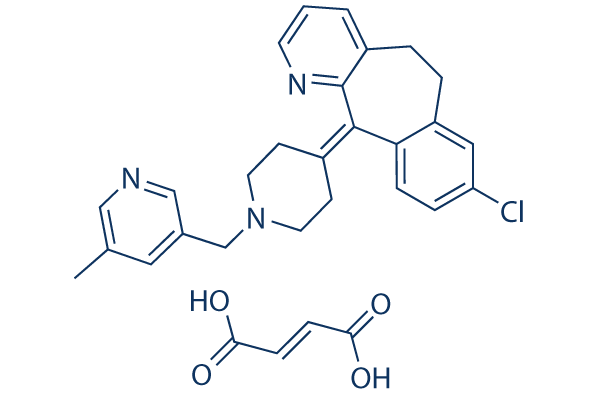
Rupatadine Fumarate Histamine Receptor inhibitor
Cat.No.S3052
Quality Control
| Related Targets | Adrenergic Receptor AChR 5-HT Receptor COX Calcium Channel Dopamine Receptor GABA Receptor TRP Channel Cholinesterase (ChE) GluR |
|---|---|
| Other Histamine Receptor Inhibitors | GSK2879552 Dihydrochloride JNJ-7777120 Mianserin HCl Ebastine Astemizole Ciproxifan Maleate Rupatadine Lafutidine Cloperastine hydrochloride Mizolastine |
Solubility
|
In vitro |
Ethanol : 13 mg/mL
DMSO
: 9 mg/mL
(16.91 mM)
Water : Insoluble |
Molarity Calculator
|
In vivo |
|||||
In vivo Formulation Calculator (Clear solution)
Step 1: Enter information below (Recommended: An additional animal making an allowance for loss during the experiment)
Step 2: Enter the in vivo formulation (This is only the calculator, not formulation. Please contact us first if there is no in vivo formulation at the solubility Section.)
Calculation results:
Working concentration: mg/ml;
Method for preparing DMSO master liquid: mg drug pre-dissolved in μL DMSO ( Master liquid concentration mg/mL, Please contact us first if the concentration exceeds the DMSO solubility of the batch of drug. )
Method for preparing in vivo formulation: Take μL DMSO master liquid, next addμL PEG300, mix and clarify, next addμL Tween 80, mix and clarify, next add μL ddH2O, mix and clarify.
Method for preparing in vivo formulation: Take μL DMSO master liquid, next add μL Corn oil, mix and clarify.
Note: 1. Please make sure the liquid is clear before adding the next solvent.
2. Be sure to add the solvent(s) in order. You must ensure that the solution obtained, in the previous addition, is a clear solution before proceeding to add the next solvent. Physical methods such
as vortex, ultrasound or hot water bath can be used to aid dissolving.
Chemical Information, Storage & Stability
| Molecular Weight | 532.03 | Formula | C26H26ClN3.C4H4O4 |
Storage (From the date of receipt) | |
|---|---|---|---|---|---|
| CAS No. | 182349-12-8 | Download SDF | Storage of Stock Solutions |
|
|
| Synonyms | N/A | SMILES | CC1=CC(=CN=C1)CN2CCC(=C3C4=C(CCC5=C3N=CC=C5)C=C(C=C4)Cl)CC2.C(=CC(=O)O)C(=O)O | ||
Read more about storage stability stock solution CAS number SMILES
Mechanism of Action
| Targets/IC50/Ki |
Histamine H1 receptor
102 nM(Ki)
PAFR
550 nM(Ki)
|
|---|---|
| In vitro |
Rupatadine inhibits both platelet-activating factor (PAF) and histamine (H1) effects through its interaction with specific receptors. Rupatadine competitively inhibits histamine-induced guinea pig ileum contraction (pA2 = 9.29 ± 0.06) without affecting contraction induced by ACh, serotonin or leukotriene D4(LTD4). It also competitively inhibits PAF-induced platelet aggregation in washed rabbit platelets (WRP) (pA2= 6.68 ± 0.08) and in human platelet-rich plasma (HPRP) (IC50 = 0.68 μM), while not affecting ADP- or arachidonic acid-induced platelet aggregation. In another study, it is reported rupatadine and loratadine shows similar inhibitory effect on histamine and TNF-α release, whereas SR-27417A only exhibits inhibitory effect against TNF-α.
|
| Kinase Assay |
[3H]-Pyrilamine binding to histamine (H1) receptors in guinea pig cerebellum membranes.
|
|
Antagonists are incubated with guinea pig cerebellum membranes (0.6 mg/ml) and [3H]-pyrilamine (1.2 nM) in 0.5 ml 50 mM PBS, pH 7.5, for 30 min at 25 ℃. The incubation is ended by the addition of 5 ml of ice-cold PBS containing 2 μM pyrilamine and the collection of membranes on Whatman GF/B filters. Then the filters are washed with 3 × 5 ml of ice-cold PBS plus 2 μM pyrilamine and transferred to counting vials. The radioactivity retained by each filter is measured by liquid scintillation counting in 3 ml of HiSafe 3. Specific binding is determined from the difference between the [3H]-pyrilamine bound in the absence and in the presence of a large molar excess (10 μM) of unlabeled promethazine.
|
|
| In vivo |
Rupatadine blocks histamine- and PAF-induced effects in vivo, such as hypotension in rats (ID50 = 1.4 and 0.44 mg/kg i.v., respectively) and bronchoconstriction in guinea pigs (ID50 = 113 and 9.6 μg/kg i.v.). Moreover, it potently inhibits PAF-induced mortality in mice (ID50 = 0.31 and 3.0 mg/kg i.v. and p.o., respectively) and endotoxin-induced mortality in mice and rats (ID50 = 1.6 and 0.66 mg/kg i.v.). Rupatadine's duration of action is long, as assessed by the histamine- and PAF-induced increase in vascular permeability test in dogs (42 and 34% inhibition at 26 h after 1 mg/kg p.o.). Rupatadine at a dose of 100 mg/kg p.o. neither modifies spontaneous motor activity nor prolongs barbiturate-sleeping time in mice, which indicates a lack of sedative effects.
|
References |
|
Clinical Trial Information
(data from https://clinicaltrials.gov, updated on 2024-05-22)
| NCT Number | Recruitment | Conditions | Sponsor/Collaborators | Start Date | Phases |
|---|---|---|---|---|---|
| NCT01605487 | Completed | Cold Contact Urticaria |
Charite University Berlin Germany|Hospital del Mar |
2012-06 | Phase 2 |
| NCT00199251 | Terminated | Urticaria |
J. Uriach and Company |
2004-04 | Phase 3 |
Read more about Clinical Trials
Tech Support
Tel: +1-832-582-8158 Ext:3
If you have any other enquiries, please leave a message.
Signaling Pathway Map

Products are for research use only. Not for human use. We do not sell to patients.
©Copyright 2013 Selleck Chemicals. All Rights Reserved.