
-
 Argentina
-
 Australia
-
 Austria
-
 Belgium
-
 Brazil
-
 Canada
-
 China
China
-
 Czech Republic
-
 Denmark
-
 Finland
-
 France
-
 Germany
-
 Greece
-
 Hong Kong
-
 Hungary
-
 Iceland
-
 India
India
-
 Ireland
-
 Israel
-
 Italy
Italy
-
 Japan
Japan
-
 Korea
Korea
-
 Luxembourg
-
 Malaysia
-
 Netherlands
-
 New Zealand
-
 Norway
-
 Poland
-
 Portugal
-
 Qatar
Qatar
-
 Romania
-
 Saudi Arabia
-
 Singapore
-
 Spain
Spain
-
 Sweden
-
 Switzerland
-
 Taiwan
-
 Turkey
-
 United Kingdom
-
 United States
research use only
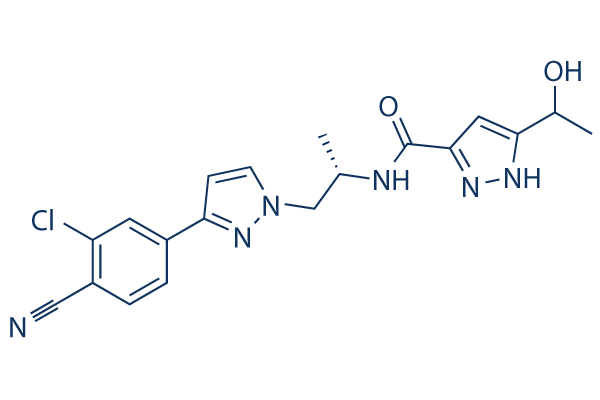
ODM-201 (Darolutamide) Androgen Receptor antagonist
Cat.No.S7559
Quality Control
| Related Targets | Adrenergic Receptor Estrogen/progestogen Receptor GPR Glucocorticoid Receptor ACE RAAS Progesterone Receptor Opioid Receptor THR PGES |
|---|---|
| Other Androgen Receptor Inhibitors | Bavdegalutamide (ARV-110) RU58841 EPI-001 Galeterone Cyproterone Acetate 3,3'-Diindolylmethane JNJ-63576253 (TRC-253) Ailanthone Proxalutamide (GT0918) Rezvilutamide |
Solubility
|
In vitro |
DMSO
: 80 mg/mL
(200.57 mM)
Ethanol : 38 mg/mL Water : Insoluble |
Molarity Calculator
|
In vivo |
|||||
In vivo Formulation Calculator (Clear solution)
Step 1: Enter information below (Recommended: An additional animal making an allowance for loss during the experiment)
Step 2: Enter the in vivo formulation (This is only the calculator, not formulation. Please contact us first if there is no in vivo formulation at the solubility Section.)
Calculation results:
Working concentration: mg/ml;
Method for preparing DMSO master liquid: mg drug pre-dissolved in μL DMSO ( Master liquid concentration mg/mL, Please contact us first if the concentration exceeds the DMSO solubility of the batch of drug. )
Method for preparing in vivo formulation: Take μL DMSO master liquid, next addμL PEG300, mix and clarify, next addμL Tween 80, mix and clarify, next add μL ddH2O, mix and clarify.
Method for preparing in vivo formulation: Take μL DMSO master liquid, next add μL Corn oil, mix and clarify.
Note: 1. Please make sure the liquid is clear before adding the next solvent.
2. Be sure to add the solvent(s) in order. You must ensure that the solution obtained, in the previous addition, is a clear solution before proceeding to add the next solvent. Physical methods such
as vortex, ultrasound or hot water bath can be used to aid dissolving.
Chemical Information, Storage & Stability
| Molecular Weight | 398.85 | Formula | C19H19ClN6O2 |
Storage (From the date of receipt) | |
|---|---|---|---|---|---|
| CAS No. | 1297538-32-9 | Download SDF | Storage of Stock Solutions |
|
|
| Synonyms | BAY-1841788 | SMILES | CC(CN1C=CC(=N1)C2=CC(=C(C=C2)C#N)Cl)NC(=O)C3=NNC(=C3)C(C)O | ||
Read more about storage stability stock solution CAS number SMILES
Mechanism of Action
| Targets/IC50/Ki |
Androgen receptor
11 nM(Ki)
|
|---|---|
| In vitro |
In AR-HEK293 cells stably expressing full-length hAR, Darolutamide (ODM-201) inhibits human AR (hAR) with IC50 of 26 nM. It inhibits VCaP cell proliferation with IC50 of 230 nM, while has no effect on the viability of AR-negative cell lines tested, DU-145 prostate cancer cells and H1581 lung cancer cells.
|
| Kinase Assay |
AR binding affinity
|
|
AR binding affinities of test compounds, including Darolutamide (ODM-201), are studied in cytosolic lysates obtained from ventral prostates of castrated rats by a competition binding assay. Fresh prostates are minced and homogenized with Buffer A containing protease inhibitors. The homogenates are centrifuged and the resultant supernatants are treated with a dextran-coated charcoal solution to remove endogenous steroids. The dissociation constant of the radio ligand [3H]mibolerone for isolated rat ARs is determined in a saturation binding experiment. For the determination of Ki values, prostate cytosol preparations and 1 nM [3H]mibolerone are incubated with increasing concentrations of test compounds overnight. After the incubation, bound and free steroids are separated by treatment with 100 μL of dextran-coated charcoal suspension. Bound radioactivity is determined by counting 100 μL of supernatant fraction in 200 μL of scintillation fluid using a microbeta counter. All procedures are carried out at 0–4 °C.
|
|
| In vivo |
In mice bearing VCaP xenografts, Darolutamide (ODM-201) (50 mg/kg, p.o.) significantly inhibits castration-resistant prostate tumor growth.
|
References |
Clinical Trial Information
(data from https://clinicaltrials.gov, updated on 2026-07-31)
| NCT Number | Recruitment | Conditions | Sponsor/Collaborators | Start Date | Phases |
|---|---|---|---|---|---|
| NCT06625970 | RECRUITING | High Risk Prostate Carcinoma; Prostate Cancer |
UNICANCER |
2025-04-10 | PHASE3 |
| NCT07190300 | RECRUITING | Metastatic Hormone-Sensitive Prostate Cancer (mHSPC) |
Novartis Pharmaceuticals |
2026-01-13 | PHASE1; PHASE2 |
| NCT07730151 | NOT_YET_RECRUITING | Prostate Cancer; Prostate; Prostate Cancer Patients |
RenJi Hospital |
2026-08-01 | PHASE2 |
| NCT07649421 | NOT_YET_RECRUITING | Metastatic Hormone-Sensitive Prostate Cancer (mHSPC) |
West China Hospital |
2026-08-01 | PHASE2 |
| NCT07711002 | NOT_YET_RECRUITING | Metastatic Hormone-Sensitive Prostate Cancer (mHSPC) |
AstraZeneca |
2026-10-01 | PHASE3 |
| NCT05367440 | ACTIVE_NOT_RECRUITING | Metastatic Prostate Cancer |
AstraZeneca |
2022-06-02 | PHASE1; PHASE2 |
Read more about Clinical Trials
Tech Support
Tel: +1-832-582-8158 Ext:3
If you have any other enquiries, please leave a message.
Signaling Pathway Map

Products are for research use only. Not for human use. We do not sell to patients.
©Copyright 2013 Selleck Chemicals. All Rights Reserved.