
-
 Argentina
-
 Australia
-
 Austria
-
 Belgium
-
 Brazil
-
 Canada
-
 China
China
-
 Czech Republic
-
 Denmark
-
 Finland
-
 France
-
 Germany
-
 Greece
-
 Hong Kong
-
 Hungary
-
 Iceland
-
 India
India
-
 Ireland
-
 Israel
-
 Italy
Italy
-
 Japan
Japan
-
 Korea
Korea
-
 Luxembourg
-
 Malaysia
-
 Netherlands
-
 New Zealand
-
 Norway
-
 Poland
-
 Portugal
-
 Qatar
Qatar
-
 Romania
-
 Saudi Arabia
-
 Singapore
-
 Spain
Spain
-
 Sweden
-
 Switzerland
-
 Taiwan
-
 Turkey
-
 United Kingdom
-
 United States
research use only
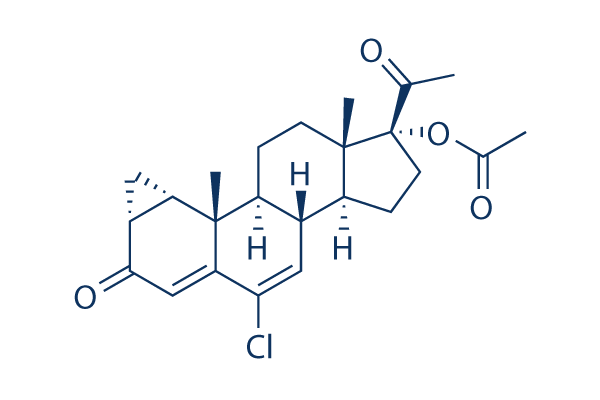
Cyproterone Acetate Androgen Receptor antagonist
Cat.No.S2042
Quality Control
| Related Targets | Adrenergic Receptor Estrogen/progestogen Receptor GPR Glucocorticoid Receptor ACE RAAS Progesterone Receptor Opioid Receptor THR PGES |
|---|---|
| Other Androgen Receptor Inhibitors | Bavdegalutamide (ARV-110) RU58841 EPI-001 Galeterone 3,3'-Diindolylmethane JNJ-63576253 (TRC-253) Ailanthone Proxalutamide (GT0918) Rezvilutamide AZD9750 |
Solubility
|
In vitro |
DMSO
: 83 mg/mL
(199.06 mM)
Ethanol : 20 mg/mL Water : Insoluble |
Molarity Calculator
|
In vivo |
|||||
In vivo Formulation Calculator (Clear solution)
Step 1: Enter information below (Recommended: An additional animal making an allowance for loss during the experiment)
Step 2: Enter the in vivo formulation (This is only the calculator, not formulation. Please contact us first if there is no in vivo formulation at the solubility Section.)
Calculation results:
Working concentration: mg/ml;
Method for preparing DMSO master liquid: mg drug pre-dissolved in μL DMSO ( Master liquid concentration mg/mL, Please contact us first if the concentration exceeds the DMSO solubility of the batch of drug. )
Method for preparing in vivo formulation: Take μL DMSO master liquid, next addμL PEG300, mix and clarify, next addμL Tween 80, mix and clarify, next add μL ddH2O, mix and clarify.
Method for preparing in vivo formulation: Take μL DMSO master liquid, next add μL Corn oil, mix and clarify.
Note: 1. Please make sure the liquid is clear before adding the next solvent.
2. Be sure to add the solvent(s) in order. You must ensure that the solution obtained, in the previous addition, is a clear solution before proceeding to add the next solvent. Physical methods such
as vortex, ultrasound or hot water bath can be used to aid dissolving.
Chemical Information, Storage & Stability
| Molecular Weight | 416.94 | Formula | C24H29ClO4 |
Storage (From the date of receipt) | |
|---|---|---|---|---|---|
| CAS No. | 427-51-0 | Download SDF | Storage of Stock Solutions |
|
|
| Synonyms | N/A | SMILES | CC(=O)C1(CCC2C1(CCC3C2C=C(C4=CC(=O)C5CC5C34C)Cl)C)OC(=O)C | ||
Read more about storage stability stock solution CAS number SMILES
Mechanism of Action
| Targets/IC50/Ki |
Androgen Receptor
7.1 nM
|
|---|---|
| In vitro |
Cyproterone acetate clearly shows antagonistic properties, while being a partial agonist also, showing agonism for the AR, with EC50 of 4.0 μM, at relatively high concentrations. In the presence of 10 nM Testosterone, low concentrations of Cyproterone acetate inhibits T-stimulated transcription of 3XHRE-LUC, but at higher concentrations, transcription is stimulated.
|
| In vivo |
LH levels in Cyproterone acetate-treated rats do not dip below pretreatment levels, although they does not increase as much in the rats treated with 3.2 mg Cyproterone acetate/kg/day as in those which received 0.2 mg Cyproterone acetate/kg/day. Cyproterone acetate exhibits direct negative effect on reproductive organs weight and significant reducing effect on sperm count and Ca2+ contents. SOD and GST activities significantly decrease in addition to significant increase in NO, MDA contents reflecting the oxidative status of testis in Cyproterone acetate treated rats. Cyproterone acetate treatment plus artificial long days in autumn has a negative effect on sperm motility and sperm morphology. Androgen receptor occupation by Cyproterone acetate preferentially reduces the levels of spermatidal protamine in testis and spermatozoa involved in nuclear chromatin condensation.
|
References |
|
Clinical Trial Information
(data from https://clinicaltrials.gov, updated on 2026-07-21)
| NCT Number | Recruitment | Conditions | Sponsor/Collaborators | Start Date | Phases |
|---|---|---|---|---|---|
| NCT07714616 | NOT_YET_RECRUITING | Contraception |
Eurofarma Laboratorios S.A. |
2027-05-31 | PHASE3 |
| NCT07513480 | COMPLETED | PCOS |
Mst.Sumyara Khatun |
2024-08-12 | |
| NCT07145281 | COMPLETED | Gender Dysphoria, Adult; Blood Coagulation; Coagulation Factors; Transgender Persons, M01.777.500; Hemostasis; Transgender Women |
Tel-Aviv Sourasky Medical Center |
2022-11-10 | |
| NCT04590417 | ACTIVE_NOT_RECRUITING | Drug Interaction |
Thai Red Cross AIDS Research Centre |
2022-01-24 | |
| NCT04831151 | UNKNOWN | Polycystic Ovary Syndrome |
Inonu University |
2021-03-01 | |
| NCT01973816 | COMPLETED | Endometriosis |
University Hospital, Rouen |
2014-09-09 | PHASE3 |
Read more about Clinical Trials
Tech Support
Tel: +1-832-582-8158 Ext:3
If you have any other enquiries, please leave a message.
Signaling Pathway Map

Products are for research use only. Not for human use. We do not sell to patients.
©Copyright 2013 Selleck Chemicals. All Rights Reserved.