
-
 Argentina
-
 Australia
-
 Austria
-
 Belgium
-
 Brazil
-
 Canada
-
 China
China
-
 Czech Republic
-
 Denmark
-
 Finland
-
 France
-
 Germany
-
 Greece
-
 Hong Kong
-
 Hungary
-
 Iceland
-
 India
India
-
 Ireland
-
 Israel
-
 Italy
Italy
-
 Japan
Japan
-
 Korea
Korea
-
 Luxembourg
-
 Malaysia
-
 Netherlands
-
 New Zealand
-
 Norway
-
 Poland
-
 Portugal
-
 Qatar
Qatar
-
 Romania
-
 Saudi Arabia
-
 Singapore
-
 Spain
Spain
-
 Sweden
-
 Switzerland
-
 Taiwan
-
 Turkey
-
 United Kingdom
-
 United States
research use only
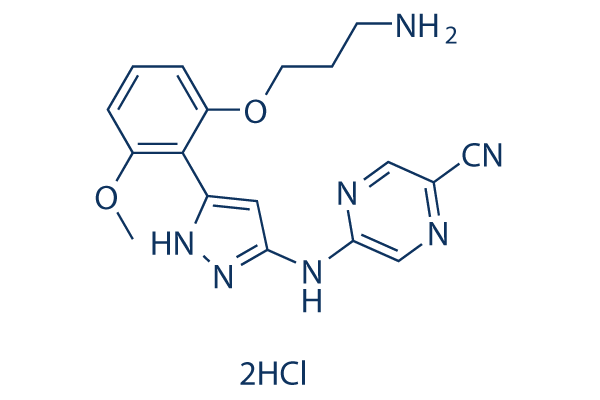
Prexasertib (LY2606368) Dihydrochloride CHK1 Inhibitor
Cat.No.S7178
Quality Control
Products Often Used Together with Prexasertib (LY2606368) Dihydrochloride
Cell Culture, Treatment & Working Concentration
| Cell Lines | Assay Type | Concentration | Incubation Time | Formulation | Activity Description | PMID |
|---|---|---|---|---|---|---|
| HeLa cells | Function assay | 33 or 100 nmol/L | 7 hours | by 7 hours, a subpopulation of cells stained strongly for DSB by both TUNEL and pH2AX | 26141948 | |
| U-2 OS cells | Function assay | 4 nmol/L | 24 h | a large shift in cell-cycle populations from G1 and G2–M to S-phase with an accompanied induction of H2AX phosphorylation. | 26141948 | |
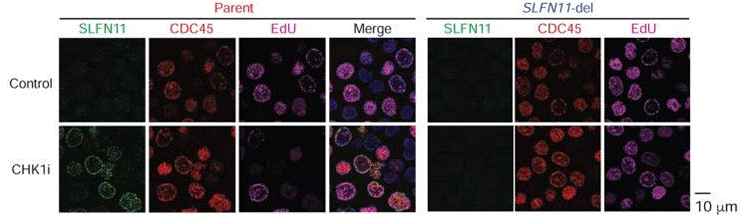
| CCRF-CEM parental cells | Function assay | 10 nM | 4 h | induced SLFN11 binding to chromatin and increased the chromatin binding of CDC45 | 29395061 | |
| SLFN11-del cells | Function assay | 10 nM | 4 h | induced SLFN11 binding to chromatin and increased the chromatin binding of CDC45 | 29395061 | |
| K562-WT | Function assay | 100 nM | 2 h | SLFN11, CDC45 and PCNA were enriched on nascent DNA | 29395061 | |
| K562-E669Q | Function assay | 100 nM | 2 h | SLFN11, CDC45 and PCNA were enriched on nascent DNA | 29395061 | |
| CCRF-CEM parental cells | Function assay | 100 nM | 2 h | SLFN11, CDC45 and PCNA were enriched on nascent DNA | 29395061 | |
| HCT-116 cells | Function assay | 10 days | inhibited both FANCD2 ubiquitination and increased Rad51 levels, significantly increased sensitivity of HCT-116 cells to F10 | 30439567 | ||
| U937 cells | Function assay | 3 nM | enhanced the cytotoxicity of CPX-351 at low nanomolar concentrations | 30837643 | ||
| KB-3-1 | Function assay | P-glycoprotein substrates identified in KB-3-1 adenocarcinoma cell line, qHTS therapeutic library screen | 31515284 | |||
| KB-8-5-11 | Function assay | P-glycoprotein substrates identified in KB-8-5-11 adenocarcinoma cell line, qHTS therapeutic library screen, Potency = 1.2995 μM. | 31515284 | |||
| Click to View More Cell Line Experimental Data | ||||||
Solubility
|
In vitro |
DMSO
: 17 mg/mL
(38.78 mM)
Water : Insoluble Ethanol : Insoluble |
Molarity Calculator
|
In vivo |
|||||
In vivo Formulation Calculator (Clear solution)
Step 1: Enter information below (Recommended: An additional animal making an allowance for loss during the experiment)
Step 2: Enter the in vivo formulation (This is only the calculator, not formulation. Please contact us first if there is no in vivo formulation at the solubility Section.)
Calculation results:
Working concentration: mg/ml;
Method for preparing DMSO master liquid: mg drug pre-dissolved in μL DMSO ( Master liquid concentration mg/mL, Please contact us first if the concentration exceeds the DMSO solubility of the batch of drug. )
Method for preparing in vivo formulation: Take μL DMSO master liquid, next addμL PEG300, mix and clarify, next addμL Tween 80, mix and clarify, next add μL ddH2O, mix and clarify.
Method for preparing in vivo formulation: Take μL DMSO master liquid, next add μL Corn oil, mix and clarify.
Note: 1. Please make sure the liquid is clear before adding the next solvent.
2. Be sure to add the solvent(s) in order. You must ensure that the solution obtained, in the previous addition, is a clear solution before proceeding to add the next solvent. Physical methods such
as vortex, ultrasound or hot water bath can be used to aid dissolving.
Chemical Information, Storage & Stability
| Molecular Weight | 438.31 | Formula | C18H19N7O2.2HCl |
Storage (From the date of receipt) | |
|---|---|---|---|---|---|
| CAS No. | 1234015-54-3 | Download SDF | Storage of Stock Solutions |
|
|
| Synonyms | N/A | SMILES | COC1=C(C(=CC=C1)OCCCN)C2=CC(=NN2)NC3=NC=C(N=C3)C#N.Cl.Cl | ||
Read more about storage stability stock solution CAS number SMILES
Mechanism of Action
| Targets/IC50/Ki |
Chk1
(Cell-free assay) 0.9 nM(Ki)
Chk2
(Cell-free assay) 8 nM
RSK
(Cell-free assay) 9 nM
|
|---|---|
| In vitro |
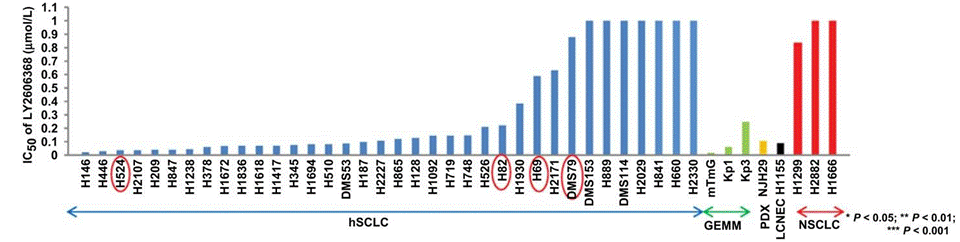
In nonclinical studies, Prexasertib HCl (LY2606368) induced DNA damage as measured by replication catastrophe and increases in pH2A.X, a marker of double-stranded DNA breaks. Treatment of cells with this compound results in the rapid appearance of TUNEL and pH2AX-positive double-stranded DNA breaks in the S-phase cell population. In a functional assay, it potently abrogated the G2–M checkpoint activated by doxorubicin in p53-deficient HeLa cells with an EC50 of 9 nmol/L. It was broadly antiproliferative with IC50 values typically <50 nmol/L in the most sensitive cell lines with a minority of cell lines showing considerable resistance with IC50's >1,000 nmol/L. This compound requires CDC25A and CDK2 to cause DNA damage. |
| In vivo |
Prexasertib HCl (LY2606368) inhibited tumor growth in cancer xenografts as monotherapy and in combination with other agents. In an orthotopic SKOV3 ovarian cancer model, it was shown to inhibit the growth of primary tumors and significantly reduce the incidence of metastases and ascites accumulation. This compound also demonstrated efficacy in an SW1990 orthotopic pancreatic cancer model resulting in a 92% inhibition of primary tumor growth and the elimination of metastases to the lymphnode, spleen, and intestine. |
References |
|
Applications
| Methods | Biomarkers | Images | PMID |
|---|---|---|---|
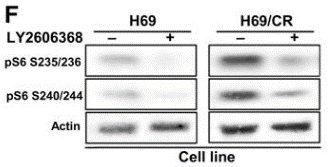
| Western blot | pS6 (S235/236) / pS6 (S240/244) CHK1 / p-CHK1(Ser345) / γH2AX / Cleaved caspase3 |
|
28490518 |
| Immunofluorescence | SLFN11 / CDC45 / EdU |
|
29395061 |
| Growth inhibition assay | IC50 Cell viability |
|
28490518 |
Clinical Trial Information
(data from https://clinicaltrials.gov, updated on 2025-02-07)
| NCT Number | Recruitment | Conditions | Sponsor/Collaborators | Start Date | Phases |
|---|---|---|---|---|---|
| NCT04023669 | COMPLETED | Brain Tumor; Brain Tumor, Recurrent; Brain Tumor, Refractory; Brain Tumor, Pediatric; Medulloblastoma; Medulloblastoma Recurrent; Medulloblastoma, Non-WNT/Non-SHH; Medulloblastoma, Non-WNT/Non-SHH, Group 3; Medulloblastoma, Non-WNT/Non-SHH, Group 4; Brain Cancer; CNS Cancer; CNS Tumor; CNS Neoplasm |
St. Jude Children's Research Hospital |
2019-08-08 | PHASE1 |
| NCT02649764 | COMPLETED | Chronic Myelomonocytic Leukemia; Recurrent Acute Myeloid Leukemia; Recurrent High Risk Myelodysplastic Syndrome; Refractory Acute Myeloid Leukemia; Refractory High Risk Myelodysplastic Syndrome |
M.D. Anderson Cancer Center |
2016-05-04 | PHASE1 |
| NCT02203513 | TERMINATED | Ovarian Cancer; Breast Cancer; Prostate Cancer |
National Cancer Institute (NCI) |
2015-01-20 | PHASE2 |
| NCT03495323 | COMPLETED | Cancer |
Dana-Farber Cancer Institute |
2018-05-16 | PHASE1 |
| NCT02873975 | COMPLETED | Advanced Cancers |
Dana-Farber Cancer Institute |
2016-10-12 | PHASE2 |
| NCT03057145 | COMPLETED | Solid Tumor |
Geoffrey Shapiro, MD, PhD |
2017-03-10 | PHASE1 |
Read more about Clinical Trials
Tech Support
Tel: +1-832-582-8158 Ext:3
If you have any other enquiries, please leave a message.
Frequently Asked Questions
Question 1:
Would you please suggest a suitable vehicle to dissolve it for in vivo use?
Answer:
It can be dissolved in a vehicle: 5% DMSO+40%PEG 300+5%Tween80+ddH2O for in vivo use in mice (i.p.). This stock concentration reaches 10mg/ml, and can be prepared for work solution as 0.5mg/ml, stable for no longer than 30min.
Question 2:
What is the solubility of it in 20% Captisol?
Answer:
It is a suspension in 20% Captisol, which is fine for oral gavage. You can dissolve this compound in this vehicle to the concentration you need as long as the suspension is homogeneous.
Signaling Pathway Map

Products are for research use only. Not for human use. We do not sell to patients.
©Copyright 2013 Selleck Chemicals. All Rights Reserved.