
-
 Argentina
-
 Australia
-
 Austria
-
 Belgium
-
 Brazil
-
 Canada
-
 China
China
-
 Czech Republic
-
 Denmark
-
 Finland
-
 France
-
 Germany
-
 Greece
-
 Hong Kong
-
 Hungary
-
 Iceland
-
 India
India
-
 Ireland
-
 Israel
-
 Italy
Italy
-
 Japan
Japan
-
 Korea
Korea
-
 Luxembourg
-
 Malaysia
-
 Netherlands
-
 New Zealand
-
 Norway
-
 Poland
-
 Portugal
-
 Qatar
Qatar
-
 Romania
-
 Saudi Arabia
-
 Singapore
-
 Spain
Spain
-
 Sweden
-
 Switzerland
-
 Taiwan
-
 Turkey
-
 United Kingdom
-
 United States
research use only
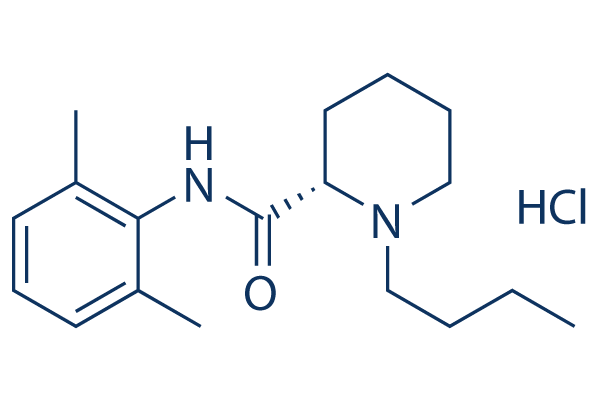
Levobupivacaine HCl Sodium Channel inhibitor
Cat.No.S4061
Quality Control
| Related Targets | CFTR CRM1 CD markers AChR Calcium Channel Potassium Channel GABA Receptor TRP Channel ATPase GluR |
|---|---|
| Other Sodium Channel Inhibitors | Camostat Mesilate A-803467 cariporide GS967 Veratramine Tolperisone HCl Bulleyaconi cine A Vinpocetine Tenapanor PF-06869206 |
Solubility
|
In vitro |
DMSO
: 64 mg/mL
(196.98 mM)
Water : 64 mg/mL Ethanol : 57 mg/mL |
Molarity Calculator
|
In vivo |
|||||
In vivo Formulation Calculator (Clear solution)
Step 1: Enter information below (Recommended: An additional animal making an allowance for loss during the experiment)
Step 2: Enter the in vivo formulation (This is only the calculator, not formulation. Please contact us first if there is no in vivo formulation at the solubility Section.)
Calculation results:
Working concentration: mg/ml;
Method for preparing DMSO master liquid: mg drug pre-dissolved in μL DMSO ( Master liquid concentration mg/mL, Please contact us first if the concentration exceeds the DMSO solubility of the batch of drug. )
Method for preparing in vivo formulation: Take μL DMSO master liquid, next addμL PEG300, mix and clarify, next addμL Tween 80, mix and clarify, next add μL ddH2O, mix and clarify.
Method for preparing in vivo formulation: Take μL DMSO master liquid, next add μL Corn oil, mix and clarify.
Note: 1. Please make sure the liquid is clear before adding the next solvent.
2. Be sure to add the solvent(s) in order. You must ensure that the solution obtained, in the previous addition, is a clear solution before proceeding to add the next solvent. Physical methods such
as vortex, ultrasound or hot water bath can be used to aid dissolving.
Chemical Information, Storage & Stability
| Molecular Weight | 324.89 | Formula | C18H28N2O.HCl |
Storage (From the date of receipt) | |
|---|---|---|---|---|---|
| CAS No. | 27262-48-2 | Download SDF | Storage of Stock Solutions |
|
|
| Synonyms | (S)-(-)-Bupivacaine HCl | SMILES | CCCCN1CCCCC1C(=O)NC2=C(C=CC=C2C)C.Cl | ||
Read more about storage stability stock solution CAS number SMILES
Mechanism of Action
| Targets/IC50/Ki |
Sodium Channel
|
|---|---|
| In vitro |
Levobupivacaine is an amide-type local anaesthetic. Levobupivacaine acts via blockade of voltage-sensitive ion channels in neuronal membranes, preventing transmission of nerve impulses. Localised and reversible anaesthesia is produced by interference with the opening of the sodium channel, which inhibits conduction of the action potential in nerves involved in sensory and motor activity and sympathetic activity.
Levobupivacaine displaces 3H-BTX from sodium channels of rat brain synaptosomes with IC50 of 2.9 μM and Hill coefficients of 1.2. When cell membrane is held at -80 mV, -70 mV, -60 mV or -100 mV, Levobupivacaine shows tonic inhibition of sodium channel in GH3 cells with IC50s of 132.1, 37.6, 21.6 and 264 μM, respectively.
Levobupivacaine depresses action potential of isolated axon in vitro. Levobupivacaine (1mM) depresses action potential amplitude and maximal rate of rise of action potential (dV/dtmax) in the crayfish giant axons with value of 88 and 81 respectively, after perfusion for 15 min.
Levobupivacaine also displays activity on cardiac ion channels. In isolated ventricular myocytes, the apparent affinity for inactivated state of the sodium channel is 4.8 μM for Levobupivacaine, with a calculated KD of 39μM. On inhibition of cardiac delayed rectifier potassium channels (hKv1.5), the steady-state block for Levobupivacaine (20 μM) is 31%, with a calculated KD of 27.3 μM. Levobupivacaine may also inhibit cardiac calcium channels. 10 μM Levobupivacaine produces a 50% decrease in contractile force of guinea-pig papillary muscles.
|
| In vivo |
Levobupivacaine has similar nerve blocking potency with bupivacaine. Levobupivacaine at a dose of 0.125%, inhibits motor and nocifensive pinch responses with maximum %MPE of 99 and 68 respectively, and inhibits the duration of deficits of motor and nocifensive pinch responses (60 and 30 , respectively) after sciatic nerve block.
|
References |
|
Clinical Trial Information
(data from https://clinicaltrials.gov, updated on 2024-05-22)
| NCT Number | Recruitment | Conditions | Sponsor/Collaborators | Start Date | Phases |
|---|---|---|---|---|---|
| NCT04221568 | Unknown status | Labor Pain |
Assiut University |
2020-03-01 | Phase 1 |
| NCT03258697 | Unknown status | Arthropathy |
Chang Gung Memorial Hospital |
2017-10-17 | Not Applicable |
Read more about Clinical Trials
Tech Support
Tel: +1-832-582-8158 Ext:3
If you have any other enquiries, please leave a message.
Signaling Pathway Map

Products are for research use only. Not for human use. We do not sell to patients.
©Copyright 2013 Selleck Chemicals. All Rights Reserved.