
-
 Argentina
-
 Australia
-
 Austria
-
 Belgium
-
 Brazil
-
 Canada
-
 China
China
-
 Czech Republic
-
 Denmark
-
 Finland
-
 France
-
 Germany
-
 Greece
-
 Hong Kong
-
 Hungary
-
 Iceland
-
 India
India
-
 Ireland
-
 Israel
-
 Italy
Italy
-
 Japan
Japan
-
 Korea
Korea
-
 Luxembourg
-
 Malaysia
-
 Netherlands
-
 New Zealand
-
 Norway
-
 Poland
-
 Portugal
-
 Qatar
Qatar
-
 Romania
-
 Saudi Arabia
-
 Singapore
-
 Spain
Spain
-
 Sweden
-
 Switzerland
-
 Taiwan
-
 Turkey
-
 United Kingdom
-
 United States
research use only
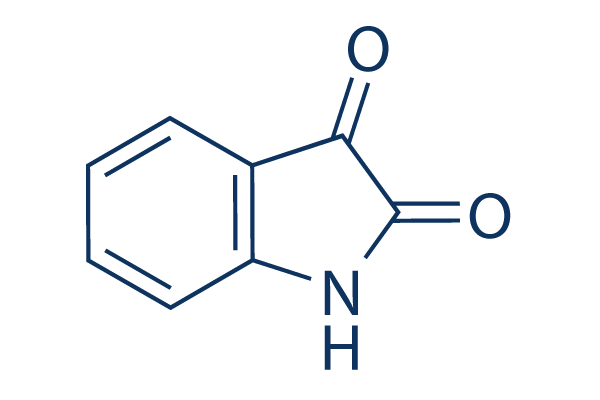
Isatin MAO inhibitor
Cat.No.S4717
Quality Control
Solubility
|
In vitro |
DMSO
: 29 mg/mL
(197.1 mM)
Ethanol : 10 mg/mL Water : Insoluble |
Molarity Calculator
|
In vivo |
|||||
In vivo Formulation Calculator (Clear solution)
Step 1: Enter information below (Recommended: An additional animal making an allowance for loss during the experiment)
Step 2: Enter the in vivo formulation (This is only the calculator, not formulation. Please contact us first if there is no in vivo formulation at the solubility Section.)
Calculation results:
Working concentration: mg/ml;
Method for preparing DMSO master liquid: mg drug pre-dissolved in μL DMSO ( Master liquid concentration mg/mL, Please contact us first if the concentration exceeds the DMSO solubility of the batch of drug. )
Method for preparing in vivo formulation: Take μL DMSO master liquid, next addμL PEG300, mix and clarify, next addμL Tween 80, mix and clarify, next add μL ddH2O, mix and clarify.
Method for preparing in vivo formulation: Take μL DMSO master liquid, next add μL Corn oil, mix and clarify.
Note: 1. Please make sure the liquid is clear before adding the next solvent.
2. Be sure to add the solvent(s) in order. You must ensure that the solution obtained, in the previous addition, is a clear solution before proceeding to add the next solvent. Physical methods such
as vortex, ultrasound or hot water bath can be used to aid dissolving.
Chemical Information, Storage & Stability
| Molecular Weight | 147.13 | Formula | C8H5NO2 |
Storage (From the date of receipt) | |
|---|---|---|---|---|---|
| CAS No. | 91-56-5 | Download SDF | Storage of Stock Solutions |
|
|
| Synonyms | 2,3-Indolinedione | SMILES | C1=CC=C2C(=C1)C(=O)C(=O)N2 | ||
Read more about storage stability stock solution CAS number SMILES
Mechanism of Action
| Targets/IC50/Ki |
MAO-B
(Cell-free assay) 14 μM
MAO
(Cell-free assay) 15 μM
MAO-A
(Cell-free assay) 58 μM
|
|---|---|
| In vitro |
Isatin induces apoptosis of MCF-7 cells. Bcl-2 expression is decreased and the ratio of Bcl-2 to Bax is significantly decreased by this compound. The mitochondrial transmembrane potential is markedly decreased and the release of cytochrome c into the cytosol is elevated following treatment with it. At the same time, caspase-9 and -3 are stimulated, followed by the degradation of ICAD, a caspase-3 substrate. This chemical and its analogs inhibits the proliferation of some cancer cells, including colon HT29, breast MCF-7, lung A549 and melanoma UACC903 cells and is a dual inhibitor of tubulin polymerization and the Akt pathway.
|
| In vivo |
Isatin is an endogenous indole that is increased in stress, inhibits monoamine oxidase (MAO) B and improves bradykinesia and striatal dopamine levels in rat models of Parkinson's disease. This compound has a distinct and discontinuous distribution in rat brain and other tissues; the highest concentrations in the brain are found in the hippocampus and cerebellum. In rodent models this chemical has been shown to cause a widespectrum of dose-dependent physiological and biological actions, such as anxiogenic and sedative effects, memory dysfunction and inhibition of food and water intake. Significantly, it readily crosses the blood-brain barrier so that a peritoneal dose of 100 mg/kg would result in a concentration of about 120 μM in the rat brain. This concentration would increase further with repeated injections.
|
References |
|
Tech Support
Tel: +1-832-582-8158 Ext:3
If you have any other enquiries, please leave a message.
Signaling Pathway Map

Products are for research use only. Not for human use. We do not sell to patients.
©Copyright 2013 Selleck Chemicals. All Rights Reserved.