
-
 Argentina
-
 Australia
-
 Austria
-
 Belgium
-
 Brazil
-
 Canada
-
 China
China
-
 Czech Republic
-
 Denmark
-
 Finland
-
 France
-
 Germany
-
 Greece
-
 Hong Kong
-
 Hungary
-
 Iceland
-
 India
India
-
 Ireland
-
 Israel
-
 Italy
Italy
-
 Japan
Japan
-
 Korea
Korea
-
 Luxembourg
-
 Malaysia
-
 Netherlands
-
 New Zealand
-
 Norway
-
 Poland
-
 Portugal
-
 Qatar
Qatar
-
 Romania
-
 Saudi Arabia
-
 Singapore
-
 Spain
Spain
-
 Sweden
-
 Switzerland
-
 Taiwan
-
 Turkey
-
 United Kingdom
-
 United States
research use only
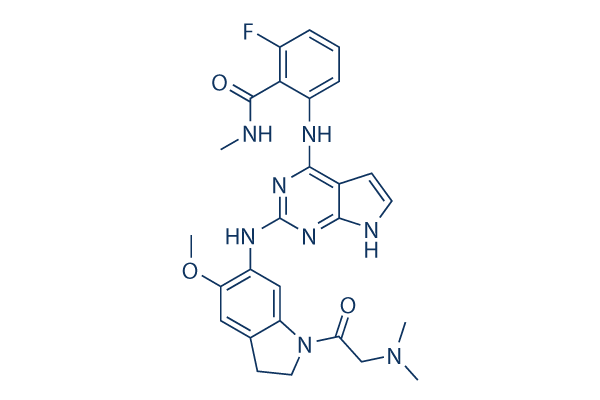
GSK1838705A ALK inhibitor
Cat.No.S2703
Quality Control
| Related Targets | EGFR VEGFR FGFR PDGFR c-Met Src MEK CSF-1R FLT3 HER2 |
|---|---|
| Other ALK Inhibitors | TAE684 (NVP-TAE684) Repotrectinib (TPX-0005) Ensartinib dihydrochloride AZD3463 AP26113-analog (ALK-IN-1) ASP3026 NVL-655 (Neladalkib) HG-14-10-04 X-376 ALK inhibitor 1 |
Solubility
|
In vitro |
DMSO
: 107 mg/mL
(200.91 mM)
Water : Insoluble Ethanol : Insoluble |
Molarity Calculator
|
In vivo |
|||||
In vivo Formulation Calculator (Clear solution)
Step 1: Enter information below (Recommended: An additional animal making an allowance for loss during the experiment)
Step 2: Enter the in vivo formulation (This is only the calculator, not formulation. Please contact us first if there is no in vivo formulation at the solubility Section.)
Calculation results:
Working concentration: mg/ml;
Method for preparing DMSO master liquid: mg drug pre-dissolved in μL DMSO ( Master liquid concentration mg/mL, Please contact us first if the concentration exceeds the DMSO solubility of the batch of drug. )
Method for preparing in vivo formulation: Take μL DMSO master liquid, next addμL PEG300, mix and clarify, next addμL Tween 80, mix and clarify, next add μL ddH2O, mix and clarify.
Method for preparing in vivo formulation: Take μL DMSO master liquid, next add μL Corn oil, mix and clarify.
Note: 1. Please make sure the liquid is clear before adding the next solvent.
2. Be sure to add the solvent(s) in order. You must ensure that the solution obtained, in the previous addition, is a clear solution before proceeding to add the next solvent. Physical methods such
as vortex, ultrasound or hot water bath can be used to aid dissolving.
Chemical Information, Storage & Stability
| Molecular Weight | 532.57 | Formula | C27H29FN8O3 |
Storage (From the date of receipt) | |
|---|---|---|---|---|---|
| CAS No. | 1116235-97-2 | Download SDF | Storage of Stock Solutions |
|
|
| Synonyms | N/A | SMILES | CNC(=O)C1=C(C=CC=C1F)NC2=NC(=NC3=C2C=CN3)NC4=C(C=C5CCN(C5=C4)C(=O)CN(C)C)OC | ||
Read more about storage stability stock solution CAS number SMILES
Mechanism of Action
| Features |
A small-molecule kinase inhibitor of IGF-1R and the insulin receptor.
|
|---|---|
| Targets/IC50/Ki |
ALK
(Cell-free assay) 0.5 nM
Insulin Receptor
(Cell-free assay) 1.6 nM
IGF-1R
(Cell-free assay) 2 nM
|
| In vitro |
GSK1838705A potently and ATP-competitively inhibits IGF-1R and IR with appKi values of 0.7 nM and 1.1 nM, respectively.In cells, this compound potently inhibits ligand-induced phosphorylation of IGF-1R and IR with IC50 of 85 nM and 79 nM, respectively. It shows the significant anti-proliferative effect in a panel of cell lines derived from solid and hematologic tumors such as L-82, SUP-M2, SK-ES and MCF-7 cells with EC50 of 24 nM, 28 nM, 141 nM and 203 nM, respectively. This chemical shows an accumulation of MCF-7 and NCl-H929 cells predominantly in G1 (2N) phase of the cell cycle. It also inhibits ALK with Ki of 0.35 nM and supresses the proliferation of nucleophosmin (NPM)-ALK fusion cells with EC50 of 24-88 nM. This compound potently inhibits NPM-ALK phosphorylation in Karpas-299 and SR-786 cells, while has modest effect on STAT3 phosphorylation.
|
| Kinase Assay |
Kinase Assays
|
|
Baculovirus-expressed glutathione S-transferase-tagged proteins encoding the intracellular domain of IGF-1R (amino acids 957-1367) and IR (amino acids 979-1382) are used for determinations of IC50s by a homogeneous time-resolved fluorescence assay. A filter binding assay is used for appKi determinations using activated IGF-1R and IR kinases. Expanded kinase-selectivity profiling of this compound is carried out by screening it in the KinaseProfiler panel.
|
|
| In vivo |
In NIH-3T3/LISN tumor-bearing mice, oral treatment of GSK1838705A (60 mg/kg) cause tumor growth inhibition by 77%, without significant weight loss. In COLO 205 tumor-bearing mice, inhibition of tumor growth by this compound (30 mg/kg) is 80%. Besides, the antitumor efficacy of this chemical is also observed in mice bearing HT29 xenograft or BxPC3 xenograft. In mice, this compound (60 mg/kg) leads to a transient 2-fold increase in blood glucose levels by inhibiting IR signaling. It (60 mg/kg) inhibits the growth of established Karpas-299 xenografts with 93% tumor growth inhibition, with no effect on weights of the rats.
|
References |
Tech Support
Tel: +1-832-582-8158 Ext:3
If you have any other enquiries, please leave a message.
Signaling Pathway Map

Products are for research use only. Not for human use. We do not sell to patients.
©Copyright 2013 Selleck Chemicals. All Rights Reserved.