
-
 Argentina
-
 Australia
-
 Austria
-
 Belgium
-
 Brazil
-
 Canada
-
 China
China
-
 Czech Republic
-
 Denmark
-
 Finland
-
 France
-
 Germany
-
 Greece
-
 Hong Kong
-
 Hungary
-
 Iceland
-
 India
India
-
 Ireland
-
 Israel
-
 Italy
Italy
-
 Japan
Japan
-
 Korea
Korea
-
 Luxembourg
-
 Malaysia
-
 Netherlands
-
 New Zealand
-
 Norway
-
 Poland
-
 Qatar
Qatar
-
 Romania
-
 Saudi Arabia
-
 Singapore
-
 Spain
Spain
-
 Sweden
-
 Switzerland
-
 Taiwan
-
 Turkey
-
 United Kingdom
-
 United States
research use only
ENMD-2076 L-(+)-Tartaric acid FLT3 inhibitor
Cat.No.S2018
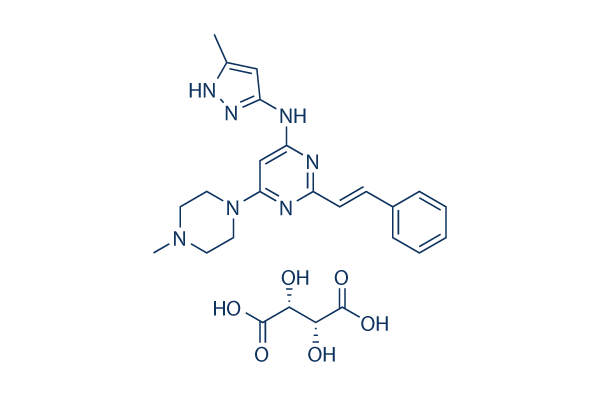
Chemical Structure
Molecular Weight: 525.56
Quality Control
| Related Targets | EGFR VEGFR JAK FGFR PDGFR Src HIF HER2 FLT Bcr-Abl |
|---|---|
| Other FLT3 Inhibitors | UNC2025 Crenolanib (CP-868596) Dovitinib (TKI-258) Dovitinib (TKI258) Lactate monohydrate Tandutinib (MLN518) ENMD-2076 KW-2449 AST-487 (NVP-AST487) TCS 359 FF-10101 |
Solubility
|
In vitro |
DMSO
: 100 mg/mL
(190.27 mM)
Water : Insoluble Ethanol : Insoluble |
Molarity Calculator
|
In vivo |
|||||
In vivo Formulation Calculator (Clear solution)
Step 1: Enter information below (Recommended: An additional animal making an allowance for loss during the experiment)
Step 2: Enter the in vivo formulation (This is only the calculator, not formulation. Please contact us first if there is no in vivo formulation at the solubility Section.)
Calculation results:
Working concentration: mg/ml;
Method for preparing DMSO master liquid: mg drug pre-dissolved in μL DMSO ( Master liquid concentration mg/mL, Please contact us first if the concentration exceeds the DMSO solubility of the batch of drug. )
Method for preparing in vivo formulation: Take μL DMSO master liquid, next addμL PEG300, mix and clarify, next addμL Tween 80, mix and clarify, next add μL ddH2O, mix and clarify.
Method for preparing in vivo formulation: Take μL DMSO master liquid, next add μL Corn oil, mix and clarify.
Note: 1. Please make sure the liquid is clear before adding the next solvent.
2. Be sure to add the solvent(s) in order. You must ensure that the solution obtained, in the previous addition, is a clear solution before proceeding to add the next solvent. Physical methods such
as vortex, ultrasound or hot water bath can be used to aid dissolving.
Chemical Information, Storage & Stability
| Molecular Weight | 525.56 | Formula | C25H31N7O6 |
Storage (From the date of receipt) | |
|---|---|---|---|---|---|
| CAS No. | 1291074-87-7 | -- | Storage of Stock Solutions |
|
|
| Synonyms | N/A | Smiles | CC1=CC(=NN1)NC2=CC(=NC(=N2)C=CC3=CC=CC=C3)N4CCN(CC4)C.C(C(C(=O)O)O)(C(=O)O)O | ||
Mechanism of Action
| Features |
Multi-functional molecule: multi-target, anti-proliferative, pro-apoptotic activity, and anti-angiogenic activity.
|
|---|---|
| Targets/IC50/Ki |
FLT3
1.86 nM
RET
10.4 nM
Aurora A
14 nM
VEGFR3/FLT4
15.9 nM
Src
20.2 nM
NTRK1/TRKA
24.2 nM
CSF-1R/c-Fms
24.8 nM
LCK
43.7 nM
FAK
54.9 nM
PDGFRα
56.4 nM
VEGFR2/KDR
58.2 nM
BLK
69.4 nM
FGFR2
70.8 nM
YES1
78.4 nM
Abl1 (T315I)
81.3 nM
FGFR1
92.7 nM
Fyn
112 nM
JAK2
120 nM
Kit
120 nM
Aurora B
350 nM
|
| In vitro |
ENMD-2076 indicates activity against multiple kinases involved in angiogenesis, including FLT3, RET, FLT4/VEGFR3, SRC, NTRK1, CSF1R/FMS, LCK, VEGFR2/KDR, FGFR1/2, and PDGFRα with IC50 from 1.86-120 nM. ENMD-2076 inhibits the growth of a wide range of human solid tumor and hematopoietic cancer cell lines with IC50 from 0.025-0.7 μM, which induces apoptosis and G2/M phase arrest. ENMD-2076 induces regression or complete inhibition of tumor growth in tumor xenograft models derived from breast, colon, melanoma, leukemia, and multiple myeloma cell lines. ENMD-2076 is the L (+) tartrate salt of ENMD-981693. ENMD-2076 shows significant cytotoxicity against myeloma cell lines (IM9, ARH-77, U266, RPMI 8226, MM.1S, MM.1R, NCI-H929) and primary cells with IC50 from 2.99 to 7.06 μM, which induces apoptosis. ENMD-2076 indicates low cytotoxicity to haematopoietic progenitors. ENMD-2076 inhibits the phosphoinositide 3-kinase/Akt pathway and downregulates survivin and X-linked inhibitor of apoptosis. ENMD-2076 also inhibits aurora A and B kinases, and induces G2/M cell cycle arrest.
|
| Kinase Assay |
Kinase assays
|
|
Recombinant Aurora A and B kinase enzymes and appropriate PanVera Z'-Lyte kinase assay kits are purchased. Assays are carried out in kinase assay buffer (50 mM of HEPES, pH 7.5, 10 mM of MgCl2, 5 mM of EGTA, 0.05% Brij-35) supplemented with 2 mM of DTT. Activities are determined at an ATP concentration equivalent to the apparent Km for each enzyme, and an enzyme concentration that results in approximately 30% phosphorylation of the peptide substrate after 1 hour. Dose–response curves of relative enzyme activity versus ENMD-2076 concentration are plotted with Grafit and used to calculate IC50 values. Potency of ENMD-2076 free base against a select panel of 100 kinase enzymes is determined using the SelectScreen kinase profiling service. ATP concentrations are at the apparent Km for each enzyme or 100 μM if the apparent Km could not be reached. Percent inhibition is determined at an ENMD-2076 free base concentration of 1 μM; for kinases where significant inhibition is noted, IC50 values are determined by generating full 10-point dose–response curves.
|
|
| In vivo |
ENMD-2076 has sustained inhibitory effects on the activation of Flt3 as well as VEGFR2/KDR and FGFR1/2 in HT29 xenograft model. ENMD-2076 could prevent the formation of new blood vessels and regress formed vessels in MDA-MB-231 xenograft model. Oral treatment with ENMD-2076 (50, 100, 200 mg/kg per day) inhibits the tumour growth in H929 human plasmacytoma xenografts, with significant reduction in phospho-Histone 3 (pH3), Ki-67, and angiogenesis, and also a significant increase in cleaved caspase-3.
|
References |
|
Clinical Trial Information
(data from https://clinicaltrials.gov, updated on 2024-05-22)
| NCT Number | Recruitment | Conditions | Sponsor/Collaborators | Start Date | Phases |
|---|---|---|---|---|---|
| NCT00904787 | Completed | Relapsed or Refractory Hematological Malignancies |
CASI Pharmaceuticals Inc. |
April 2009 | Phase 1 |
| NCT00806065 | Completed | Multiple Myeloma |
CASI Pharmaceuticals Inc. |
December 2008 | Phase 1 |
| NCT00658671 | Completed | Advanced Cancer |
CASI Pharmaceuticals Inc. |
April 2008 | Phase 1 |
Tech Support
Tel: +1-832-582-8158 Ext:3
If you have any other enquiries, please leave a message.
Signaling Pathway Map

Products are for research use only. Not for human use. We do not sell to patients.
©Copyright 2013 Selleck Chemicals. All Rights Reserved.