
-
 Australia
-
 Austria
-
 Belgium
-
 Brazil
-
 Canada
-
 China
China
-
 Czech Republic
-
 Denmark
-
 Finland
-
 France
-
 Germany
-
 Greece
-
 Hong Kong
-
 Hungary
-
 Iceland
-
 India
India
-
 Ireland
-
 Israel
-
 Italy
Italy
-
 Japan
Japan
-
 Korea
Korea
-
 Luxembourg
-
 Malaysia
-
 Netherlands
-
 New Zealand
-
 Norway
-
 Poland
-
 Qatar
Qatar
-
 Romania
-
 Saudi Arabia
-
 Singapore
-
 Spain
Spain
-
 Sweden
-
 Switzerland
-
 Taiwan
-
 Turkey
-
 United Kingdom
-
 United States
research use only
G-749 FLT3 inhibitor
Cat.No.S7545
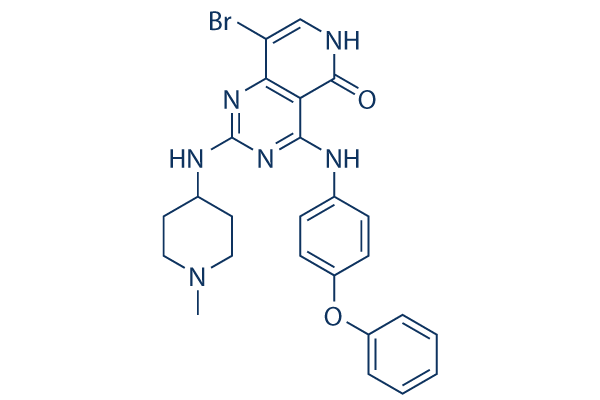
Chemical Structure
Molecular Weight: 521.41
Quality Control
| Related Targets | EGFR VEGFR JAK FGFR PDGFR Src HIF HER2 FLT Bcr-Abl |
|---|---|
| Other FLT3 Inhibitors | UNC2025 Crenolanib (CP-868596) Dovitinib (TKI-258) Dovitinib (TKI258) Lactate monohydrate Tandutinib (MLN518) ENMD-2076 KW-2449 AST-487 (NVP-AST487) TCS 359 FF-10101 |
Solubility
|
In vitro |
DMSO
: 24 mg/mL
(46.02 mM)
Water : Insoluble Ethanol : Insoluble |
Molarity Calculator
|
In vivo |
|||||
In vivo Formulation Calculator (Clear solution)
Step 1: Enter information below (Recommended: An additional animal making an allowance for loss during the experiment)
Step 2: Enter the in vivo formulation (This is only the calculator, not formulation. Please contact us first if there is no in vivo formulation at the solubility Section.)
Calculation results:
Working concentration: mg/ml;
Method for preparing DMSO master liquid: mg drug pre-dissolved in μL DMSO ( Master liquid concentration mg/mL, Please contact us first if the concentration exceeds the DMSO solubility of the batch of drug. )
Method for preparing in vivo formulation: Take μL DMSO master liquid, next addμL PEG300, mix and clarify, next addμL Tween 80, mix and clarify, next add μL ddH2O, mix and clarify.
Method for preparing in vivo formulation: Take μL DMSO master liquid, next add μL Corn oil, mix and clarify.
Note: 1. Please make sure the liquid is clear before adding the next solvent.
2. Be sure to add the solvent(s) in order. You must ensure that the solution obtained, in the previous addition, is a clear solution before proceeding to add the next solvent. Physical methods such
as vortex, ultrasound or hot water bath can be used to aid dissolving.
Chemical Information, Storage & Stability
| Molecular Weight | 521.41 | Formula | C25H25BrN6O2 |
Storage (From the date of receipt) | |
|---|---|---|---|---|---|
| CAS No. | 1457983-28-6 | Download SDF | Storage of Stock Solutions |
|
|
| Synonyms | N/A | Smiles | CN1CCC(CC1)NC2=NC3=C(C(=O)NC=C3Br)C(=N2)NC4=CC=C(C=C4)OC5=CC=CC=C5 | ||
Mechanism of Action
| Targets/IC50/Ki |
FLT3
(Cell-free assay) 0.4 nM
FLT3 (D835Y)
(Cell-free assay) 0.6 nM
Mer
(Cell-free assay) 1 nM
Aurora B
(Cell-free assay) 6 nM
RET
(Cell-free assay) 9 nM
VEGFR1/FLT1
(Cell-free assay) 18 nM
Fms
(Cell-free assay) 19 nM
Axl
(Cell-free assay) 20 nM
Aurora C
(Cell-free assay) 24 nM
FGFR1
(Cell-free assay) 25 nM
FGFR3
(Cell-free assay) 30 nM
VEGFR2/KDR
(Cell-free assay) 39 nM
c-Kit
(Cell-free assay) 142 nM
IGF-1R
(Cell-free assay) >300 nM
PDGFRα
(Cell-free assay) >300 nM
PDGFRβ
(Cell-free assay) >300 nM
|
|---|---|
| In vitro |
In FLT3-WT-bearing RS4-11 cells and FLT3-ITD-harboring MV4-11 and Molm-14 cells, G-749 potently inhibits autophosphorylation of FLT3 with IC50 of ≤8 nM. In leukemia cells, this compound shows antiproliferative activity by inducing apoptosis. In BaF3 cell lines that stably express FLT3-ITD/N676D, FLT3-ITD/F691L, FLT3-D835Y, or FLT3-D835Y/N676D, it shows strong inhibitory activity with IC50 of <10 nM, and thus overcomes drug resistance. In blasts of AML patients, this chemical also exhibits potent antileukemia activity.
|
| Kinase Assay |
Kinase assay
|
|
Activity assays are conducted using Lance Ultra time-resolved fluorescence resonance energy transfer (TR-FRET) technology from Perkin-Elmer. Briefly, 10 ng/mL FLT3 enzyme, a serial diluted G-749, 80 nM substrate of ULight-poly-GT peptide and variable amounts of ATP (8.5 µM to 1088 μM) are mixed in kinase assay buffer (50 mM HEPES pH 7.5, 10 mM MgCl2, 1 mM EGTA, 2 mM DTT and 0.01% Tween-20) and are added to a 384-well OptiPlate-384 in a volume of 10 μL. Kinase reactions are incubated at room temperature for up to 1 h and then stopped by the addition of 5 μL of 10 mM EDTA. A volume of 5 μL of the specific Eu-labeled-anti-phosphopeptide antibody diluted in LANCE Detection Buffer is then added to a final concentration of 2 nM. After 30-minute incubation, assay plates are incubated at 23°C and the LANCE signal is measured on an EnVision Multilabel Reader. Excitation wavelength is set at 320 nm and emission monitored at 615 nm (donor) and 665 nm (acceptor). The IC50 is calculated using nonlinear regression analysis analysis by GradPad Prism 5.
|
|
| In vivo |
In MV4-11 xenograft mice, G-749 (30 mg/kg p.o.) effectively inhibits the FLT3 pathway and significantly inhibits tumor growth. In an orthogonal model of bone marrow engraftment using Molm-14 cells, this compound (20 mg/kg p.o.) also inhibits tumor growth and increases survival.
|
References |
Tech Support
Tel: +1-832-582-8158 Ext:3
If you have any other enquiries, please leave a message.
Signaling Pathway Map

Products are for research use only. Not for human use. We do not sell to patients.
©Copyright 2013 Selleck Chemicals. All Rights Reserved.