
-
 Argentina
-
 Australia
-
 Austria
-
 Belgium
-
 Brazil
-
 Canada
-
 China
China
-
 Czech Republic
-
 Denmark
-
 Finland
-
 France
-
 Germany
-
 Greece
-
 Hong Kong
-
 Hungary
-
 Iceland
-
 India
India
-
 Ireland
-
 Israel
-
 Italy
Italy
-
 Japan
Japan
-
 Korea
Korea
-
 Luxembourg
-
 Malaysia
-
 Netherlands
-
 New Zealand
-
 Norway
-
 Poland
-
 Portugal
-
 Qatar
Qatar
-
 Romania
-
 Saudi Arabia
-
 Singapore
-
 Spain
Spain
-
 Sweden
-
 Switzerland
-
 Taiwan
-
 Turkey
-
 United Kingdom
-
 United States
research use only
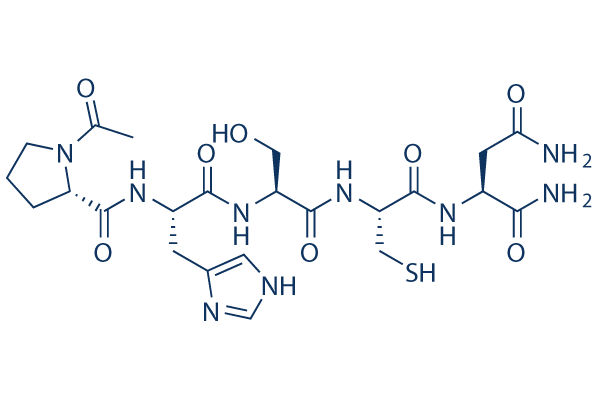
ATN-161 Integrin antagonist
Cat.No.S8454
Quality Control
| Related Targets | Akt Wnt/beta-catenin PKC HSP ROCK Microtubule Associated Bcr-Abl Actin FAK Kinesin |
|---|---|
| Other Integrin Inhibitors | SB273005 Cilengitide trifluoroacetate Cilengitide (EMD 121974) RGD peptide (Arg-Gly-Asp) Cyclo(RGDyK) TFA Cyclo(-RGDfK) TFA Leukadherin-1 A-205804 RGD peptide (GRGDNP) Pyrintegrin |
Solubility
|
In vitro |
Water : 10 mg/mL (Heat under ultrasonication at 60 °C for 10 minutes.)
DMSO
: 3 mg/mL
(5.01 mM)
Ethanol : Insoluble |
Molarity Calculator
|
In vivo |
|||||
In vivo Formulation Calculator (Clear solution)
Step 1: Enter information below (Recommended: An additional animal making an allowance for loss during the experiment)
Step 2: Enter the in vivo formulation (This is only the calculator, not formulation. Please contact us first if there is no in vivo formulation at the solubility Section.)
Calculation results:
Working concentration: mg/ml;
Method for preparing DMSO master liquid: mg drug pre-dissolved in μL DMSO ( Master liquid concentration mg/mL, Please contact us first if the concentration exceeds the DMSO solubility of the batch of drug. )
Method for preparing in vivo formulation: Take μL DMSO master liquid, next addμL PEG300, mix and clarify, next addμL Tween 80, mix and clarify, next add μL ddH2O, mix and clarify.
Method for preparing in vivo formulation: Take μL DMSO master liquid, next add μL Corn oil, mix and clarify.
Note: 1. Please make sure the liquid is clear before adding the next solvent.
2. Be sure to add the solvent(s) in order. You must ensure that the solution obtained, in the previous addition, is a clear solution before proceeding to add the next solvent. Physical methods such
as vortex, ultrasound or hot water bath can be used to aid dissolving.
Chemical Information, Storage & Stability
| Molecular Weight | 597.64 | Formula | C23H35N9O8S |
Storage (From the date of receipt) | |
|---|---|---|---|---|---|
| CAS No. | 262438-43-7 | Download SDF | Storage of Stock Solutions |
|
|
| Synonyms | Ac-PHSCN-NH2 | SMILES | CC(=O)N1CCCC1C(=O)NC(CC2=CN=CN2)C(=O)NC(CO)C(=O)NC(CS)C(=O)NC(CC(=O)N)C(=O)N | ||
Read more about storage stability stock solution CAS number SMILES
Mechanism of Action
| Targets/IC50/Ki |
integrin α5β1
αvβ3
|
|---|---|
| In vitro |
ATN-161 interacts with the N-terminus of the β1-domain of integrin α5β1, which may lock this integrin in an inactive conformation. This compound treatment up to 100 μmol/L shows no significant effect on tumor cell proliferation compared with the vehicle-treated control group of cells. However, this chemical significantly inhibits MAPK phosphorylation with maximal effects observed at 20 μmol/L of this compound after 30 minutes of treatment.
|
| In vivo |
ATN-161 (Ac-PHSCN-NH2), a 5-mer capped peptide derived from the synergy region of fibronectin that binds to α5β1 and αvβ3 in vitro, blocks breast cancer growth and metastasis. Treatment with this compound causes a significant dose-dependent decrease in tumor volume and either completely blocked or caused a marked decrease in the incidence and number of skeletal as well as soft tissue metastases. Treatment with this peptide results in a significant decrease in the expression of phosphorylated mitogen-activated protein kinase, microvessel density, and cell proliferation in tumors grown in vivo. It is a peptide with a fairly short plasma half-life. compared with the plasma pharmacokinetics of this compound, It is cleared from the tumor with much slower kinetics supporting the hypothesis that this peptide exerts its effects through a durable interaction with its target(s)in the tumor.
|
References |
|
Clinical Trial Information
(data from https://clinicaltrials.gov, updated on 2012-05-02)
| NCT Number | Recruitment | Conditions | Sponsor/Collaborators | Start Date | Phases |
|---|---|---|---|---|---|
| NCT00352313 | COMPLETED | Brain and Central Nervous System Tumors |
National Institutes of Health Clinical Center (CC) |
2006-05 | PHASE1; PHASE2 |
| NCT00131651 | TERMINATED | Carcinoma, Renal Cell |
Attenuon |
2005-08 | PHASE2 |
Read more about Clinical Trials
Tech Support
Tel: +1-832-582-8158 Ext:3
If you have any other enquiries, please leave a message.
Signaling Pathway Map

Products are for research use only. Not for human use. We do not sell to patients.
©Copyright 2013 Selleck Chemicals. All Rights Reserved.