
-
 Argentina
-
 Australia
-
 Austria
-
 Belgium
-
 Brazil
-
 Canada
-
 China
China
-
 Czech Republic
-
 Denmark
-
 Finland
-
 France
-
 Germany
-
 Greece
-
 Hong Kong
-
 Hungary
-
 Iceland
-
 India
India
-
 Ireland
-
 Israel
-
 Italy
Italy
-
 Japan
Japan
-
 Korea
Korea
-
 Luxembourg
-
 Malaysia
-
 Netherlands
-
 New Zealand
-
 Norway
-
 Poland
-
 Portugal
-
 Qatar
Qatar
-
 Romania
-
 Saudi Arabia
-
 Singapore
-
 Spain
Spain
-
 Sweden
-
 Switzerland
-
 Taiwan
-
 Turkey
-
 United Kingdom
-
 United States
research use only
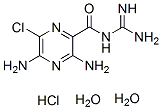
Amiloride HCl dihydrate Sodium Channel inhibitor
Cat.No.S2560
Quality Control
| Related Targets | CFTR CRM1 CD markers AChR Calcium Channel Potassium Channel GABA Receptor TRP Channel ATPase GluR |
|---|---|
| Other Sodium Channel Inhibitors | Camostat Mesilate A-803467 cariporide GS967 Veratramine Tolperisone HCl Bulleyaconi cine A Vinpocetine Tenapanor PF-06869206 |
Solubility
|
In vitro |
DMSO
: 100 mg/mL
(330.99 mM)
Water : 5 mg/mL Ethanol : 0 mg/mL |
Molarity Calculator
|
In vivo |
|||||
In vivo Formulation Calculator (Clear solution)
Step 1: Enter information below (Recommended: An additional animal making an allowance for loss during the experiment)
Step 2: Enter the in vivo formulation (This is only the calculator, not formulation. Please contact us first if there is no in vivo formulation at the solubility Section.)
Calculation results:
Working concentration: mg/ml;
Method for preparing DMSO master liquid: mg drug pre-dissolved in μL DMSO ( Master liquid concentration mg/mL, Please contact us first if the concentration exceeds the DMSO solubility of the batch of drug. )
Method for preparing in vivo formulation: Take μL DMSO master liquid, next addμL PEG300, mix and clarify, next addμL Tween 80, mix and clarify, next add μL ddH2O, mix and clarify.
Method for preparing in vivo formulation: Take μL DMSO master liquid, next add μL Corn oil, mix and clarify.
Note: 1. Please make sure the liquid is clear before adding the next solvent.
2. Be sure to add the solvent(s) in order. You must ensure that the solution obtained, in the previous addition, is a clear solution before proceeding to add the next solvent. Physical methods such
as vortex, ultrasound or hot water bath can be used to aid dissolving.
Chemical Information, Storage & Stability
| Molecular Weight | 302.12 | Formula | C6H8ClN7O.HCl.2H2O |
Storage (From the date of receipt) | |
|---|---|---|---|---|---|
| CAS No. | 17440-83-4 | Download SDF | Storage of Stock Solutions |
|
|
| Synonyms | MK-870 hydrochloride dihydrate | SMILES | C1(=C(N=C(C(=N1)Cl)N)N)C(=O)N=C(N)N.O.O.Cl | ||
Read more about storage stability stock solution CAS number SMILES
Mechanism of Action
| Targets/IC50/Ki |
Sodium channel
|
|---|---|
| In vitro |
Amiloride also induces the dephosphorylation of P13K (phosphatidylinositol 3-kinase) and PDK-1 (phosphoinositide-dependent kinase-1) kinases along with PTEN (phosphatase and tensin homolog deleted on chromosome 10) and PP1 alpha phosphatases. Amiloride inhibits phosphorylation of kinases and phosphatases by competing with ATP. Amiloride, which causes little or no cytotoxicity by itself, enhances TRAIL-induced apoptosis. Amiloride precludes the alkalinization and in parallel inhibit cellular proliferation. Amiloride directly inhibits autophosphorylation of the EGF receptor. Amiloride significantly enhances recovery to a maximum of 39%, 88%, and 78% for force, +dF/dt, and -dF/dt, respectively. Amiloride, a frequently used inhibitor of Na+/H+ exchange, rapidly inhibits phorbol ester-stimulated protein phosphorylation in vivo and protein kinase C-mediated phosphorylation in vitro, both with potency similar to that with which Amiloride inhibits Na+/H+ exchange. Amiloride blocks phorbol ester-induced adhesion of HL-60 cells (adhesion being a property indicative of the differentiated state), but dimethylamiloride (as well as ethylisopropylamiloride, another very potent amiloride analog) does not. Amiloride inhibits the ouabain-sensitive rate of oxygen consumption (QO2) of a suspension of rabbit intact proximal tubules in the presence of different concentrations of extracellular sodium. |
References |
|
Clinical Trial Information
(data from https://clinicaltrials.gov, updated on 2026-06-11)
| NCT Number | Recruitment | Conditions | Sponsor/Collaborators | Start Date | Phases |
|---|---|---|---|---|---|
| NCT06224673 | RECRUITING | HER2 Low Breast Carcinoma; Triple Negative Breast Cancer; Hormone-receptor-positive Breast Cancer; Hormone Receptor Positive Breast Carcinoma |
Laura Huppert, MD, BA |
2026-06-05 | PHASE2 |
| NCT05753059 | RECRUITING | Heart Failure |
Yale University |
2023-08-10 | PHASE1 |
| NCT04063540 | RECRUITING | Migraine With Aura |
Centre Hospitalier Universitaire de Nice |
2020-08-11 | PHASE2 |
| NCT07634068 | NOT_YET_RECRUITING | Vertebrobasilar Dolichoectasia |
Huashan Hospital |
2026-06 | PHASE2 |
| NCT06923709 | RECRUITING | Chronic Kidney Disease(CKD); Proteinuria |
Odense University Hospital |
2024-10-10 | PHASE2 |
| NCT05228574 | COMPLETED | Autosomal Dominant Polycystic Kidney |
Erasmus Medical Center |
2022-03-11 | PHASE4 |
Read more about Clinical Trials
Tech Support
Tel: +1-832-582-8158 Ext:3
If you have any other enquiries, please leave a message.
Signaling Pathway Map

Products are for research use only. Not for human use. We do not sell to patients.
©Copyright 2013 Selleck Chemicals. All Rights Reserved.