
-
 Argentina
-
 Australia
-
 Austria
-
 Belgium
-
 Brazil
-
 Canada
-
 China
China
-
 Czech Republic
-
 Denmark
-
 Finland
-
 France
-
 Germany
-
 Greece
-
 Hong Kong
-
 Hungary
-
 Iceland
-
 India
India
-
 Ireland
-
 Israel
-
 Italy
Italy
-
 Japan
Japan
-
 Korea
Korea
-
 Luxembourg
-
 Malaysia
-
 Netherlands
-
 New Zealand
-
 Norway
-
 Poland
-
 Portugal
-
 Qatar
Qatar
-
 Romania
-
 Saudi Arabia
-
 Singapore
-
 Spain
Spain
-
 Sweden
-
 Switzerland
-
 Taiwan
-
 Turkey
-
 United Kingdom
-
 United States
research use only
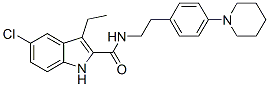
Org 27569 Cannabinoid Receptor agonist
Cat.No.S1534
Quality Control
| Related Targets | CXCR Hedgehog/Smoothened PKA Adrenergic Receptor AChR 5-HT Receptor Histamine Receptor Dopamine Receptor Ras KRas |
|---|---|
| Other Cannabinoid Receptor Inhibitors | AM1241 AM251 6-Iodopravadoline (AM630) CID16020046 Otenabant (CP-945598) HCl BML-190 WIN 55, 212-2 mesylate GW842166X Pregnenolone monosulfate sodium RTICBM-189 |
Solubility
|
In vitro |
DMSO
: 82 mg/mL
(200.02 mM)
Water : Insoluble Ethanol : Insoluble |
Molarity Calculator
|
In vivo |
|||||
In vivo Formulation Calculator (Clear solution)
Step 1: Enter information below (Recommended: An additional animal making an allowance for loss during the experiment)
Step 2: Enter the in vivo formulation (This is only the calculator, not formulation. Please contact us first if there is no in vivo formulation at the solubility Section.)
Calculation results:
Working concentration: mg/ml;
Method for preparing DMSO master liquid: mg drug pre-dissolved in μL DMSO ( Master liquid concentration mg/mL, Please contact us first if the concentration exceeds the DMSO solubility of the batch of drug. )
Method for preparing in vivo formulation: Take μL DMSO master liquid, next addμL PEG300, mix and clarify, next addμL Tween 80, mix and clarify, next add μL ddH2O, mix and clarify.
Method for preparing in vivo formulation: Take μL DMSO master liquid, next add μL Corn oil, mix and clarify.
Note: 1. Please make sure the liquid is clear before adding the next solvent.
2. Be sure to add the solvent(s) in order. You must ensure that the solution obtained, in the previous addition, is a clear solution before proceeding to add the next solvent. Physical methods such
as vortex, ultrasound or hot water bath can be used to aid dissolving.
Chemical Information, Storage & Stability
| Molecular Weight | 409.95 | Formula | C24H28ClN3O |
Storage (From the date of receipt) | |
|---|---|---|---|---|---|
| CAS No. | 868273-06-7 | Download SDF | Storage of Stock Solutions |
|
|
| Synonyms | N/A | SMILES | CCC1=C(NC2=C1C=C(C=C2)Cl)C(=O)NCCC3=CC=C(C=C3)N4CCCCC4 | ||
Read more about storage stability stock solution CAS number SMILES
Mechanism of Action
| Features |
Traps the receptor in a distinct agonist-bound, but non-signaling conformational state.
|
|---|---|
| Targets/IC50/Ki |
CB1
|
| In vitro |
Org 27569 is an allosteric modulator of CB1 cannabinoid receptor. It significantly increases the binding of CB1 receptor agonist and causes a significant decrease in specific binding of CB1 receptor inverse agonist. This compound induces CB1 high affinity agonist binding, receptor internalization, and downstream ERK phosphorylation. The allosteric ligand promotes agonist binding to CB1, yet blocks the agonist-induced conformational changes in TM6. It traps the receptor in a distinct agonist-bound, but nonsignaling conformational state.
|
| Kinase Assay |
Equilibrium Binding Assays.
|
|
Binding assays are performed with the CB1 receptor agonist [3H]CP 55,940 (0.7 nM) and the CB1 receptor antagonist [3H]SR 141716A (1.2 nM), 1 mg/ml BSA and 50 mM Tris buffer containing 0.1 mM EDTA and 0.5 mM MgCl2, pH 7.4, in a total assay volume of 500 μl. Binding is initiated by the addition of mouse brain membranes (30 μg). Assays are carried out at 37°C for 60 min before termination by addition of ice-cold wash buffer (50 mM Tris buffer and 1 mg/ml BSA) and vacuum filtration using a 24-well sampling manifold and Whatman GF/B glass-fiber filters that have been soaked in wash buffer at 4°C for 24 h. Each reaction tube is washed five times with a 4-ml aliquot of buffer. The filters are oven-dried for 60 min and then placed in 5 ml of scintillation fluid, and radioactivity is quantitated by liquid scintillation spectrometry. Specific binding is defined as the difference between the binding that occurred in the presence and absence of 1 μM concentrations of the corresponding unlabeled ligand and is 70 to 80% of the total binding.
|
References |
|
Tech Support
Tel: +1-832-582-8158 Ext:3
If you have any other enquiries, please leave a message.
Signaling Pathway Map

Products are for research use only. Not for human use. We do not sell to patients.
©Copyright 2013 Selleck Chemicals. All Rights Reserved.