
-
 Argentina
-
 Australia
-
 Austria
-
 Belgium
-
 Brazil
-
 Canada
-
 China
China
-
 Czech Republic
-
 Denmark
-
 Finland
-
 France
-
 Germany
-
 Greece
-
 Hong Kong
-
 Hungary
-
 Iceland
-
 India
India
-
 Ireland
-
 Israel
-
 Italy
Italy
-
 Japan
Japan
-
 Korea
Korea
-
 Luxembourg
-
 Malaysia
-
 Netherlands
-
 New Zealand
-
 Norway
-
 Poland
-
 Portugal
-
 Qatar
Qatar
-
 Romania
-
 Saudi Arabia
-
 Singapore
-
 Spain
Spain
-
 Sweden
-
 Switzerland
-
 Taiwan
-
 Turkey
-
 United Kingdom
-
 United States
research use only
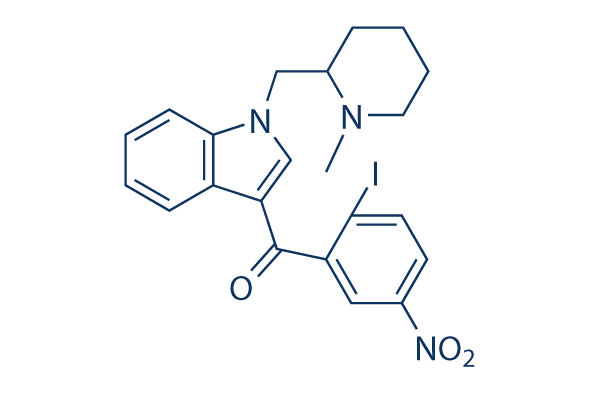
AM1241 Cannabinoid Receptor agonist
Cat.No.S1544
Quality Control
| Related Targets | CXCR Hedgehog/Smoothened PKA Adrenergic Receptor AChR 5-HT Receptor Histamine Receptor Dopamine Receptor Ras KRas |
|---|---|
| Other Cannabinoid Receptor Inhibitors | AM251 6-Iodopravadoline (AM630) CID16020046 Otenabant (CP-945598) HCl BML-190 Org 27569 WIN 55, 212-2 mesylate GW842166X Pregnenolone monosulfate sodium RTICBM-189 |
Solubility
|
In vitro |
DMSO
: 101 mg/mL
(200.66 mM)
Water : Insoluble Ethanol : Insoluble |
Molarity Calculator
|
In vivo |
|||||
In vivo Formulation Calculator (Clear solution)
Step 1: Enter information below (Recommended: An additional animal making an allowance for loss during the experiment)
Step 2: Enter the in vivo formulation (This is only the calculator, not formulation. Please contact us first if there is no in vivo formulation at the solubility Section.)
Calculation results:
Working concentration: mg/ml;
Method for preparing DMSO master liquid: mg drug pre-dissolved in μL DMSO ( Master liquid concentration mg/mL, Please contact us first if the concentration exceeds the DMSO solubility of the batch of drug. )
Method for preparing in vivo formulation: Take μL DMSO master liquid, next addμL PEG300, mix and clarify, next addμL Tween 80, mix and clarify, next add μL ddH2O, mix and clarify.
Method for preparing in vivo formulation: Take μL DMSO master liquid, next add μL Corn oil, mix and clarify.
Note: 1. Please make sure the liquid is clear before adding the next solvent.
2. Be sure to add the solvent(s) in order. You must ensure that the solution obtained, in the previous addition, is a clear solution before proceeding to add the next solvent. Physical methods such
as vortex, ultrasound or hot water bath can be used to aid dissolving.
Chemical Information, Storage & Stability
| Molecular Weight | 503.33 | Formula | C22H22IN3O3 |
Storage (From the date of receipt) | |
|---|---|---|---|---|---|
| CAS No. | 444912-48-5 | Download SDF | Storage of Stock Solutions |
|
|
| Synonyms | N/A | SMILES | CN1CCCCC1CN2C=C(C3=CC=CC=C32)C(=O)C4=C(C=CC(=C4)[N+](=O)[O-])I | ||
Read more about storage stability stock solution CAS number SMILES
Mechanism of Action
| Targets/IC50/Ki |
CB2
3.4 nM(Ki)
CB1
280 nM(Ki)
|
|---|---|
| In vitro |
AM-1241 is a protean agonist of CB2 based on the different effect observed in various assays (calcium influx, extracellular signal-regulated kinase (ERK) phosphorylatin and cAMP measurement)) and on the switch from neutral antagonism to agonism in the cAMP assay when forskolin concentration is lowered. In [3H]CP 55,940 competition binding assays, this compound displays high affinity at the human CB2 receptor with a Ki value of about 7 nM, whereas its affinity at the human CB1 receptor is more than 80-fold weaker, using membrane preparations from stable HEK and CHO cell lines expressing the recombinant human CB2 and CB1 receptors, respectively.
|
| Kinase Assay |
Binding Assays
|
|
Binding to cannabinoid receptors is tested by using competition-equilibrium binding vs. [3H]CP55,940. AM-1241 is diluted into 25 mM Tris base (pH 7.4)/5 mM MgCl2/1 mM EDTA/0.1% essentially fatty acid-free BSA and transferred to Regisil-treated 96-well plates. [3H]CP55,940 (DuPont_NEN; specific activity 100–180 Ci/ mmol; 1 Ci =37 GBq) is added to a concentration of 0.8 nM. Membranes prepared from rat brain (containing CB1 receptors) or mouse spleen (containing CB2 receptors) are added (≈50 μg of membrane protein per well), plates are incubated at 30 °C for 1 hour, and the contents are filtered over Packard Unifilter GF/B 96-well filters by using a Packard Filtermate 196 cell harvester. Filters are washed with ice-cold 50 mM Tris base/5 mM MgCl2/0.5% BSA and dried. Bound radioactivity is quantitated and corrected for nonspecific binding, and results are normalized between 0% and 100% [3H]CP-55,940 specifically bound. IC50 is determined by nonlinear regression analysis using GraphPad PRISM and transformed to a Ki value. All data are collected in duplicate. IC50 and Ki values are determined from three independent experiments.
|
|
| In vivo |
AM-1241 dose-dependently reverses tactile and thermal hypersensitivity produced by ligation of the L5 and L6 spinal nerves in rats. This compound is also active in blocking spinal nerve ligation-induced tactile and thermal hypersensitivity in mice lacking CB1 receptors (CB1-/- mice), confirming that it reverses sensory hypersensitivity independent of actions at CB1 receptors. This chemical (100, 330 μg/kg i.p.) suppresses the development of carrageenan-evoked thermal and mechanical hyperalgesia and allodynia. And this suppression is blocked by CB2 antagonist SR144528 but not by CB1 antagonist SR141716A. It produces dose-dependent antinociception to a thermal stimulus applied to the hindpaw, when administered into the hindpaw on the side of testing (ipsilateral i. paw), while much less active into the contralateral to the side. A50 (analgesic dose yielding a 50% effect) of this compound is 847 μg/kg with the maximum possible effect (100% MPE) being achieved at 3.3 mg/kg. It also produces dose-dependent antinociception when administered intraperitoneally (i.p.), with an A50 of 103μg/kg. The antinociceptive actions of this chemical are blocked by the CB2 receptor-selective antagonist AM630, but not by the CB1 receptor-selective antagonist AM251. This compound dosn't produce the CNS cannabinoid effects of hypothermia, catalepsy, inhibition of activity or impaired ambulation, while this tetrad of effects is produced by the mixed CB1/CB2 receptor agonist WIN55,212-2. Daily injections of this chemical through a i.p. route, initiated at symptom onset, increases the survival interval after amyotrophic lateral sclerosis (ALS) onset by 56% in a transgenic mouse model of ALS.
|
References |
|
Tech Support
Tel: +1-832-582-8158 Ext:3
If you have any other enquiries, please leave a message.
Signaling Pathway Map

Products are for research use only. Not for human use. We do not sell to patients.
©Copyright 2013 Selleck Chemicals. All Rights Reserved.