
-
 Argentina
-
 Australia
-
 Austria
-
 Belgium
-
 Brazil
-
 Canada
-
 China
China
-
 Czech Republic
-
 Denmark
-
 Finland
-
 France
-
 Germany
-
 Greece
-
 Hong Kong
-
 Hungary
-
 Iceland
-
 India
India
-
 Ireland
-
 Israel
-
 Italy
Italy
-
 Japan
Japan
-
 Korea
Korea
-
 Luxembourg
-
 Malaysia
-
 Netherlands
-
 New Zealand
-
 Norway
-
 Poland
-
 Portugal
-
 Qatar
Qatar
-
 Romania
-
 Saudi Arabia
-
 Singapore
-
 Spain
Spain
-
 Sweden
-
 Switzerland
-
 Taiwan
-
 Turkey
-
 United Kingdom
-
 United States
research use only
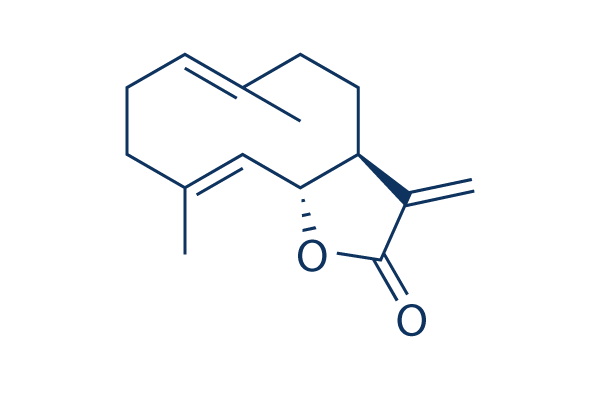
Costunolide Telomerase inhibitor
Cat.No.S1319
Quality Control
| Related Targets | HDAC PARP ATM/ATR DNA-PK WRN DNA/RNA Synthesis Topoisomerase PPAR Sirtuin Casein Kinase |
|---|---|
| Other Telomerase Inhibitors | BIBR 1532 RHPS 4 methosulfate Cycloastragenol TAC (TERT Activator-1) Cyclogalegenol Braco-19 trihydrochloride L-778123 hydrochloride Epitalon MST-312 |
Solubility
|
In vitro |
DMSO
: 47 mg/mL
(202.3 mM)
Ethanol : 47 mg/mL Water : Insoluble |
Molarity Calculator
|
In vivo |
|||||
In vivo Formulation Calculator (Clear solution)
Step 1: Enter information below (Recommended: An additional animal making an allowance for loss during the experiment)
Step 2: Enter the in vivo formulation (This is only the calculator, not formulation. Please contact us first if there is no in vivo formulation at the solubility Section.)
Calculation results:
Working concentration: mg/ml;
Method for preparing DMSO master liquid: mg drug pre-dissolved in μL DMSO ( Master liquid concentration mg/mL, Please contact us first if the concentration exceeds the DMSO solubility of the batch of drug. )
Method for preparing in vivo formulation: Take μL DMSO master liquid, next addμL PEG300, mix and clarify, next addμL Tween 80, mix and clarify, next add μL ddH2O, mix and clarify.
Method for preparing in vivo formulation: Take μL DMSO master liquid, next add μL Corn oil, mix and clarify.
Note: 1. Please make sure the liquid is clear before adding the next solvent.
2. Be sure to add the solvent(s) in order. You must ensure that the solution obtained, in the previous addition, is a clear solution before proceeding to add the next solvent. Physical methods such
as vortex, ultrasound or hot water bath can be used to aid dissolving.
Chemical Information, Storage & Stability
| Molecular Weight | 232.32 | Formula | C15H20O2 |
Storage (From the date of receipt) | |
|---|---|---|---|---|---|
| CAS No. | 553-21-9 | Download SDF | Storage of Stock Solutions |
|
|
| Synonyms | NSC 106404 | SMILES | CC1=CCCC(=CC2C(CC1)C(=C)C(=O)O2)C | ||
Read more about storage stability stock solution CAS number SMILES
Mechanism of Action
| Targets/IC50/Ki |
FPTase
20 μM
Telomerase (MDA-MB-231)
65 μM
Telomerase (MCF-7)
90 μM
|
|---|---|
| In vitro |
Costunolide inhibits the growth and telomerase activity of MCF-7 and MDA-MB-231 cells in a concentration- and time-dependent manner. This compound also inhibits the farnesylation process of human lamin-B by farnesyl–proteinttransferase (FPTase), in a dose dependent manner. Continuously treatment of this chemical for 48 hours will significantly decrease proliferation of human tumor cells (A549, SK-OV-3, SK-MEL-2, XF498 and HCT-1) in a dose-dependent manner. It induces apoptosis by ROS-mediated mitochondrial permeability transition and cytochrome C release to the cytosol in HL-60 human leukemia cells. A recent study indicates that this compound shows significant antifungal activity, including Trichophyton mentagrophytes, T.simlii, T.rubrum, and so on.
|
| Kinase Assay |
Telomerase activity assay
|
|
The telomerase activity is measured by the TRAP assay using the TRAPez Telomerase Detection Kit, which includes primers of a 36-bp internal control (IC) for quantifying the amplification of telomerase activity within a linear range close to 2.5 logs. For RNase treatment, 10μL of extract are incubated with 1μg of RNase at 37 °C for 20 minutes. The products of the TRAP assay are resolved by electrophoresis in a nondenaturing12% PAGE in a buffer containing 0.5 × Tris–borate EDTA and detected by autoradiograph. For quantification of TRAP products, the dried gels are exposed to Fuji Imaging Plate at room temperature. Results are corrected for background, and a standard value of 100 is given to the untreated control cell signal. Signal intensities of this compound-treated cells are compared to the standard and are expressed as a fraction of the maximum value of 100.
|
|
| In vivo |
Costunolide inhibits angiogenic response by blocking the angiogenic factor signaling pathway. In a mouse corneal micropocket assay, this compound reduces VEGF-stimulated neovascularization in mice.
|
References |
|
Tech Support
Tel: +1-832-582-8158 Ext:3
If you have any other enquiries, please leave a message.
Signaling Pathway Map

Products are for research use only. Not for human use. We do not sell to patients.
©Copyright 2013 Selleck Chemicals. All Rights Reserved.