
-
 Argentina
-
 Australia
-
 Austria
-
 Belgium
-
 Brazil
-
 Canada
-
 China
China
-
 Czech Republic
-
 Denmark
-
 Finland
-
 France
-
 Germany
-
 Greece
-
 Hong Kong
-
 Hungary
-
 Iceland
-
 India
India
-
 Ireland
-
 Israel
-
 Italy
Italy
-
 Japan
Japan
-
 Korea
Korea
-
 Luxembourg
-
 Malaysia
-
 Netherlands
-
 New Zealand
-
 Norway
-
 Poland
-
 Portugal
-
 Qatar
Qatar
-
 Romania
-
 Saudi Arabia
-
 Singapore
-
 Spain
Spain
-
 Sweden
-
 Switzerland
-
 Taiwan
-
 Turkey
-
 United Kingdom
-
 United States
research use only
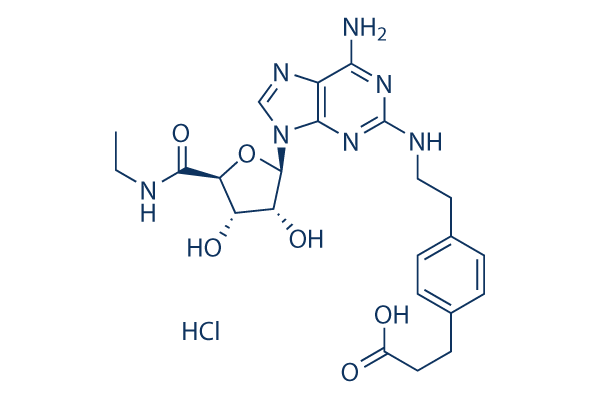
CGS 21680 HCl Adenosine Receptor agonist
Cat.No.S2153
Quality Control
| Related Targets | CXCR Hedgehog/Smoothened PKA Adrenergic Receptor AChR 5-HT Receptor Histamine Receptor Dopamine Receptor Ras KRas |
|---|---|
| Other Adenosine Receptor Inhibitors | Reversine ZM241385 SCH58261 Ciforadenant (CPI-444) A2AR antagonist 1 Etrumadenant (AB928) Imaradenant (AZD4635) DPCPX SCH-442416 Namodenoson (CF-102) |
Solubility
|
In vitro |
DMSO
: 100 mg/mL
(186.57 mM)
Water : Insoluble Ethanol : Insoluble |
Molarity Calculator
|
In vivo |
|||||
In vivo Formulation Calculator (Clear solution)
Step 1: Enter information below (Recommended: An additional animal making an allowance for loss during the experiment)
Step 2: Enter the in vivo formulation (This is only the calculator, not formulation. Please contact us first if there is no in vivo formulation at the solubility Section.)
Calculation results:
Working concentration: mg/ml;
Method for preparing DMSO master liquid: mg drug pre-dissolved in μL DMSO ( Master liquid concentration mg/mL, Please contact us first if the concentration exceeds the DMSO solubility of the batch of drug. )
Method for preparing in vivo formulation: Take μL DMSO master liquid, next addμL PEG300, mix and clarify, next addμL Tween 80, mix and clarify, next add μL ddH2O, mix and clarify.
Method for preparing in vivo formulation: Take μL DMSO master liquid, next add μL Corn oil, mix and clarify.
Note: 1. Please make sure the liquid is clear before adding the next solvent.
2. Be sure to add the solvent(s) in order. You must ensure that the solution obtained, in the previous addition, is a clear solution before proceeding to add the next solvent. Physical methods such
as vortex, ultrasound or hot water bath can be used to aid dissolving.
Chemical Information, Storage & Stability
| Molecular Weight | 535.98 | Formula | C23H29N7O6.HCl |
Storage (From the date of receipt) | |
|---|---|---|---|---|---|
| CAS No. | 124431-80-7 | Download SDF | Storage of Stock Solutions |
|
|
| Synonyms | N/A | SMILES | CCNC(=O)C1C(C(C(O1)N2C=NC3=C(N=C(N=C32)NCCC4=CC=C(C=C4)CCC(=O)O)N)O)O.Cl | ||
Read more about storage stability stock solution CAS number SMILES
Mechanism of Action
| Targets/IC50/Ki |
Adenosine A2 receptor
(in rat brain tissue) 22 nM
|
|---|---|
| In vitro |
CGS 21680 HCl is an adenosine A2 receptor agonist with IC50 of 22 nM, exhibits 140-fold over A1 receptor. In an isolated perfused working rat heart model, CGS 21680C effectively increases coronary flow with an ED25 value of 1.8 nM. CGS 21680 binds adenosine A2 receptor with high affinity (Kd = 15.5 nM) and limited capacity (apparent Bmax = 375 fmol/mg of protein) to a single dass of recognition sites. In hippocampal slices, CGS 21680 apis weak agonist on pre- and postsynaptic measures of electrophysiologicaJ activity (putative Al receptor mediated events) and is ineffective at stimulating the formation of cAMP (a putative A2 mediated response). In striatal slices, CGS 21680 potently stimulates the formation of cAMP with an EC50 of 110 nM but is ineffective at inhibiting electrically stimulated dopamine release. CGS 21680A is the hydrochloride salt, while CGS 21680C is the sodium salt of CGS 21680.
|
| In vivo |
CGS 21680A is active p.o. in the spontaneously hypertensive rat at a dose of 10 mg/kg with efficacy for up to 24 hr. CGS 21680A caused a transient (60 min) increase in heart rate. CGS 21680 is a potent depressant of the spontaneous, acetylcholine and glutamate evoked firing of rat cerebral cortical neurons.
|
References |
|
Tech Support
Tel: +1-832-582-8158 Ext:3
If you have any other enquiries, please leave a message.

Products are for research use only. Not for human use. We do not sell to patients.
©Copyright 2013 Selleck Chemicals. All Rights Reserved.